
Myriam Bregman, the Trotskyist who is the Argentine politician with the best image
With an ironic, confrontational style, the deputy has stood out within an opposition that has shown a tepid reaction to Javier Milei’s sweeping austerity drive
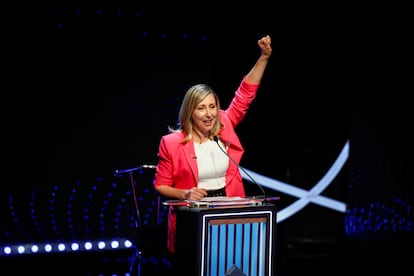
“Milei is an employee of the big businessmen who have made millions in recent years and expect to make many more with him. He is not a lion, he is a pampered kitten of economic power.” It was October 2023, and Myriam Bregman, from the lectern assigned to her at the candidates’ debate, issued a warning about the man who, days later, would become president of Argentina. While many politicians avoided confronting a figure whose popularity was rising fast, Bregman delivered one jab after another, using the same ironic, irreverent style that infused the libertarian discourse — only in the opposite direction.
Over Milei’s two and a half years in office, Bregman — 54, a national deputy for the Workers’ Left Front–Unity — has held that line, setting herself apart from an opposition she describes as hesitant and fearful when it comes to resisting policies such as labor reform or cuts to education, healthcare, wages, and pensions. An opposition, she warns, that seems overly concerned with not contradicting the spirit of the times or the dictates of marketing handbooks.
That stance, in part, is what has propelled her in Argentine polls. She appears as the political figure with the highest positive rating in surveys such as those by Atlas Intel, where she scores 47 points of positive image (against 46 negative) and is the only one among the 14 leaders measured to show a favorable balance. Pollsters note that a positive image does not equate to voting intention, but the figure reflects growing public recognition of her and her party, which until now has always been electorally marginal. In the 2023 presidential election, Bregman finished fifth, with 2.7% of the vote.
Nicknamed La Rusa — “the Russian” — because of the combination of her Jewish surname, blond hair, and light eyes, Myriam Bregman was born in a tiny town called Timote, 280 miles from Buenos Aires. She had to move at age 15 to finish high school in a nearby town. She studied law at the University of Buenos Aires, where she became active in left‑wing politics and, together with other lawyers, founded the Center of Professionals for Human Rights (CeProDH) to defend people detained during the countless protests of the 1990s.
Amid the political, economic, and social chaos unleashed by the 2001 financial crisis, the organization also took on the challenge of defending workers who were taking over bankrupt factories. And shortly afterward, when the laws guaranteeing impunity for those responsible for the crimes of the last military dictatorship (1976–1983) were struck down, it began working on prosecutions against the perpetrators. Within the collective Justicia Ya!, Bregman became a plaintiff in cases involving crimes against humanity and pushed forward the trial of the notorious repressor Miguel Etchecolatz — during which the witness Jorge Julio López was disappeared.
She held her first institutional post in 2015, when she became a deputy for the Workers’ Left Front — the coalition that brings together the four main parties of the Argentine left: the Socialist Workers’ Party (PTS), to which she belongs; the Workers’ Party (PO); Socialist Left (IS); and the Socialist Workers’ Movement (MST). She stepped in to complete the term begun by a colleague, under an internally agreed‑upon rotation system. She later served as a legislator in the city of Buenos Aires and was then elected national deputy in 2021 and 2025.
Her profile is the mirror image of Milei’s, in the sense that what the Argentine president uses as insults are, for her, identity markers: she is left‑wing, socialist, a human‑rights advocate, feminist, anti‑imperialist.
“He says his proposal is antagonistic to ours, and the truth is it is,” she tells EL PAÍS. “Milei is submissive to the International Monetary Fund, he lets himself be governed by Donald Trump and by [U.S. Treasury Secretary Scott] Bessent, and we truly fight for the dream of San Martín and Bolívar: to integrate Latin America, to confront imperialism, to fight for a federation of Latin American states — essentially the opposite of being a Yankee colony."
She continues: “[Milei] believes there should be practically slave labor, and we think work hours should be shared between the employed and unemployed, that no one should work more than six hours a day, five days a week, with a salary one can live on.”
The conversation is occasionally interrupted by the barking of her dog, aptly named Dimitri. Bregman lives in the Buenos Aires neighborhood of Chacarita and, in line with her party’s doctrine, earns the equivalent of a teacher’s salary and donates the rest to “various struggles.”
“Anyone you ask will tell you they see us on the street, on the subway, teaching,” she says. “We live like any worker, and I believe we should. It’s easy to talk about ‘the caste,’ but to show up in a Tesla [she is referring to a recent appearance by Manuel Quintar in the Congress parking lot with a Tesla Cybertruck, which sells locally for more than $200,000] or to travel on a private plane while decrying the caste is contradictory. I think Milei believed he could manage that contradiction, and his mask is falling off — that’s why the Adorni affair has caused him such a crisis. These were people who said they would fight the caste and now live like the caste."
Bregman is referring to Manuel Adorni, Milei’s chief of staff, who is being investigated by the courts for alleged illicit enrichment. Adorni was on the receiving end of one of her barbs a few weeks ago, when he appeared in Congress to deliver his mandatory periodic report. “Do you know what people call you?” Bregman asked the official. “Aloe vera, a popular joke — a popular joke meaning that every day they discover more properties.”
Her explosive rhetoric does not prevent her from maintaining good relations with lawmakers across parties. Even Milei, who sat next to her when both were deputies, once said before taking office that he found her “likeable” and “coherent.”
Bregman doesn’t remember whether the scene described in a newspaper column actually happened — veteran lawmaker Miguel Ángel Pichetto telling her in a congressional elevator that if she toned down the Trotskyism and moved toward social democracy, the Casa Rosada, the seat of government in Argentina, would be within reach. But she says it wouldn’t have been the first time she received such advice.
“Some suggest it to you, others try to beat it into your head through repression in the streets,” she says. “There are different ways of trying to get us to moderate, but if we have gained this recognition, it is precisely because we did not moderate. Moderation has already been tried; it has a name — Alberto Fernández’s government — and it was a resounding failure."
Despite the discontent with Milei, many Argentines still credit his government with certain economic achievements — from lower inflation to fiscal discipline. When asked how she squares these two realities, she replies: “Argentina’s political leadership is very colonized by neoliberal ideas that have deeply penetrated and now seem sacrosanct. People talk about fiscal balance and zero deficit as if they were good in themselves, achieved through wage and pension cuts. The great hemorrhage here is external debt, and there is no way out unless the fraudulent debt is challenged.”
Bregman continues: “It’s not hard to find examples around the world that show that with the United States and the IMF steering a country’s destiny, there is no way out for the popular majority. Argentina produces food, and kids go to bed hungry; Argentina produces energy, and we can’t pay the bills. There is a plundering of resources in Argentina, and today it seems you have to accept it silently or be labeled utopian.”
In Argentina, the left has historically been overshadowed by Peronism, a movement based on the legacy of former president Juan Domingo Perón, built on a broad working‑class base. From her rise in the polls, the challenge she identifies is “organizing the sympathy”: preventing that surge of support from dissipating and turning it into actual activism.
The goal is to use the current moment to reach sectors that had never looked to the left as an electoral option and to represent what she calls a “new working class” — one that goes beyond the archetype of the unionized factory worker and now includes, for example, precarious professionals, app‑based delivery workers, teachers, and public employees. Her presidential candidacy for next year “is on the table,” though the final decision will come from the Workers’ Left Front’s internal debate.
“Despite this increase in recognition, I try to be serious and not create the impression that it’s easy to challenge the power structures or take on the dominant classes, because we’ve come through many years of demagoguery in which leaders present themselves as knowing everything and solving everything, and then produce enormous frustrations,” she says. “To change the situation, you have to affect interests, and that can only be done with mobilization and organization, with struggle, because no one will give up their power and privileges willingly. Not even through an election. They will fight and defend with all their might everything they can.”
Sign up for our weekly newsletter to get more English-language news coverage from EL PAÍS USA Edition









































