
Morocco and Spain deploy forces at border amid online calls for new mass incursion into Ceuta
Spanish authorities are also working to speed up the removal of the 5,000 irregular migrants still in the city following the influx of July 30 and 31
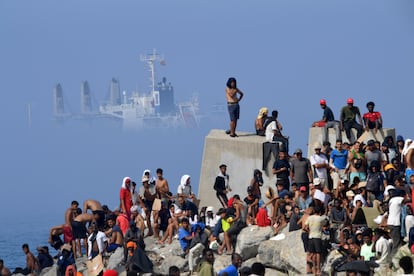
This Saturday is marked in red on the calendars of Spanish and Moroccan authorities. On social media, messages have been circulating for days encouraging a repeat of the scenes from July 30 and 31, when thousands of migrants entered the small Spanish territory of Ceuta, located on the northern coast of Africa, by swimming around the breakwater separating it from Morocco.
“The Ceuta border will be open on the 15th [of August], a holiday in Spain,” read some posts shared online urging people to take part in a new mass incursion. In response, Rabat has reinforced the border post in the town of Fnideq with hundreds of security personnel backed by military troops, according to videos that have circulated for almost a week on Moroccan digital media. Images have also been shared showing concertina wire and fencing being installed on the barriers that mark the border on the Moroccan side.
A new maritime barrier along the El Tarajal breakwater has also been laid out, and a similar structure has been created in the waters around Melilla — another Spanish city in North Africa — with a surface height of only 30 to 70 centimeters, but which now authorizes security forces to carry out pushbacks under the recent Supreme Court ruling that allegedly played a role in the July influx by ruling that migrants entering by sea cannot be immediately sent back.
“All necessary measures have been taken to prevent any attempt at an illegal crossing and to intercept anyone who tries to participate in one,” Morocco’s Interior Ministry spokesman Rachid el Jalfi said on Wednesday, describing the current deployment as part of a “system of continuous surveillance” at the border crossings of Ceuta and Melilla. El Jalfi urged citizens to ignore calls he described as “suspicious and misleading,” and which pose “serious risks to people’s safety.”
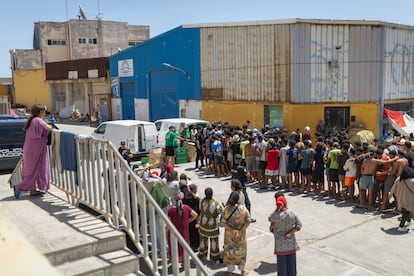
On the other side of the border, Spain’s interior minister, Fernando Grande-Marlaska, delivered the same message on Thursday during his second visit to Ceuta: “I tell them not to heed the mafias who play with their lives. None of them will stay [in Ceuta], none of them will go to the peninsula, none of them will get legal status.”
On the Spanish side, the combined number of National Police and Civil Guard officers has risen from just over 1,100 to about 1,600. In addition, 2,000 military troops have taken on support roles. The efforts are not focused only on the border; they also aim to make the presence of officers more visible on the streets — the minister admitted that returning Ceuta to the “normality” of July 29 “will obviously” take time in the face of residents’ complaints about insecurity — and to speed up the removal of the estimated 5,000 irregular migrants still in the city.
Since the crisis erupted, Marlaska has repeatedly expressed confidence that Morocco will assume much of the responsibility for stopping any attempt at another mass entry like the one in late July, when Moroccan police stood by and let people through, according to migrant accounts. “It has always been, is and will be extraordinary and exceptional,” the minister said when asked to describe the cooperation between Madrid and Rabat, even when he was reminded of the previous major incident at the Ceuta border, when 10,000 migrants entered in May 2021.
Arrests in Morocco
Moroccan authorities said they had detected numerous social media messages organizing and coordinating another mass crossing toward the Spanish cities this Saturday. Several people have been arrested and charged with spreading hoaxes to facilitate illegal migration, the Interior spokesman told the state news agency MAP.
Nonetheless, the Moroccan Interior Ministry is also calling on Spanish authorities to speed up the return procedures for the thousands of Moroccan minors who entered Ceuta in late July— Marlaska said on Thursday that 1,898 had already been placed under guardianship.
While the foreign and interior ministries of Morocco, whose chiefs are appointed directly by King Mohammed VI, have maintained a diplomatic tone in the current migration crisis, Justice Minister Abdelatif Uahbi has adopted a confrontational attitude toward Spain. As one of the main leaders of the Authenticity and Modernity Party (PAM, center-right), Uahbi is campaigning for the legislative elections scheduled for September 23, in which PAM’s candidate, Fuzi Lekjaa — president of the Royal Moroccan Football Federation and minister of budgets — is positioned as the likely winner. The Moroccan justice minister has criticized Spain for accepting irregular migrants while, he says, Morocco tried to stop them. In an interview with the Efe news agency, Uahbi said: “We prevent migrants from leaving, not only Moroccans but others too, but when they arrive in Spain they are accepted and their situation is regularized.”
However, EL PAÍS and other outlets found during the early days of the crisis that Moroccan security forces at the border refrained from confronting the tens of thousands of migrants heading for Ceuta. A government source in Rabat justified that response three days later, saying security forces did not confront the crowd to avoid causing harm.
Sign up for our weekly newsletter to get more English-language news coverage from EL PAÍS USA Edition









































