
The same crisis in Ceuta in a different world
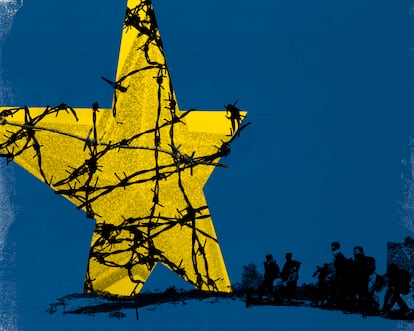
Europe needs a more mature conversation about immigration, one that turns its current vulnerability into resilience

The great Hispano-Arabic sage Averroes used to say: “True friendship is not measured by temporary interests, but is nourished by selfless love.” For the Andalusian philosopher, neighbors should unite not out of mere economic convenience but from an authentic desire to pursue the common good.
Perhaps that is the most telling absence in relations between Spain and Morocco, and by extension between Europe and its southern border. The latest crisis in Ceuta demonstrates this with unbearable starkness: more than 80 young people dead, many of them still unidentified; families desperately searching for their loved ones; and thousands of minors abandoned to their fate. This is the shameful toll of this tragedy.
However, it would be a mistake to interpret it as just another episode in a long succession of border crises. The year 2026 marks a turning point for three fundamental reasons that cannot be ignored when looking ahead, especially since geography offers no possibility of relocation.
The first concerns the return of power politics. Since the last major crisis in Ceuta in 2021, the world has changed. Force is once again prevailing over law, and coercion is replacing established norms. From Ukraine to the Middle East, from Sudan to Venezuela, and also along our southern border, countries are abandoning multilateral cooperation and diplomatic negotiation in favor of strategic dominance based on a zero-sum logic.
The struggle for control over sovereign territories, maritime routes, and strategic borders has resurfaced, pursued through constant pressure. Recent examples include Greenland, the Strait of Hormuz, and the Suez Canal. The threshold for conflict is steadily lowering through strategies designed to destabilize an adversary without crossing the red line that would provoke an open military response or a formal declaration of war.
These operations are often carried out covertly, allowing the aggressor to deny direct involvement and making attribution more difficult. This has repeatedly been the case in the Baltic Sea, where submarine cables have been cut and gas pipelines damaged. Such tactics also create a form of strategic asymmetry, enabling actors with comparatively weaker military capabilities to challenge stronger powers by exploiting their internal vulnerabilities.
In this new geopolitical context, almost anything can become an instrument of pressure: migration flows, energy dependence, trade, cyberspace, and social media networks transformed into battering rams of polarization and destabilization. The algorithm has become the new deadly weapon, deployed through silent disinformation campaigns, and those who control it can wield it as they please.
That is why the crisis in Ceuta cannot be analyzed solely as a migration crisis. It is the manifestation of a different way of exercising power. More subtle than conventional warfare, but no less effective for that. Those who apply pressure at a border are not merely seeking to open a passage. They seek to sow uncertainty, wear down institutions and divide democracies. It is a method. And for that reason, it requires a firm response.
There is a second transformation, perhaps less visible but equally decisive. Power politics, too, has its limits. No country can project abroad a strength it does not possess at home. When a nation devotes more resources to displaying influence than to building prosperity for its citizens, it ultimately weakens the very thing it sought to strengthen. No international strategy is sustainable if it rests on a society that is losing confidence in its future.
Perhaps that is the most telling image of this crisis. In the space of a few hours, thousands of young people were willing to leave their country with little more than the clothes on their backs. They were not fleeing a war. They were fleeing the absence of a future. They joined the protests of a generation that is increasingly well educated, yet increasingly convinced that its future lies elsewhere. No foreign policy can indefinitely conceal this reality.
Tactical victories often provide immediate satisfaction. The strength of a state, however, is measured on a different scale. Not by its ability to pressure its neighbors, but by its ability to offer stability, opportunity and hope to its own people. When external action becomes a way of postponing domestic challenges, the risk ceases to be diplomatic. It becomes political and social. And over time, regional as well. Because instability never remains confined within the borders of its source. It always spills over onto its neighbours. Spain included.
The third lesson speaks directly to Europe. The crisis in Ceuta has also revealed a European Union that is far more politically vulnerable than we would like to admit. Not because it lacks the means to protect its borders, but because the migration debate has come to dominate almost the entire European political conversation. Immigration has ceased to be a matter of public policy and has become a source of fear. And few fears shape the decisions of European governments more than one that has the potential to decide an election.
There is also a paradox that Europe has yet to resolve. Every EU member state, without exception, brings in thousands of foreign workers each year because its economy requires them. All of them do. Very few dare to explain it. Demographic aging, labor shortages and the long-term sustainability of the welfare state make orderly immigration an economic necessity. But political discourse continues to present it solely as a security problem. The gap between reality and rhetoric has become one of the European Union’s main strategic vulnerabilities.
Europe needs to have a more mature conversation about immigration. To turn that vulnerability into resilience. That means strengthening control of external borders against hybrid attacks, more effectively combating the criminal networks that traffic in human beings and cooperating with countries of origin and transit. But it also means creating legal pathways for migration and international protection that reduce the appeal of irregular routes. Security and prosperity depend on one another.
As long as Europe remains trapped in a debate driven by fear, others, both within and beyond its borders, will continue to find in migration an instrument of pressure. That is why any response to pressure on an external border must, above all, be a European one. Spain, however, has an additional responsibility. By virtue of its history, geography and experience, it is called upon to lead that debate on Europe’s southern frontier. To do so, it will need something that is in short supply in Spanish politics: a broad national consensus built on the country’s long-term interests rather than empty rhetoric or the short-term political gains that each crisis may offer.
For the real border at stake today does not separate Spain from Morocco. It separates two ways of understanding Europe. One turns every crisis into a pretext for building new walls between Europeans; the other recognizes that external borders can only be defended if there is first something worth defending on the other side of them. Sovereignty begins at the border. But Europe’s strength has always begun much earlier: in the trust of those who chose to share them.
It is time to change course.
Sign up for our weekly newsletter to get more English-language news coverage from EL PAÍS USA Edition









































