
Maricarmen, elderly woman evicted from home in Spain, becomes a global symbol for housing activists
A European network of social movements and tenants’ unions has joined the encampment protest in Madrid and hopes the Spanish initiative will be replicated in cities around the world

They came to Madrid to counterprogram one of Europe’s largest real estate fairs, The District. What they found was an 87-year-old woman who was about to be evicted from their home — and was, before their eyes. Around 200 housing activists from more than 20 countries across Europe decided to join the demonstrations against the eviction, and later joined a spontaneous encampment in front of the Madrid regional government headquarters at the historic Puerta del Sol plaza.
They are activists from Ireland, Germany, Portugal, France, England, Greece, Romania and Switzerland, among others, who see Maricarmen’s case as a turning point and hope the Spanish movement will spread to cities around the world, including their own.

“We are witnessing a historic moment. I’d never seen an eviction in Spain make the news in England. And now everyone is talking about it,” says Nadz Vogel, 29, a member of the London Renters’ Union. He landed in Madrid last Wednesday afternoon and, before boarding the plane, saw images on social media of police removing Maricarmen from her home and taking her out on a stretcher to the hospital. The image reminded him of an eviction he had tried to stop two weeks earlier, of a 71-year-old woman in a neighborhood of the English capital. They couldn’t stop that one, either. “They dragged us, they shoved us. It’s a form of violence that tenants around the world know well,” says the 29-year-old activist.
Maricarmen reminds Vogel of dozens of people that he knows — “she’s our grandmother, our siblings, ourselves” — and he finds many parallels between the demands he has been hearing for a day and a half in Sol and their own back in the U.K.: “Raising a tenant’s rent with no controls; vulture funds promoting new luxury housing that isn’t meant for any of us; social housing sold to private companies; people being pushed out of their homes.”
Vogel says that five months ago he witnessed a historic day in England and hopes that on Tuesday, when a housing decree is due to reach the Spanish Cabinet for a vote, Spain will also experience a historic day. He is referring to the May 1 entry into force of a permanent ban on no-fault evictions (the right to repossess a property at short notice without needing to give a specific reason), a measure that is part of the Renters’ Rights Act, passed in the fall of 2025. “We need a massive tenants’ movement because, in reality, there are far more of us than them [the real estate companies and investment funds]. The only thing we need is to become aware of that power.”

Vogel’s union is one of the organizations that belong to the European Action Coalition for the Right to Housing and the City, the network that coordinates social movements across the continent and which this week was holding its summit in Madrid. Several of its members camped out in Sol, and on Sunday afternoon they debated whether to extend their trip for a couple more days to see how far the protest would go. They were feeling inspired and stronger than when they arrived. Some of them were there the day Maricarmen was evicted, part of in the human barricade at the doorway.
One of them was Teresa Mamede, a lawyer and member of the Lisbon Renters’ Union. “We were furious about what happened. And the beautiful, powerful thing is that we organized that rage, we channeled it,” notes the 31-year-old activist with tears in her eyes. “It’s not just about Maricarmen. We are all going through this, in every country. And to see people united here, willing to spend the night on the street, in a tent, together, without sleeping... It’s a great demonstration of the power we have.” Mamede says that she wants to take “what happened in Sol” to Lisbon.
This summer, the Portuguese government pushed through a reform of the rental market that, among other changes, removes limits on the prices of new contracts. “It will take even more of our rights away, make things even more precarious. I’m going to bring Maricarmen’s case to my city so it can be an inspiration. We should pay attention to what’s happening here so that it gives us strength and shows us that it’s possible [in Portugal] too,” says Mamede.
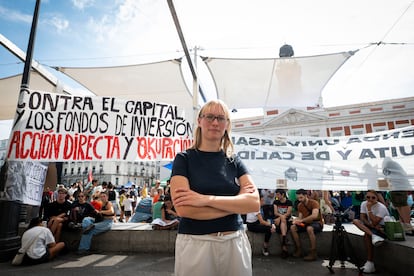
In Berlin the outlook is a little more hopeful, says Ronja Senkpiel, 31. Although renting an apartment in the German capital has become almost 70% more expensive over the past 10 years, the alternation between conservatives and social democrats in power has been broken and Die Linke (The Left) has emerged as the most voted party in the city with a campaign focused above all on fighting high housing prices. The party leader, Elif Eralp, could become the first mayor of Berlin from the leftist political group if she managed to reach a coalition agreement with the Greens and the social democrats.
“We’re very happy she won, because she also campaigned for our demand to expropriate large real estate companies in Berlin. Now everything depends on how the negotiations end and whether our demand will be implemented,” Senkpiel says from Puerta del Sol. She is talking about the post‑communist party’s promise to expropriate more than 200,000 apartments owned by large real estate companies and place them under public management.
The hundreds of people camping out in Madrid give her hope. Maricarmen is a symbol of shared problems, she says, and therefore the struggle must be a joint one.
The words of Senkpiel, Mamede and Vogel are echoed by the rest of the European activists gathered in Sol. There is excitement, a sense that this time things are different, and a desire to replicate the movement elsewhere. The feeling is summed up by Federico Tomasone, a political analyst at the Rosa Luxemburg Foundation.
“What is happening here is a signal for all of Europe. People are truly fed up. There is a huge mismatch between what the market offers and the real needs of the population. And you can’t treat an elderly woman as if she were a bicho [literally a bug, and the word used by the real estate market to describe a tenant who is still living in a house for sale]. This transcends borders. There are many Maricarmens everywhere.”
Sign up for our weekly newsletter to get more English-language news coverage from EL PAÍS USA Edition









































