
Trump’s obsessions are hurting Republicans ahead of midterms
Polls give Democrats their largest lead to date and show the president’s priorities are out of tune with voters’ concerns
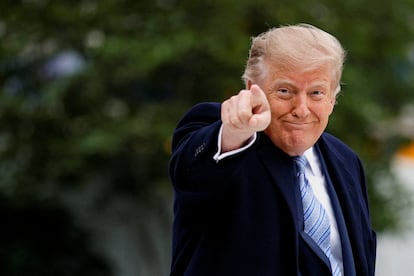

There is a phrase in Trumpist newspeak used to indicate that the president of the United States is on top of matters — “maintains laser focus.” The problem, just a little over a month before the midterms, is that polls show voters are not satisfied with the issues Trump is pointing that laser at.
The obsessions that drive him these days include, among others: the architectural projects he has undertaken or wants to carry out at the White House and in Washington; attacks on three media outlets whose coverage he dislikes; promoting fear of communism; his and his family’s personal enrichment; and promoting (and renaming) artificial intelligence (AI), which he has been trying to relabel — without much success, but with great determination — as “superintelligence.”
Voters and Republican candidates in the most competitive districts would prefer his priorities to be different: lowering the cost of living; reducing the price of gasoline and diesel (which this past week hit a historic record, with inflationary carryover); cutting back somewhat on corruption; ending the war with Iran. They would also prefer he take the threat from AI seriously, given that its experts openly describe it as potentially catastrophic for humanity, and that he rein in data centers — now an electoral white unicorn, one of those rare issues that unites the left and the right.
This past week, there were new examples of that dissonance. It began with the public row with three media outlets, which he barred from entering the White House to punish them for their coverage, although his lawyers — too late — later changed the rationale to a national security issue. It continued with an address to the United Nations that sounded like a campaign rally for a candidate with a dazzling record, albeit one at odds with reality. And it ended with a reception for Chinese President Xi Jinping that offered more honors than results, while his administration released a controversial video against communism and in praise of the president’s ego. The controversy stemmed more from the fact it was paid for with taxpayers’ money than from the choir that set the music, repeating “Love me” over a barrage of images of Trump. Americans have long grown accustomed to his vanity, probably his greatest obsession.
The best indicator
It has also been a week of terrible polls for the Republican Party. Democrats lead by 8.4 points (the largest margin to date), according to an aggregate of surveys measured by the so-called “generic ballot,” which gives the best snapshot for an election like the midterms. On November 3 hundreds of contests will be decided: all 435 seats in the House of Representatives and 35 of the 100 Senate seats are up for grabs, and the future of 36 governorships and many other offices are also at stake. To gauge voter intention in such a heterogeneous contest, pollsters ask respondents which party they lean toward in the abstract.
Moreover, the president’s unpopularity continues to set new records, and voters give him failing marks, according to recent polls, on issues such as his handling of the war with Iran, managing the economy, immigration, and tariffs.
But those numbers do not seem to affect the direction of Trump’s laser. Nor does the fact that more and more Republicans are removing references to him from campaign websites and would in fact prefer it if he did not visit their districts. Or that the most desperate candidates (about a dozen so far) have publicly spoken out against some of his policies.
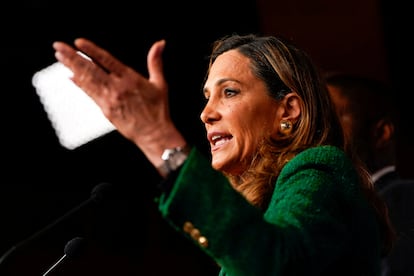
There is Representative María Elvira Salazar of Florida, who posted a video criticizing ICE’s brutality, or Michigan Senate candidate Mike Rogers, who said in an ad that Americans cannot wait any longer for an end to the war with Iran. Trump promised at the UN that it would end the day after the midterms, but after seven months of constantly changing timelines no one believes his deadlines anymore. Nor can his maneuvers to subvert the elections be ruled out: obstructing access to voting or denying the legitimacy of the result.
“He does not think in partisan terms. Nor national. Nor global. He only thinks of himself,” warns conservative columnist Jay Nordlinger in an email, saying he believes the president already considers the elections lost and “is thinking about life after Republican majorities in Congress.” Nordlinger also refers to remarks Trump made a couple of weeks ago on Fox News: “I’ll be a block [for the Democrats],” he said. “I’ll block all their bad stuff for two years.”
After legislative elections like November’s, which the party in power traditionally loses, the opposition has the power to stall the executive’s agenda and even to pursue an impeachment. Even more so if, as some polls already predict, Democrats win control of both chambers — something that has happened in only six midterm elections.
“Trump is perhaps the most talented and successful narcissist in United States history. He deeply cares about leaving his mark on Washington, and he has less than a year left to do it before the 2028 campaign eclipses his presidency,” Georgetown professor and Democratic Party historian Michael Kazin says in an interview, predicting that for the rest of the term the president “will issue more decrees [as he has since taking office a second time] and dare the courts to overturn them.”
One could say the prelude to the next presidential campaign has already begun, which, as Kazin notes, will steal the spotlight from Trump’s final year, since he cannot run again. It is a tentative dance in which no one wants to draw too much attention until the right moment.
While Vice President J. D. Vance hinted at a presidential run at the Republican convention in Dallas while White House sources told the press that staff prefer Secretary of State Marco Rubio, California Governor Gavin Newsom played coy on the Democratic side by saying that if Kamala Harris runs in 2028 he will step aside. Harris campaigned this week in Michigan alongside Abdul El-Sayed, who hopes to become the first Muslim senator in the Capitol from a socialist platform.
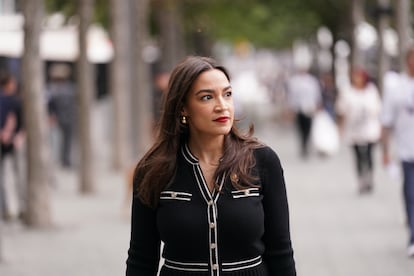
But the central figure has been Alexandria Ocasio-Cortez, who in an interview with The New York Times raised her bid to become the first Latina in the White House. The headline read: “Life doesn’t wait for you to be ready.” In the article, the congresswoman said she will make a decision after the midterms, echoing a widespread idea in Washington: “Oftentimes in politics, you do only get one shot.”
For Kazin, “the problem for Democrats is that most voters are not clear on what they stand for, since the only thing that unites moderates and progressives (socialists or not) is opposition to everything — or almost everything — Trump has done and said.”
The problem for the U.S: president is that that opposition, or at least a certain indifference, is spreading even among his most loyal supporters. An investigation by The Wall Street Journal concluded, after an AI-enabled analysis of 70,000 hours of MAGA podcasts, that mentions per hour of the commander-in-chief have plummeted in recent months, especially since the start of the war with Iran. Curiously, left-leaning hosts’ rates remain much higher.
And Trump? On Saturday he woke with the laser focused on his personal Truth account (that early-morning forum is the best thermometer of his obsessions) aimed at the “fake news” media, the notion that Iran cannot have nuclear weapons, or the “hoax” of climate change, which he again denied to the UN on Tuesday despite the scientific evidence. He also posted video after video about himself.
Sign up for our weekly newsletter to get more English-language news coverage from EL PAÍS USA Edition









































