
The Latino vote, still unpredictable, will be key to deciding control of Congress in the midterms
Hispanics have partially withdrawn their support for Trump, but polls do not show they are necessarily giving it back to the Democratic Party
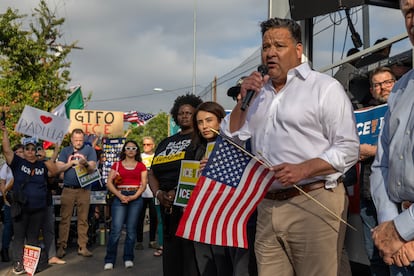

With just six weeks to go until the midterm elections, the outcome will depend largely on how Latino voters cast their ballots. However, although polls show voter disenchantment with the Donald Trump administration, it is not clear that the Democratic Party will pick up the votes of those who have withdrawn their support from the Republicans.
A recent report from the Latino organization UnidosUS warns that a large share of Hispanic voters—38%—remain undecided. “They are skeptical, and the fact that many do not perceive differences between the parties when it comes to delivering results for working families should set off alarm bells for candidates seeking their support. It’s a further reminder that these voters cannot be taken for granted or courted only at the last minute,” said Clarissa Martínez De Castro, vice president of UnidosUS’s Latino Vote Initiative, last week.
The direction taken by the Latino electorate will be crucial to the new configuration of the House of Representatives because in 12 of the 37 most contested districts, Hispanics have a strong presence. According to VoteHub, a media outlet focused on political and electoral data analysis that describes itself as independent and nonpartisan, Hispanic voters are the community with the greatest voting power in House elections.
In seven of the 30 districts that Trump won in 2024 by 10 points or less, the share of voting-age citizen Hispanic population exceeds 20%. Given that Hispanic votes made the Republican victory possible, a return of Hispanic voters to the Democrats would be disastrous for the GOP. Of the seven seats that Trump narrowly won in 2024 in areas with a significant Hispanic voter bloc, three are considered competitive according to VoteHub’s projections, and Democrats are favored in six of them, in the states of California, Colorado, New Mexico, Arizona, New Jersey and Florida.
Although their vote will be decisive in the midterms, VoteHub stresses that “it is difficult at this time to determine the stance of the Hispanic electorate.” “While there are signs that Hispanic support for Trump and the Republican Party has declined, it is also unclear to what extent that discontent has translated into backing for the Democrats.”
Trump won historic support from Latino voters in 2024. In 2020, Joe Biden carried Hispanic voters by 25 percentage points, and they had supported Hillary Clinton by an even larger margin in 2016. However, Trump was virtually tied with Kamala Harris among Hispanic voters, losing to her by only three points (48% to the Democratic candidate’s 51%). The Republican prevailed for the first time among Hispanic men, according to Pew Research data.
By November, however, signs suggest the Democratic Party will recover at least part of the vote that went to Trump. Hispanics supported him believing it would benefit them economically and bring down prices. They also trusted his campaign message that his so-called largest deportation in history would be limited to removing criminals from the country. So far in his term the president has failed on both counts. Inflation has surged, driven by higher fuel costs stemming from the war in Iran, and statistics show that a very low percentage—around 30%—of migrants detained had criminal records. The brutality ICE agents have shown during arrests, the images of parents forcibly separated from their children, innocent people dying at the hands of officials and deportations carried out without affording detainees due process have eroded the trust Hispanics placed in Trump.
According to an Equis poll that includes voter testimony, nearly three in 10 Latinos who backed Trump in 2024 express disappointment or regret, and a majority (65%) believe Trump has gone too far on immigration and that his actions harm the country.
Other recent polls also record voter discontent, especially among Hispanics. The latest survey published by The New York Times and Siena shows that only 31% of voters think the country is on the right track, a figure that falls to 29% among Hispanics. In another poll published by conservative network Fox, 61% of citizens disapprove of Trump’s performance as president, going up to 67% among Hispanics.
The latest data published by Reuters show that the White House occupant’s approval, at 32%, has fallen to its lowest level since he returned to the presidency. In January 2025 Trump began his second term with a 47% approval rating.
All signs suggest the Republican Party, which is fighting to control both legislative chambers in the November elections, will be harmed by the Trump administration’s policies. Voters will also elect governors and state legislatures in most states. If Democrats regain Congress they would alter the course of the last two years of his term, with increased oversight and vetoes of his decisions.
Discontent among Hispanics has even been felt within Republican ranks. Florida Rep. María Elvira Salazar published a controversial ad last week attacking Trump over his immigration policy. “Mr. President, your immigration policies have gone too far,” Salazar said in a Spanish-language video posted to social media that appears to show the White House in the background. “In July, your government detained 50,000 people and half of them had no criminal records. Be careful about what your advisers tell you. The same Hispanics who brought you to the White House in 2024 feel betrayed today,” she added.
Salazar is seeking reelection in District 27, which covers Miami-Dade County, against the Democrat Eliott Rodríguez, a former Miami television host. The congresswoman has also suffered in the polls from Hispanic disillusionment: Hispanics make up 74% of her district’s electorate. While she won by more than 20 points in 2024, polls now predict a tie between the two candidates.
An analysis of Pew Research Center’s National Public Opinion Reference Survey shows a decline in the share of Hispanic adults identifying as Republicans (29%) compared with their 2024 peak (34%). Nevertheless, Democrats, at 57%, have not yet reached the peak levels of support they recorded in 2021 (63%). Democrats will need Latino voters to win a congressional majority, and Republicans will need them to hold on to it.
Sign up for our weekly newsletter to get more English-language news coverage from EL PAÍS USA Edition









































