
The three witnesses to Lorenzo Salgado’s death are free as the case moves toward a grand jury
The district attorney in the Texas county where the Mexican migrant was killed says he hopes to reinterview the passengers who witnessed the shooting, including Salgado’s brother Víctor, now that they are out of detention and can speak freely without fear of being monitored

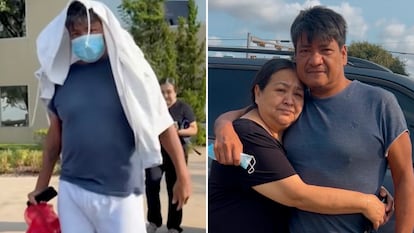
Shortly after 10:15 a.m. on Sunday, Víctor Salgado was able to embrace his family for the first time after 54 days in detention at an Immigration and Customs Enforcement (ICE) facility in Houston. During those 54 days, he repeatedly relived the operation in which his brother, Lorenzo Salgado Araujo, was fatally shot by an ICE agent. His attorney, Ruby L. Powers, visited him minutes after he returned home. She found a man who was “relieved and grateful,” but who was also beginning to grieve — a process that had been put on hold during his detention.
Powers did not disclose the conditions of Salgado’s release, including whether he had been fitted with an ankle monitor, as the other two material witnesses were. She said, however, that he is focused on recovering from weeks of detention so that he can participate, from outside custody, in the investigation being led by the Harris County District Attorney’s Office.
“He wants to be available for that process. He knows the district attorney needs him for the grand jury,” Powers told EL PAÍS. She added that her last conversation with Harris County District Attorney Sean Teare took place last week.
In Texas, a grand jury, which is made up of ordinary citizens, determines whether there is enough evidence to bring formal charges against a person.
Víctor Salgado, 44, was one of three migrants traveling with Lorenzo Salgado to a construction job on July 7 when ICE agents began pursuing them. The operation ended with Lorenzo Salgado being shot and taken to a hospital, where he was pronounced dead. The three witnesses, meanwhile, were handcuffed and taken to the same detention facility, though they were kept separated from one another.
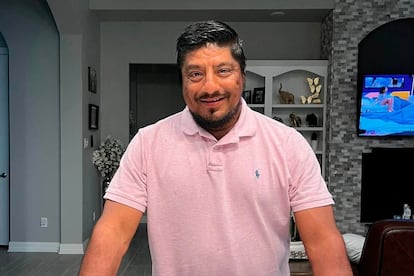
In recent weeks, two of those witnesses, José Trinidad Rojas, 51, and Daniel Tirado Pantoja, 43, were released following habeas corpus petitions filed by their attorneys. With Víctor Salgado’s release from ICE custody, the county’s investigation into the operation enters a new phase, one that has raised expectations within both the local community and Salgado Araujo’s family.
The road to a grand jury
In an interview on Houston Public Media on Friday, District Attorney Sean Teare outlined the next steps in the investigation into Lorenzo Salgado’s death.
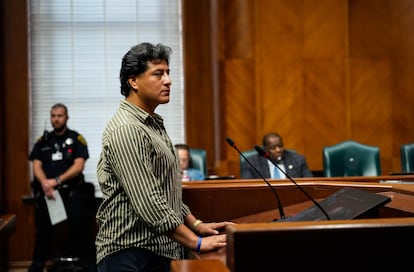
Investigators have already interviewed the three witnesses while they were being held at the Montgomery ICE Processing Center. But Teare said that he wants to speak with them again, now that they are free “in a clean place […] where they’re not worried someone might be listening.”
The district attorney’s office plans to present their testimony “soon,” along with the rest of the evidence, to a grand jury in the near future. The panel will then decide what charges, if any, should be brought, and against whom, in connection with the death of Lorenzo Salgado Araujo.
“We are at an inflection point. In material terms, when you talk about the evidence generated that day, we’ve reached the point where we have obtained practically everything we could,” he said.
Through its digital forensics unit and investigators who spent an entire month on the ground, Taere said, the office collected surveillance footage from cameras in the community and interviewed witnesses, allowing it to reconstruct ICE’s pursuit of Salgado’s van and the events that unfolded after the shooting.
But because the ICE agents involved in the operation were not wearing body cameras, investigators have been unable to piece together a complete video record of the chain of events that led an agent to shoot Salgado. “Deploying these people onto the streets — who simply flouted the Constitution and did so without any kind of recording — is, frankly, inexcusable,” said Teare.
The lack of a complete account of how the July 7 operation ended has made the testimony of the three witnesses crucial to understanding why they were pursued, cornered and shot at, even though none of the occupants of the van were targets of the ICE operation that morning.
Their accounts differ from the version the Department of Homeland Security shared with the media after the incident. The agency initially claimed that Lorenzo Salgado Araujo had attempted to evade arrest and rammed an ICE vehicle with his van. According to DHS, the agent opened fire in self-defense.
In a previous interview, Powers, citing Víctor Salgado’s testimony, said the agent who fired the shot ran from a vehicle parked behind Salgado’s van to the passenger-side window. From there, he ordered the occupants to stop and, almost simultaneously, fired the bullet that killed Lorenzo Salgado Araujo.
Teare said Friday that investigators are still awaiting information requested from the federal government, including the identities of the Guatemalan nationals ICE was seeking that morning and records of the mandatory use-of-force training received by the agents involved.
And although he did not specify whether his office had already obtained that information, the district attorney said he is “no longer concerned” about the identity of the agent who fired at the van.
54 days of detention
The three witnesses to the death of Lorenzo Salgado Araujo were held in detention for more than a month, confined to separate cells and unable to communicate with one another.
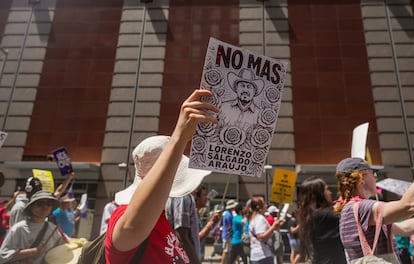
On July 29, ICE released the first of them, José Trinidad Rojas Pliego. That same day, the migrant visited the memorial covered with flowers, messages and photographs that the Houston community created to honor Salgado and protest his death. Videos shared on social media showed him in tears. “I want justice for Lorenzo Salgado,” he said.
The second material witness was released nearly a month later, on August 26. Daniel Tirado Pantoja was greeted by his wife outside the Montgomery Processing Center. Organizations supporting the families said he had lost between 20 and 30 pounds because of poor detention conditions, as well as the depression and trauma stemming from the operation on Canal Street.
To the surprise of many in the community, the last to be released was Lorenzo Salgado’s own brother. His attorney says that during his 54 days in detention, Víctor Salgado struggled to sleep. He learned of his brother’s death only after being taken into custody and, despite the trauma of the shooting, the loss itself, and the anguish of being unable to help him, he was denied the opportunity to grieve alongside his family.
“When you see him, you can tell he’s happy to be free, but then the sadness and pain come rushing back when he thinks about what happened to his brother. It’s a mix of emotions. It’s as if everything happened yesterday, because he didn’t have the chance to cry,” Powers said.
Although he has been released from detention, Salgado is still on the radar of immigration authorities at a time when the Donald Trump administration is pursuing mass arrests and deportations. He is facing two separate proceedings: a U visa application as a witness to a crime, tied to his brother’s case and currently under review by U.S. Citizenship and Immigration Services (USCIS); and his deportation case, which is now moving to a different court.
Sign up for our weekly newsletter to get more English-language news coverage from EL PAÍS USA Edition









































