
What are Jair Bolsonaro’s chances of being freed? And on what timeline?
There are three possible routes to his hypothetical release: a court ruling, a congressional amnesty law or a presidential pardon if his son Flavio wins the runoff against Lula
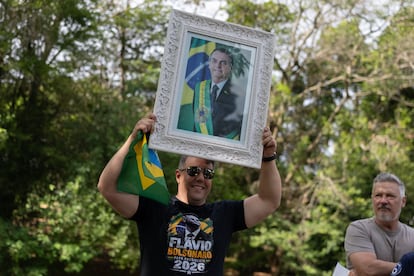

The inauguration in Brazil includes a moment of enormous symbolism that comes courtesy of the architect Óscar Niemeyer. The elected head of state arrives at the Praça dos Três Poderes and ascends to power on foot, walking up the ramp that leads into Planalto Palace. “In 2027, I will climb the ramp with my father,” Flávio Bolsonaro repeatedly promised during the presidential campaign; he is now the favorite to win the October 25 runoff after attracting 47% of the vote last Sunday over incumbent president Luiz Inácio Lula da Silva’s 45%. Flávio knows that his supporters prefer the original Bolsonaro to the copy. He has also declared that, if he defeats President Lula on October 25, his first move will be to pardon Jair Messias Bolsonaro, who is serving a 27-year sentence for attempting a coup.
But what are the chances that the former president will regain his freedom if his eldest son and political heir wins the election? And what would the timing be? Would he make it in time to climb the ramp with him? This time the inauguration will no longer be on New Year’s Day but on January 5.
Bolsonaro Sr., 71, has served the first year of a 27-year sentence. He is under house arrest because of health problems, confined and silenced by court order at his Brasília chalet, where he lives with his wife, Michelle Bolsonaro, their daughter and the other daughter of the former first lady. After Sunday’s victory, Flávio Bolsonaro asked the judge to lift the existing prohibition and allow him to visit the retired military officer. They have not seen each other for almost three months, before the campaign began.
There would be three possible routes to his hypothetical release: a court ruling, a congressional amnesty law or a presidential pardon.
Free by court order
The defense for Bolsonaro Sr. has filed a criminal review petition seeking his release. One of the Supreme Court justices, Kassio Nunes, announced on Wednesday that he intends to hear the matter after the runoff, from which the country’s next president will emerge, according to a confirmation on Wednesday. He plans to take the case to the full court — that is, the current 10 justices because there is one vacancy.
The newspaper Folha de S.Paulo revealed his plans on Monday. According to the paper, the magistrate believes the judicial process against the former president was marked by “exaggerations” such as the severity of the sentence and factors that, in his view, undermined the accused’s right to a defense. He has also told colleagues that he has not ruled on the petition earlier to avoid accusations of interfering in the elections.
Brazil’s Supreme Court is an important actor in political life because of its decisions, shifts in doctrine and control of timing. And Nunes holds a particularly sensitive post at the moment. He also presides over the Superior Electoral Court, in addition to his seat on the high court. He was appointed to the Supreme Court by Bolsonaro. (President Lula also named several current justices to the high court, including two who convicted the far-right former president by a 4–1 vote).
Amnesty law
Another option would be for Congress, where the Bolsonaro family’s Liberal Party holds the largest bloc, to push through an amnesty law after a hypothetical victory by Bolsonaro’s son. That is framed as “the power of the president-elect.” The current legislature ends in late January 2027. Then the newly elected lawmakers, including four Bolsonaros, will take office.
Last year, lawmakers rejected an amnesty bill that would have annulled the crimes and sentences of everyone convicted for the assault on government buildings, Congress itself and the Supreme Court in 2023 — from Bolsonaro and the generals who led the plot to the ranks of hundreds of Bolsonarista rioters who invaded the institutions. They caused heavy damage to the Praça dos Três Poderes, created by architect Niemeyer and urban planner Lúcio Costa, including the palace whose ramp previous presidents climbed and that the next president will ascend.
In a classic Brazilian conciliatory move, Congress embraced a second bill that, instead of an amnesty, would have reduced the sentences of the convicted insurrectionists, but it stalled in the legislative process.
Presidential pardon
If Brazilians elect Flávio Bolsonaro president, he could sign his father’s pardon one minute after taking office, according to the Brazilian press — that is, at the moment the early hours begin on January 5. That would leave several hours to complete the necessary formalities before the judge handling the coup plot case, Alexandre de Moraes of the Supreme Court — the same justice who sentenced Bolsonaro and whom the conspirators planned to kill along with Lula.
If there were time to complete the procedures, the patriarch of the far-right clan would regain his freedom. His sentence, though not the underlying crime, would be annulled. Free, he could dress in a suit and tie and go outside for the first time since August 2025. He could stage a second inauguration, eight years after the one that made him Brazil’s first far-right president. This time it would not be as head of state but as a father, political godfather to his eldest son and leader of Brazil’s right wing.
Sign up for our weekly newsletter to get more English-language news coverage from EL PAÍS USA Edition









































