
Three Afghans arrested in Kabul for playing in the Chess Olympiad: ‘We feel afraid, our situation is unsustainable’
The EU, the Spanish government and FIDE are undertaking efforts in support of the three chess players detained a week ago, while remaining cautiously optimistic
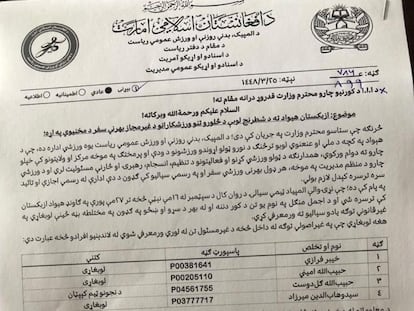

Anxiety hangs over the three Afghans who have been under house arrest for a week after traveling to Samarkand, Uzbekistan, to compete in the Chess Olympiad. The players were arrested upon their return to Afghanistan, where chess is banned. Khaiber Farazi, Habibullah Amini and Habibullah Guldoost are awaiting punishment from the Taliban authorities, though there are grounds for hope: EL PAÍS has learned that the International Chess Federation (FIDE), the European Parliament and the Spanish government are all working to support them.
The psychological strain is greatest on Farazi, who is also widely known for his work as a comedian on Afghan television, as several of his relatives have died in episodes of violence. From Kabul, where he lives with his wife, he described his state of mind as follows: “Given the circumstances we are facing, my wife and I feel a great sense of insecurity and fear staying at home. It is having a significant impact on our emotional and psychological well-being. We are deeply concerned for our safety and do not believe our current situation is sustainable.” Shortly after writing those words, he was contacted directly by Ahmad Noorzai, a member of the European Union delegation in Afghanistan, who expressed his support.
Amini, one of his teammates on Afghanistan’s national team, is clinging to hope. “I trust that the expressions of support from various organizations will translate into effective practical assistance,” he says.
Guldoost, by contrast, captain of the women’s team at the Chess Olympiad (which is made up of four women living abroad), also speaks of his anguish: “Until two days ago I had not informed my wife and children, who live with me, about my situation. However, the news about the three of us was broadcast on Afghanistan International TV in Dari [one of Afghanistan’s two official languages, alongside Pashto], and my name was mentioned directly. Unfortunately, my family’s psychological well-being has been severely affected, and they are now suffering enormous stress and anxiety.”
The International Chess Federation, whose 204 members include countries and autonomous territories, has been a member of the International Olympic Committee (IOC) since 1999, following a unanimous decision by its General Assembly promoted by the organization’s then president, Spain’s Juan Antonio Samaranch. Two weeks ago, Kazakhstan’s Timur Turlov took over as president of FIDE, the sport’s governing body. A source very close to him told EL PAÍS: “We are carrying out very discreet diplomatic actions from FIDE. And we are moderately optimistic.”
Spanish MEP Ignacio Sánchez Amor, of the Socialists and Democrats group, shares that cautious optimism. “The fact that the EU delegate in Afghanistan is in direct contact with the detainees is encouraging. If necessary, we will put the matter on the agenda of the Parliament’s November plenary — it is not possible in October — but we trust there will be a good solution beforehand, and we will try to keep the issue in the spotlight.” His Italian colleague Alessandra Moretti, who oversees Afghanistan-related issues, has also published a video expressing her support.
On Monday, Spain’s Minister of Education, Vocational Training and Sports, Milagros Tolón, sent two very similar letters, one to Kirsty Coventry, the Zimbabwean president of the IOC, and the other to Timur Turlov. In both, she expressed her “deep concern” that the three detainees could face “reprisals and physical punishment for having taken part in an international competition”.
The final paragraph opens with the following statement: “No athlete should ever be forced to choose between practising their sport and safeguarding their freedom and physical integrity.”
Sign up for our weekly newsletter to get more English-language news coverage from EL PAÍS USA Edition









































