
Spain calls snap election as housing protests spread nationwide
Spanish Prime Minister Pedro Sánchez brings elections forward to November 29 after Congress rejected two decrees aimed at addressing the crisis
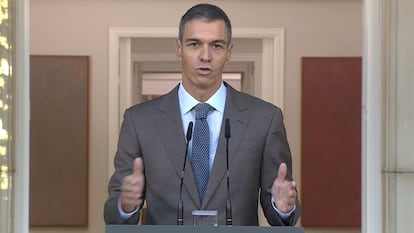
Spanish Prime Minister Pedro Sánchez delivered an institutional address from La Moncloa, the seat of government in Spain, to announce that a snap general election will be held on November 29.
Sánchez acknowledged that his government had “made mistakes” and had not succeeded in accomplishing everything it had set out to do. After a weekend of extensive consultations with members of his cabinet, leaders of his party, the Spanish Socialist Party (PSOE), and allies from other political groups, he decided to take the step of dissolving Parliament nine months before the scheduled end of the legislative term, which until now he had always intended to complete.
“More than three years ago, voters chose to place their trust once again in a progressive coalition government,” he said in the address on Monday. “We have had to deal with unprecedented emergencies and navigate an extremely difficult international environment. We have had to work with a highly confrontational Congress. We have had to take on very powerful elites that do not stand for election but want to control our country. And we have faced the worst opposition in history, one that blocks policies that are good for the country and sabotages them from the regions.”
“Despite all that, Spain has continued to move forward. It is the fastest-growing economy in the EU. Purchasing power has increased three times more than in France or Germany. We have expanded scholarships, parental leave, dependency benefits and healthcare services,” he continued.
“There are still many social injustices to correct and many goals yet to be achieved in public services and housing. The truth is that, to do more, we need the support of the people; we need Parliament to give us a much broader progressive majority. That is why, after informing the King, I have decided to convene an extraordinary Cabinet meeting to call elections for November 29. Now it is up to you. The world is entering a very complex period,” the prime minister concluded.
Sánchez’s decision follows more than a week of nationwide demonstrations over Spain’s housing crisis. The protests were sparked by the eviction of 87-year-old Maricarmen Abascal from her Madrid home, a case that crystallized public anger over rising rents, evictions and a chronic shortage of affordable housing.
Demonstrations spread to more than 50 cities, including Barcelona, Valencia, Seville and Málaga. Tens of thousands of people have taken to the streets, while activists have also established protest camps in central Madrid, drawing comparisons with the 15-M anti-austerity movement.
The protests intensified after Congress rejected two decrees designed to strengthen protections for tenants. Junts per Catalunya (Together for Catalunya) opposed both measures, joining forces with the Popular Party (PP) and Vox, despite the fact that the government had negotiated parts of their content with the Catalan separatist party.
The parliamentary setback highlighted what had already become increasingly clear in recent months: Sánchez no longer has a majority capable of passing significant legislation. It also shattered the prime minister’s plan to present the first full budget of the legislature, at least as a way of demonstrating a willingness to negotiate with parliamentary groups, setting out a roadmap for future social measures and extending his time in office for a few more months.
Within the PSOE, the shift in the political climate following Maricarmen Abascal’s eviction and the housing protest camps is being seen as an opportunity to contest the election under more favourable conditions than those of recent weeks. The Ceuta crisis — when more than 80,000 people crossed from Morocco into the Spanish exclave city — and the government’s heavily criticized response had badly damaged the morale of PSOE supporters. The surge in migration pushed an issue that analysts generally regard as more advantageous to the right to the top of the political agenda. Housing has had the opposite effect. Opinion polls show that a majority of Spaniards, including substantial numbers of right-wing voters, support policies traditionally championed by the left, such as capping rents.
Another major challenge facing Sánchez will be the weakness of the political space to the left of the PSOE, which proved decisive in preventing a right-wing victory in 2023. The alliance formerly known as Sumar, and soon to be renamed the Broad Front, does not even have a candidate in place. And unlike in the previous election, that political space could end up running on two separate tickets if the split with the left-wing party Podemos is not resolved.
Euphoria, by contrast, is the prevailing mood on the right. Buoyed in particular by the government’s heavy political damage from the Ceuta migration crisis, both the PP and Vox are increasingly confident that victory will not slip from their grasp this time. That is unlikely, however, to prevent a struggle between the two parties over the balance of power should they secure a parliamentary majority after the election.
Over the past three years, the PP has remained largely stuck at around 30% of the vote, posting figures similar to those it achieved in 2023, while Vox has recorded significant growth.
The other major factor that has steadily weakened the Socialist leader has been a string of judicial battles. Some have generated relatively little controversy, such as the conviction of former transport minister and PSOE heavyweight José Luis Ábalos on corruption charges and the investigation into an alleged influence-peddling network linked to party activist Leire Díez. Others have proved far more contentious, including the cases brought against Sánchez’s wife and brother, as well as the prosecution that led to the conviction of former attorney general Álvaro García Ortiz.
Sánchez emerged relatively unscathed from other crises, including the deadly Valencia floods of October 2024. But the Ceuta migration crisis has opened up yet another breach in the government’s credibility.
Since being ousted by the PSOE old guard in 2016 for refusing to facilitate Mariano Rajoy’s investiture, Sánchez has built something of a reputation for overcoming political adversity. Yet he has never faced a challenge as steep as this election. For months he sought to avoid it, until the reality of governing without a parliamentary majority became impossible to ignore.
Sign up for our weekly newsletter to get more English-language news coverage from EL PAÍS USA Edition









































