
The uncertainty of families of the 280,000 people missing in the war between Russia and Ukraine: ‘They must live with silence’
The International Committee of the Red Cross helps relatives in Moscow who are searching for their loved ones and struggling with the pain of absence
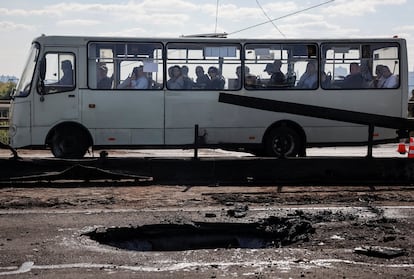

At least 280,000 people are missing due to the war between Russia and Ukraine, according to the vast list maintained by the International Committee of the Red Cross (ICRC). It includes Ukrainians and Russians, without distinction, and the true figure is likely higher because the list contains only requests registered with the organization. The vast majority are soldiers. Although many have probably died, some parents and wives still set a meal at an empty chair and leave their rooms unchanged in case the person suddenly returns home. They carry a pain psychologists call ambiguous loss.
“There was no news of him for a long time. Later the men in his regiment said an explosion tore him to pieces. My friend wouldn’t accept it, a mother’s heart couldn’t accept it; he was her son, anything could have happened with so much smoke,” a woman in her seventies told this newspaper after asking for more support for relatives of those missing in the conflict at a campaign event for the opposition Yabloko party.
“He had married recently. He was a troubled boy, but an angel came into the family. My friend eventually accepted that her son had been blown to pieces, and that angel, his young wife, had to go from place to place to sort out his paperwork,” the woman lamented, asking to speak anonymously for fear of the authorities.
The Ukrainian Commissioner for Persons Missing under Special Circumstances estimated in spring that 90,000 of the country’s citizens were unaccounted for, including military personnel and civilians. The Russian government does not publish figures for its nationals.
Relatives come daily to the ICRC offices in Moscow searching for their loved ones. Sadness covers their faces. “Unfortunately, the number of missing increases month by month,” Wilhelm Odde, head in Russia of the ICRC’s Protection and Restoring Family Links unit, said in his office during a meeting in September. “And all the relatives are left with is the absence of their loved one.”
This is the phenomenon of ambiguous loss, coined by researcher Pauline Boss in the 1970s. “They must live with silence, with no element of reality to hold on to in order to accept or reject their [loved one’s] death. They harbor hope that the person is alive, but at the same time they can see that they are not, because they are not here. Being alive also implies being present, having a voice, but they must live with silence. This creates very difficult situations for families,” Odde said.
An ICRC staffer had just received a set of parents. The missing serviceman was “very young.” Their case is one of the most common: “They have been looking for their son since 2023. His death has not been confirmed and they refuse to give up. They think that if they have not received the body, he is not dead; he could be in hiding. They came from a very remote region of Russia. After so long they no longer cry, they only nod with that sad look,” she said.
Some households are plunged into solitude. “I spoke with a grandfather who has been searching for his grandson for two years,” another worker recounted. “He is about 90 and lives alone. He told me he wakes up and his grandson’s things are still hanging there. His clothes, his cologne, everything is intact”
“One day he found his poems; no one in the family knew he wrote poetry. He read them to me; I couldn’t help but cry. He told me he looks out the window and sees people returning from work; he imagines his grandson returning too,” she recalled.
Others refuse to accept the loss even after forensic analysis. Recently, “a woman came. She had official information about her son’s death, she even buried the remains, but she is certain they are not his,” another ICRC employee said.
“I don’t feel like he’s dead; I feel like he’s alive” is another phrase that some parents repeat to deny reality. For example, one woman said that a friend of hers had dreamed that her son was at sea, and another resorted to telepathic experiences — one of the tricks used by scammers.
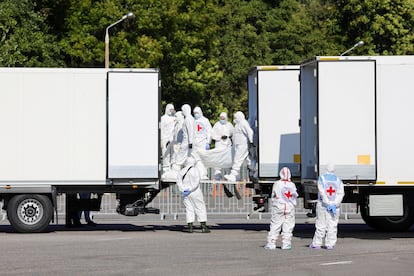
“The calls are constant, the phone never stops ringing,” said Lucile Marbeau, head of communications for the International Red Cross delegation in Moscow. “Our work is guided by the principle of not creating false hopes for families. We never promise to find the person. That complicates our work, but the guiding idea is always the families, not causing them more pain than they are already in.”
Nevertheless, any small detail can reactivate that hope. “That hope is stronger than any protocol we may have,” another ICRC worker told this newspaper.
Family disagreements make the disappearance even more painful. “We have many cases of elderly mothers who do not accept that the son has died, but the wives do, and that causes many family disputes. The mother considers the wife a traitor, thinks she was only after money, but the woman simply accepted the death. There is nothing wrong with that; she moved on, but the mother cannot, because she is his mother,” another worker said.
A wound for future generations
The International Red Cross never informs families of deaths; that is the responsibility of the authorities. The role of the offices in Ukraine and Russia is to collect families’ requests and cross-check them with available information from both sides. “Given that this is an international armed conflict, it goes without saying that communication between the two parties is not easy. This is where the ICRC’s role as a neutral intermediary is crucial,” Odde said.
The organization has been able to inform only 18,400 families that their loved ones, both civilian and military, are alive since the invasion of Ukraine began in 2022. Messages from prisoners of war are a key “proof of life.” The ICRC has been involved in exchanging about 38,400 personal messages.
At the same time, the Russian Red Cross, an organization completely independent from the ICRC, provides psychological support to families through a large support center.
“Is the person alive or dead? That is what the ICRC calls the right to know,” Odde stressed. “This right to know the whereabouts of a missing relative is enshrined in international humanitarian law.” Both Ukraine and Russia are signatories to the Geneva Conventions and are obliged to inform families of their missing relatives.
“If the person has died,” Odde continued, “their relatives need official confirmation for many reasons, from receiving financial compensation to being able to begin grieving.”
Russian families can receive up to 14 million rubles, more than $155,000, in compensation in some cases. This includes a federal payment of five million rubles plus other regional bonuses, military insurance, and other social benefits.
Verification of bodies is carried out by the side of the deceased, although it is not always possible to recover remains. “There are relatives who have been searching for their loved ones with no answer for four years. They never give up; I do not know any family that has completely surrendered,” the head of the ICRC office in Moscow said.
The tragedy can remain present for decades. “It is something that accompanies the family, something that endures generation after generation, reminding them that the grandfather left one day. And that leaves a mark,” Odde said.
Sign up for our weekly newsletter to get more English-language news coverage from EL PAÍS USA Edition









































