
The dark side of Starship’s success: Musk sidelines NASA in his bid to dominate space
SpaceX is focused on its giant Starship rocket to expand the Starlink network and deploy orbital AI data centers, rather than on returning humans to the Moon or launching satellites for other customers
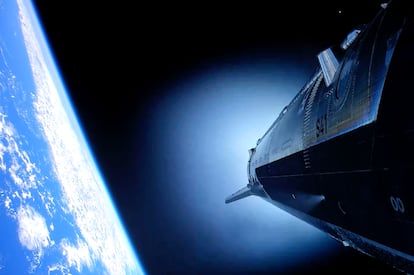

Elon Musk is stepping on the gas with Starship. His flagship spacecraft, the largest ever built, entered orbit for the first time on Monday, and his space company, SpaceX, has already received approval from the U.S. federal government to accelerate the current testing phase and launch it twice more in October if it wishes.
And Musk does not intend to stop there. “Starship is two to three years away from hourly flights,” he declared last week on his social media platform X.
That is what the tech billionaire needs to expand his Starlink network to 100,000 satellites orbiting Earth, alongside the space-based data centers his company is already building. It is his plan to dominate the skies.
Accustomed to Musk’s bursts of enthusiasm and his unrealistic timelines for establishing human colonies on Mars and the Moon, the space industry believes it will take considerably longer for Starship to become fully operational. Musk, however, views that moment as imminent. SpaceX is already planning to retire the Falcon 9 rockets in 2028, despite the fact that they are currently used by numerous space agencies and companies for the vast majority of launches.
“The prospect of this loss is already spurring panic among some satellite operators,” according to Caleb Henry, research director at consultancy Quilty Space, who told CNN that many in the sector fear Musk’s push to accelerate Starship could end up slowing launches for everyone else. The concern is that such a disruption could trigger a crisis affecting everyone from small startups to NASA, once the undisputed powerhouse of the space industry.
And indeed, of the 325 space launches worldwide in 2025, SpaceX carried out more than 50%. All were conducted using its Falcon 9 rockets, including a specialized variant, the Falcon Heavy, designed to carry heavier payloads into orbit.
One example of that dominance came on Thursday, October 1, when Musk’s company conducted three launches in just 13 hours. First, a crew of four astronauts departed from Cape Canaveral, Florida, bound for the International Space Station. Next, on the opposite side of the United States, another Falcon 9 lifted off from a launch site in California carrying Google’s first orbital AI data center, and, on the same flight, delivered 129 smaller payloads for numerous companies. Then, back in Florida just before midnight, SpaceX launched a Falcon Heavy carrying a U.S. government spy satellite.
All of this would have been unthinkable just a decade ago. No space agency or private company had achieved anything similar, and SpaceX does it at a cost its customers can afford. But Musk wants to reduce costs (which remain astronomical) even further for putting satellites, astronauts and scientific robotic probes into space. His formula is to use a much larger rocket, Starship, that is also fully reusable: he has called it “the holy grail of rocketry.” Currently, SpaceX only recovers the lower part of each Falcon — the main booster, reused in dozens of missions — while the upper stage breaks up on reentry after delivering its payload into orbit.
The space industry fears that the resulting reduction in costs will, at least initially, only benefit SpaceX. After a long testing period that began in 2023, Starship is preparing to take over. On Monday, it reached orbit for the first time and deployed 26 Starlink satellites. It is the first step toward realizing the world’s richest man’s most lucrative ambition: taking his Starlink network, his biggest source of revenue by far, to an entirely new level, well beyond contracts from customers such as Google or even NASA.
What are the next steps to make Starship viable?
Despite marking a historic milestone in the space race with its first orbital flight, for now, Starship is only useful for deploying Starlink satellites. It is essentially a gigantic disposable dispenser for those specific payloads. To meet the needs of other customers, SpaceX would have to design and build different versions of the spacecraft. But Musk has other priorities first: on upcoming flights, he wants Starship itself to become reusable.
That will require recovering the spacecraft with a pair of giant robotic arms. At the moment, Starship ends its missions by splashing down in the ocean before subsequently exploding. In 2024, SpaceX successfully recovered the lower section of the giant rocket, the Super Heavy booster, using this method. Musk has promised that by early 2027 the company will not only recover both stages of Starship after every flight but will eventually relaunch both the spacecraft and booster that it retrieves. To keep that promise, the first thing he needs to do is greatly increase the frequency of test flights, launching several each month.
At present, about two months pass between tests. When Starship began completing suborbital flights in 2024, Musk blamed the administration of former president Joe Biden for preventing a faster pace of development by failing to authorize launches whenever upgrades were ready. Yet since Donald Trump returned to the White House, Starship’s progress has stagnated for almost two years, while the program also suffered a series of accidents and explosions in early 2025. It has yet to regain the launch cadence it achieved at the end of Biden’s presidency, when just 37 days separated the successful fifth and sixth test flights of the mega-rocket.
Will Starship be ready for Artemis 3?
When Trump returned to office in January 2025, NASA’s plan was for the Artemis 3 mission to land the first woman on the Moon in mid-2027. The date remains the same, but almost everything else has changed. No female astronaut will be aboard, and the mission is no longer expected to travel to the Moon. Instead, it will be conducted entirely in low Earth orbit, a few hundred miles above the planet. NASA decided in March to alter the mission’s destination because of delays in Starship’s development.
To participate successfully in that mission, Starship will need to remain docked for an entire day with the Orion capsule carrying four astronauts. In its most recent test, Musk’s spacecraft finally reached orbit, but it stayed there for less than three hours. The original objective had been a 10-hour mission completing six orbits of Earth. SpaceX mission controllers chose to deorbit the vehicle during its second orbit after one of its engines shut down prematurely during ascent.
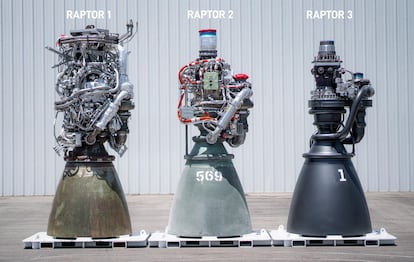
Since their debut in May, the third-generation Raptor engines have experienced some form of malfunction on every flight. Their highly simplified design also makes modifications more difficult as engineers search for solutions. NASA will not accept engine reliability problems that could endanger the mission and crew. Starship is not yet ready to take part in Artemis 3, and it is hard to know when it will be.
The space sector assumes that Artemis 3 will be delayed, and NASA is no longer relying solely on SpaceX for its return to the Moon. The agency has also brought in Blue Origin, the space company founded by fellow tech billionaire Jeff Bezos. Under the current plan, which is still light on detail for a crewed mission scheduled for less than a year from now, Blue Origin’s Blue Moon lander would launch first and wait in orbit for NASA’s Orion capsule carrying four astronauts. Once the two spacecraft had docked, Musk’s Starship would launch and rendezvous with the lunar vehicle. Altogether, the operations would take two weeks.
“Artemis 3 will be a highly choreographed dance with a demanding launch sequence across multiple launch pads and equally demanding mission operations for our ground and flight crews, making it one of the most complex and ambitious missions NASA has ever undertaken,” said Jeremy Parsons, director of the Artemis programme.
And when will it be able to travel to the Moon?
If it is difficult to predict when Starship will have fully reliable engines, it is even harder to say when it will be ready for Artemis 4. Before a Starship can travel to the Moon, it must overcome an even greater technological challenge: orbital refuelling.
Its enormous tanks would have to be topped up in Earth orbit by other Starships carrying fuel, a process expected to require between 15 and 20 spacecraft. Nothing like this has ever been attempted in the history of spaceflight. SpaceX initially said it would demonstrate the technology in 2025, then pushed the target back to 2026. It currently has no plans to make a first attempt in 2027 to prove that such a system is technically feasible.
In addition, the Starship destined for the Moon would need a crew cabin and certification for human flight. That version of the spacecraft has yet to be built, and certifying spacecraft for human use is a lengthy process that takes years. The current launch date for Artemis 4, in 2028, is highly unlikely, and significant delays are widely expected, as has happened with previous missions in the lunar program.
More uncertainty for the space station
NASA has outsourced both lunar landings and astronaut transport to the International Space Station (ISS) to private companies. SpaceX is currently the leading contractor in both areas, and alternative providers remain far behind. At present, SpaceX and its Dragon capsules are NASA’s only means of reaching the ISS. But those spacecraft are launched on Falcon 9 rockets.
“I do not think it’s a secret that SpaceX intends to sunset older platforms like Falcon and Dragon as they concentrate on their next-generation capability Starship,” NASA administrator Jared Isaacman said last week.
And if Elon Musk follows through on that plan, he could leave NASA without a means to travel to the ISS. To fill that gap, the agency has resumed its project with Boeing to transport astronauts to the station on the Starliner, the spacecraft whose failed 2024 mission left two astronauts stranded on the station for months.
After two years of work by NASA and Boeing to resolve Starliner’s technical problems, an uncrewed test flight is scheduled for the coming months. If successful, Isaacman hopes the spacecraft will be able to begin carrying astronauts to the ISS in 2028. That is the same year in which NASA hopes to return humans to the Moon and Elon Musk hopes, once again, to revolutionize the space industry.
Sign up for our weekly newsletter to get more English-language news coverage from EL PAÍS USA Edition









































