
The end of the world has yet to reach Spain’s Sol square
A sprawling encampment with a life of its own has managed to turn a housing crisis that used to only emerge sporadically on political agendas into a major public issue followed closely by millions of people
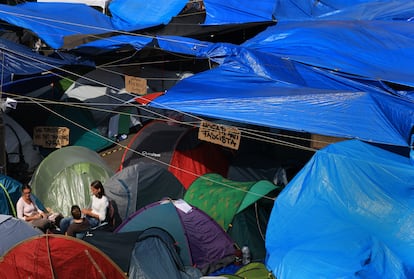

It’s Friday night in Madrid. Walking down Preciados street towards Sol square, the tents and the huge banners announcing the protest encampment can already be seen some distance away. Suddenly, a voice cries out amid the crowds from an indeterminate spot on the street. It belongs to an old man with white hair, his nose and chin almost touching. His name is Héctor, he is Ecuadorian, he is going hoarse, and he deserves some credit for what he is attempting to do: standing next to the epicenter of Spain’s mass protests for decent housing, with a country convulsed and fed up with prohibitive prices and home evictions, Héctor is preaching the end of the world and urging people to return to God. “What do you think of what’s happening over there, in Sol?” the reporter asks, pointing to the packed square. Héctor, escorted by a woman named Noemí, approaches and whispers mysteriously: “The final times are always dangerous times. Uncivilized times.” He then asks Noemí to show the reporter some texts from Timothy. “The first thing people must do is repent and return to God,” he concludes. He says goodbye with a smile and goes back to his shouting.
It is impossible to walk in Sol. The few inner aisles left between the tents are cordoned off for cleaning, and rivers of people flow around the protest encampment. There are reporters doing live broadcasts, demonstrators crowding around the sculpture of the bear and the strawberry tree (the symbol of Madrid); and above all, a huge number of people have come to take photos and record with their phones in a mix of excitement and curiosity. Many signs ask that no images be taken. “We don’t want the protest to become just another tourist attraction in Madrid,” says Óscar, 24. “We’re very attractive but not a tourist attraction,” reads a placard facing the Madrid regional government building. But the reservations are not entirely justified. Sol has been the epicenter for days of something so big that its tremors not only reached Congress with unprecedented urgency, but have even led to the announcement of early elections, now set for late November instead of summer of 2027. Anyone passing through Madrid or living here wants to take a memento.
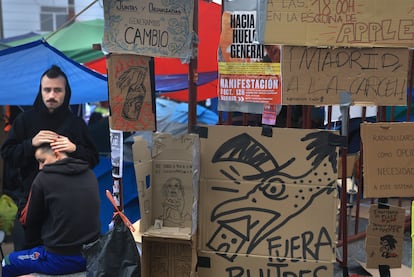
This labyrinthine city built in a few hours, with its streets and squares, its spontaneous assemblies, its health and care units and even a materials depot, has turned a crisis that until now was statistical — an emergency voiced only rhetorically from political pulpits — into a conflict that has exploded across the country after the eviction of Maricarmen Abascal.
In recent years dozens of listings demanding steep rent for squalid apartments or outright hovels — places where you literally cannot stand upright — have gone viral; humor has channeled this reality brilliantly, using sarcasm as protest. But what happened after September 26 was a “no more laughing” moment. Something broke. In 2025, 44.3% of Spaniards aged 26 to 34 were still living with their parents and, among these, 47.3% said the main reason was that they could not afford to buy or rent their own place. Of all Spaniards who had looked for a home but failed to move out, 67.2% cited price as the main obstacle.
So an 87-year-old woman evicted from the apartment where she had lived for more than seven decades has functioned as what sociologists call a moral shock — an individual case that suddenly makes a collective grievance visible. The nervousness among those who do not want anything to change for interests that time will reveal is such that in recent days they have taken to warning about Maricarmen Abascal’s “bad character,” according to her former landlords — well, good heavens, a bad neighbor! — as if the people camping in Sol were demanding that housing be a right only for nice people, or rather, for those whom landlords consider to be upstanding citizens.
At Plaza de la Perra, next to the tobacco shop in the middle of Sol that is still holding on (“business has dropped, of course; you have to make your way through all this to reach it,” says the employee), Manuel, Lucía and Gaspar are busy. A small sign demands silence between midnight and 8.00 am, because being rested “is essential for the struggle.” Manuel is 22, he balances his studies with his job and lives with his parents. He has no idea when he will be able to move out: he sleeps in Sol these days to start gaining his independence; he is protesting and camping out so his generation can have housing too. Gaspar is 19 and lives with his mother — “a single-mother family,” he says. Lucía, 22, has just graduated and lives with her parents. The three knew each other before and, with a larger group of friends, have been camping out in Sol. Manuel, Lucía and Gaspar are working in a kind of improvised depot with ropes, scissors, tape and cardboard. They are repairing several signs that were damaged by the rain. They are aware that the government’s proposed housing decrees did not make it through parliament, and vowed to “stay here until we win.”
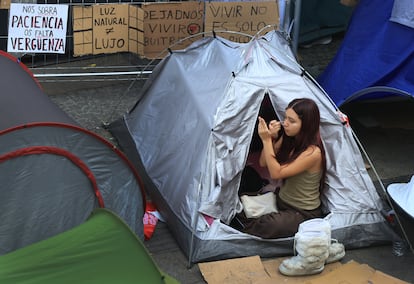
A correspondent from Portugal’s public television network goes live just as several activists are politely asking tourists to step back. “We are not fairground monkeys,” says one. If in 2011 the Indignados movement occupied Sol questioning everything (democracy, banks, employment), in 2026 people have returned to the same place with a very specific target: housing. Perhaps because of the rapid and effective mobilization, and the widespread exhaustion detected across many layers of the population, not just young people, the government took just three days to put two decrees to a vote. Sol — the microcosm of protest — has shown it can set laws on the table, but not pass them.
Olalla and Martina, two young women who share an apartment, do not believe that the Sol protest will have been for nothing despite the legal setback. “There is a collective awareness,” says Martina, a student. “Before this, not finding an apartment was a problem you dealt with alone: I don’t earn enough, I chose the wrong profession, I should move farther away, I should share with roommates. But an encampment, with people supporting each other, working together and protesting together, creates a lot of force.”
This is exactly one of the roles of social movements. The numbers explain why: the Bank of Spain estimates that 32.5% of Spanish households renting at market rates spend more than 30% of their net income on rent; among those under 35, the share is 34.2%. In Madrid it reaches 41.3%, Barcelona 43.5%, Seville 46.8% and Málaga 46.7%. And there is a delicate generational reality to digest: you can now be in a precarious position despite having a job. In 2011 the protest symbol for the Indignados movement was largely a young person unable to find a job after the financial disaster of 2008. In 2026, many of the protesters already have jobs, but it is of little help. According to the Bank of Spain, two young people with similar incomes who wanted to move in together would have to devote on average 36.5% of their net income to rent, and that percentage shoots to nearly 50% in Madrid, Málaga, Barcelona and Valencia. This reality changes the traditional idea of upward mobility: having a job no longer automatically guarantees the gateway to adult life.
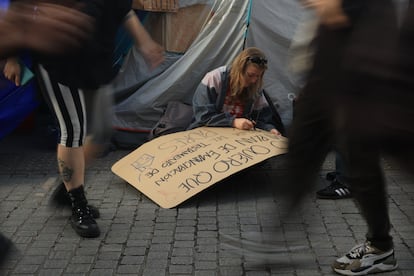
Adult life, in fact, is an increasingly distant dream. In 2011 the system as a whole was being discussed; now the conversation is about one door, a set of keys, a room, a landlord and a bank transfer at the start of the month. It is about leaving your parents’ home, about not being forced to return to their house after a breakup, about having children without first having to create a spreadsheet analyzing the expenses. Housing, which for years was an economic debate, is now a biographical debate in Spain.
An hour and a half later, Héctor is still announcing the end of the world on the margins of Sol, urging people to repent and return to God. A few meters away, Manuel, Lucía and Gaspar are taping the street names of their small provisional city back together. They are drinking a lot of beer. Someone goes into a tent to sleep.
The late Pitita Ridruejo, a member of Spain’s high society who made headlines in the 1980s for claiming to have visions of the Virgin Mary, once famously said that it wasn’t in many people’s best interest for the Apocalypse to come. It is indeed likely that some people would find it rather inconvenient. But what is certain is that, if the end must finally come, everyone would prefer to receive it inside their own house, sitting on their own sofa or looking out from their own window.
Sign up for our weekly newsletter to get more English-language news coverage from EL PAÍS USA Edition









































