
Colombia and Ecuador forge alliance to crack down on Ecuadorian criminals hiding across the border
The two governments are focusing on crime bosses who have reinvented themselves under assumed identities and low-profile lifestyles
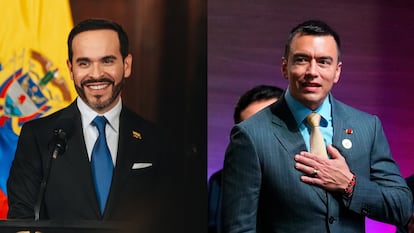
A development that passed largely unnoticed in Colombia has generated major attention in Ecuador. Authorities last week announced the arrest of Inda Mariela Peñarrieta Tuárez and Michelle Macías Peñarrieta, the wife and daughter of José Adolfo Macías, alias “Fito,” the leader of the Los Choneros gang, who is currently imprisoned in the United States. Colombian President Abelardo de la Espriella welcomed the arrests and said he would “gladly” send the two women to his “friend” Daniel Noboa. “That’s how it’s done, Abelardo,” the Ecuadorian president replied.
The cooperation between the two South American countries is particularly significant given that, in recent years, Colombia has become something of a rear base for Ecuadorian criminal organizations.
Michelle had been posing as Paola Zapata. Using a fake Colombian identity card, she sought to live an inconspicuous life in the small town of Sabana de Torres, in the department of Santander, more than 600 miles from Ecuador’s border. Her true identity was uncovered when Colombian police, in an operation coordinated with the FBI and Ecuadorian authorities, raided the house where she was living with her mother.
Both women were the subject of Interpol red notices in connection with a money-laundering investigation being conducted by Ecuadorian prosecutors into the family network of Fito. According to the Attorney General’s Office, they moved around $25 million through a network of companies.
John Reimberg, Ecuador’s interior minister, said the mother and daughter had taken refuge in Colombia under the “protection of irregular groups.” He linked that alleged protection to the ties that Los Choneros have established in Colombia through their criminal activities. Authorities say several investigations have shown that Ecuadorian criminal gangs have forged alliances with Colombian groups, including the Clan del Golfo (The Gulf Clan) and various dissident factions of the former Revolutionary Armed Forces of Colombia (FARC).
Así se trabaja, Abelardo: juntos y con resultados. Las capturamos en Colombia y enfrentarán a la justicia en Ecuador.
— Daniel Noboa Azin (@DanielNoboaOk) September 27, 2026
Ellas están llamadas a juicio por lavado de activos para los choneros. El dinero que compra armas, paga sicarios y sostiene extorsiones. Es la estructura con la… https://t.co/MY0VxYr6Pj
The arrest of the two women was the first joint operation carried out by the governments of Noboa and De la Espriella, two leaders who have pledged to intensify the fight against drug-trafficking networks and have shown a strong affinity on security matters.
In a recent interview with Caracol Radio, the Ecuadorian president said that, since the criminal lawyer took office on August 7, relations between the two countries had become “very different” and that there was now “real security cooperation” with Colombia. “We are going after the criminals. We are going after the people who do so much harm to our families,” he added.
The two leaders have also aligned their countries with the Shield of the Americas, a coalition promoted by U.S. President Donald Trump to combat transnational crime across the region. Under that framework, they have strengthened joint operations.
The new relationship marks a complete break from the one Noboa maintained with former Colombian president Gustavo Petro. In January, Ecuador launched a trade dispute with Colombia, accusing Petro’s government of failing to cooperate on bilateral security. Noboa only backed down after speaking with then-presidential candidate De la Espriella, who promised to implement a tough-on-crime agenda if elected.
Even so, many of the recent arrests of Ecuadorian crime bosses in Colombia took place during Petro’s administration. Colombian and Ecuadorian police, working alongside Interpol, the FBI and other agencies, conducted a series of operations to track down Ecuadorian fugitives who had crossed the border.
In October 2025, authorities arrested Ronald Javier Macías Villamar, alias “Fede,” Fito’s successor, in Medellín. The then leader of Los Choneros had apparently been living openly in Antioquia’s capital, concealed behind a false identity and protected by a large security detail. He had arrived there after escaping from the Litoral Penitentiary, one of Ecuador’s most dangerous prisons.
Months later, in June, police arrested Ronald Javier Macías Villamar “Javi,” Fito’s brother, in Bogotá. Authorities said they had known for around 18 months that he was in Colombia and was moving freely between the two countries. Reimberg accused Petro of allowing Ecuadorian criminals to find refuge across the border: “The Colombian police are world-class, but often political decisions do not support this kind of operation against criminal groups. Criminals fleeing Ecuador seek protection in Colombia. If they did not find guarantees there to remain hidden, they would have looked for another destination.”
Kingpins with false identities
They are far from the only Ecuadorian criminals to have taken refuge in Colombia. Ángel Aguilar Morales, alias “Lobo Menor,” one of the alleged masterminds behind the assassination of presidential candidate Fernando Villavicencio, lived in Medellín for several years. He bought property and vehicles and built a life in Colombia under a false identity before eventually being arrested in Mexico in March.
The list also includes Juan David Cabezas Ruano, alias “Ruano,” the alleged leader of the gang La Siate, whom Ecuadorian authorities have linked to a dissident FARC faction. Tracked down in the Colombian city of Tumaco on May 27, he was handed over to Ecuador that same night. A few weeks later, another familiar name surfaced: Galo Javier Suárez Román, alias “Gato Negro,” the second-in-command of the Los Tiguerones criminal organization. He was arrested in Colombia on June 30 and was back in Guayaquil by July 3.
Perhaps the clearest illustration of the phenomenon is the case of Wilmer Chavarría, alias “Pipo,” leader of Los Lobos and also implicated in Villavicencio’s murder. Pipo not only hid in Colombia but created an entirely new identity. After faking his death in Ecuador, he began using the name Danilo Ramón Fernández Calderón, an identity linked to a Venezuelan-born individual. He obtained Colombian documents in August 2021 and used a Colombian passport to travel from Medellín to Spain in April 2022. There, he continued living under another false identity until his arrest in November 2025.
His journey illustrates Colombia’s particular role in the escape routes used by Ecuadorian criminals. It is not merely a place where they cross the border to hide, but a country where they can establish new identities, secure protection from Colombian criminal organizations and use it as a springboard to move on to other destinations.
The new alliance between Quito and Bogotá is aimed at curbing a pattern that has become increasingly visible in recent years. And De la Espriella and Noboa are not the only leaders interested in the effort. Washington is also watching closely, given the strategic importance of a border region that has become one of the main drug-trafficking corridors to the Pacific Ocean.
It was precisely this area that the head of the US Southern Command visited in early September during a trilateral meeting at which the three countries agreed to strengthen their military presence and deepen intelligence cooperation in the fight against drug cartels. Colombian and Ecuadorian media later reported, citing anonymous sources, that officials had even discussed the possibility of creating a joint Colombian-Ecuadorian military base.
Fito’s wife and daughter have been back in Ecuador since Tuesday after their failed attempt to disappear from the radar of law enforcement. The two governments have hailed the operation as a symbol of their increasingly close security partnership. “International cooperation continues to strike at organized crime and its financial networks. It is only a matter of time: everyone falls,” Reimberg said after their extradition.
Sign up for our weekly newsletter to get more English-language news coverage from EL PAÍS USA Edition









































