
US launches new military alliance with Colombia focused on Pacific narco-boats and the border with Ecuador
The head of Southern Command visited the country to formalize the renewed cooperation between Washington and the government of Abelardo de la Espriella
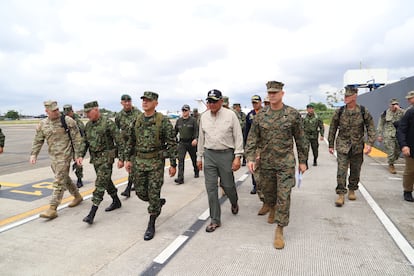

The strengthening of military cooperation between Colombia and the United States is advancing at a rapid pace. Two weeks after the government of Abelardo de la Espriella joined the Shield of the Americas, the anti-narcotics coalition founded by Donald Trump, a joint agenda is already being formalized to tackle the country’s drug trafficking networks. One of the highest-ranking U.S. military officers visited Colombia last week and prioritized operations on the border with Ecuador, surveillance over the Pacific — the main trafficking route for drugs exported northward — and the rehabilitation of the aerial fleet.
Gen. Francis L. Donovan, head of U.S. Southern Command (SOUTHCOM), was in Colombia last Thursday and Friday and met with Defense Minister Jorge Mora. “Commander Donovan’s visit reaffirms the commitment to continue working together against narcoterrorists, the cartels, and all criminal organizations that seek to sow violence,” the Colombian official said of the U.S. military visit. SOUTHCOM’s official account highlighted the importance of “strengthening its military relationship with a vital, long-standing security partner.”
A central focus for the command was Donovan’s visit to southwestern Colombia. The senior U.S. officer traveled to Tumaco, a city on the Pacific coast that has become one of the main maritime exit points for drug trafficking. Its strategic location has turned it into an area with a heavy presence of armed groups, including the ELN, the Gulf Clan and FARC dissidents, all organizations Washington has declared terrorist.
From there, officials discussed the possibility of moving radars to detect boats used in drug trafficking, according to a report by Colombian newspaper El Tiempo published Tuesday. “Placing those systems in Tumaco would allow the tracking of movements of semi-submersibles and speedboats from an area used as a departure point for drug shipments and provide information to Colombian units,” a source quoted by the paper said.
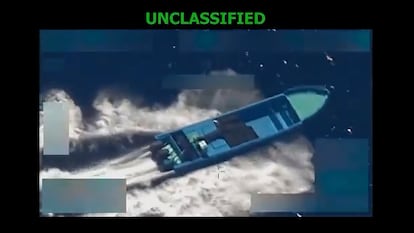
In the past year, Washington has launched 68 strikes against alleged narco-boats in the Pacific and the Caribbean, killing 227 people, according to an updated tally by The New York Times. Although Trump says this is one of the best strategies to curb regional drug trafficking, human rights groups have described the actions as “extrajudicial executions.” The most recent strike against a vessel occurred on August 26 in the Caribbean, killing four crew members.
Maritime surveillance is only one element of the agenda the White House wants to implement in the region. Donovan also visited San Lorenzo, a town in Ecuador near the Colombian border. There he took part in a tripartite meeting that included Ecuador’s defense minister, Gian Carlo Loffredo. The countries agreed to strengthen military presence in the area and deepen intelligence cooperation to dismantle the cartels.
“The border region between southwest Colombia and northwest Ecuador is a major corridor for cocaine trafficking by some of the world’s most violent organizations. Today in the heart of that region, top Americas Counter Cartel Coalition leaders stood with elite forces in San Lorenzo, Ecuador, to sharpen a joint strategy to target cartel operations and leadership,” SOUTHCOM posted on X. In addition to these informal announcements, Ecuadorian newspaper Expreso reported that the three-way meeting weighed the idea of creating a binational military base between Colombia and Ecuador.
De la Espriella, who took office less than a month ago, has prioritized military cooperation with other countries in his security strategy. On one hand, he has held several conversations with Ecuadorian President Daniel Noboa, who shares his hardline view toward armed groups. On the other, he has fully restored military cooperation with Washington, which was severely strained during Gustavo Petro’s government, often at odds with Trump. The new administration’s closeness to the White House is such that, according to U.S. Defense Secretary Pete Hegseth, Bogotá authorized joint military operations on Colombian soil. The decision has not been confirmed by Colombian authorities.
Colombia is the world’s largest producer of cocaine; and the United States is its largest consumer. If these operations go into effect, the cooperation pact would give De la Espriella access to one of the world’s most powerful militaries and its intelligence apparatus to fight around 30 armed groups and their more than 20,000 members across the country. At the same time, it opens the door for Trump to deepen his hardline strategy against drug trafficking in one of Latin America’s most strategically important states.
A restoration of the aerial fleet
Donovan concluded his visit at Tolemaida Military Fort, the most important military base in central Colombia. Another item on his agenda was the rehabilitation of the military air fleet. According to figures received by the current government during the transition period, dozens of aircraft are not operational, including 11 of the 19 MI-17 helicopters in the armed forces’ inventory.
In that context, SOUTHCOM announced Tuesday its participation in a joint operation led by the Colombian Air Force that resulted in the interception of 4.5 tons of cocaine, two fast boats, three high-speed vessels and the arrest of eight people. “The Americas Counter Cartel Coalition (AC3) is taking decisive action to defeat cartels and narco-terrorists in the Western Hemisphere,” it wrote on X.
Trump has found in De la Espriella a friendly president with whom to expand his military influence in the region, while the Colombian leader seeks to solidify this cooperation to fulfill his promise of tough, swift security measures.
Sign up for our weekly newsletter to get more English-language news coverage from EL PAÍS USA Edition









































