
Drug traffickers profit from end of intelligence cooperation between Colombia and the US
Gustavo Petro has suspended the sending of confidential information to the Donald Trump administration, but Washington was already offering little cooperation to Bogotá and other key allies
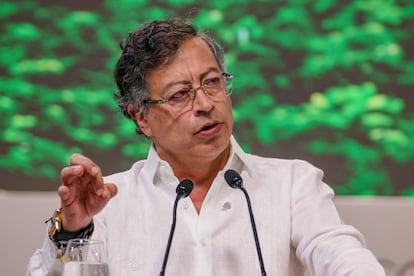

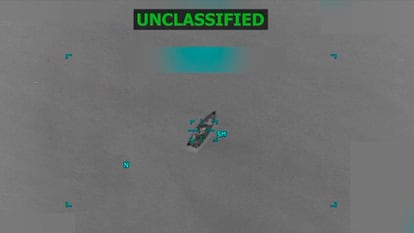
Colombian President Gustavo Petro ordered Colombian intelligence services to suspend the transfer of information to U.S. agencies on Tuesday night, ending decades of bilateral cooperation through a publication on X. “This measure will remain in effect as long as the missile attacks on boats in the Caribbean continue,” he explained. The news has not yet received a response from President Donald Trump or his Secretary of State, Marco Rubio, but the reduction in intelligence cooperation is not unique to Colombia. In recent days, both the United Kingdom and the Netherlands, which do not have such a tense relationship with the White House but do have territories in the Caribbean, have also limited the intelligence they send to Washington. According to CNN, the British government fears that the information they gather on their islands is being used for indiscriminate U.S. bombings. The only ones who benefit from the end of this cooperation, experts say, are those supposedly being targeted: the drug traffickers.
Elizabeth Dickinson, a researcher with the International Crisis Group, believes that if Petro doesn’t change his mind, “it would be a very strong blow against the United States, because Washington depends heavily on Colombia in the war on drugs.” She cites, for example, a figure revealed by Congressman Gregory Meeks before the U.S. House Committee on Foreign Relations, according to which 85% of the intelligence gathered at the Key West Naval and Air Base between January 2024 and June 2025 came from Colombia. This information, Dickinson explains, is usually used to intercept illegal drugs heading north. It is at this military base in South Florida that cooperation between the United States and Latin America in the fight against drug trafficking is coordinated.
“It would be a reciprocal blow, because for several weeks now the United States has not been sharing military intelligence, not only with Colombia, but also with other NATO allies in Europe,” Dickinson explains. Despite Washington’s large military deployment in the Caribbean Sea, these allies have not received information about Trump’s plans in the region. If he plans to attack Venezuela, for example, should the allies evacuate their diplomatic or consular staff from Caracas? Washington offers no answer. “I think the countries that are cutting off their intelligence assistance are reminding the United States that this has to be reciprocal,” the analyst adds.
Retired Vice Admiral Paulo Guevara also believes that both countries are losing valuable information. “The biggest beneficiaries are the drug traffickers,” he states. “Drug trafficking affects many countries; it’s complex, variable, and involves millions of dollars. That’s why the best tool for combating drug trafficking has been international cooperation. For example, if Colombia shares information about a ship heading to the United States, Washington alerts Mexico, and they intercept it off the Mexican coast,” he explains.
On the other hand, the officer adds, information from the United States has been crucial for Colombia to understand drug trafficking networks within its borders. “When a captured drug trafficker cooperates with the justice system, they are interviewed. That information is very useful to us here,” he explains. The officer laments that the Egmont Group, a system that allows countries to share information on money laundering and how transnational crime moves its assets, suspended Colombia in 2024 after Petro revealed confidential information about a purchase of the Pegasus software during the previous administration.
“The United States is losing an ally of 40 years that provides it with a great deal of intelligence, but the consequences for Colombia are truly disastrous, because we will be left without resources for the fight against drug trafficking. A large part of our intelligence is financed with American aid,” the vice admiral added.
An official who worked closely with Colombian intelligence services, but who cannot reveal his name, points out that Colombia’s weakest point lies in the cutting-edge technology the South American country has acquired in recent years, which it would be unable to maintain without U.S. support. “U.S. intelligence agencies have always been leaders in advanced technology, such as satellites or communications interception, much more so than in human intelligence,” he maintains.
“With Colombia, cooperation began to grow in the 1990s, and a large part of our military and intelligence apparatus, as a middle-income country, would not have been able to access all the information gathered without that technology. We didn’t have the budgetary or technical capacity to develop that technology locally,” he asserts. With it, they were able not only to track the movement of small planes or boats carrying drugs, but also to gather early warnings about operations by the former FARC guerrillas. “But these technologies become obsolete quickly, so you have to constantly modernize them, and that’s only possible if you maintain good coordination with the United States,” the expert adds.
That synchronicity, with Trump and Petro, is utopian. The former has labeled the latter a member of the drug trade and has decertified Colombia’s work in the war on drugs. The Colombian president has responded with decisions such as ending intelligence cooperation. In the end, both governments will lose the information they had been building about the power and routes of drug trafficking. And in that ignorance, the only winners are the drug traffickers.
Sign up for our weekly newsletter to get more English-language news coverage from EL PAÍS USA Edition









































