
Maduro raises military alert in Venezuela amid escalating tensions with the United States
The decision, effective this Tuesday and Wednesday, coincides with the arrival in Caribbean waters of the ‘USS Gerald Ford,’ the most advanced aircraft carrier in the US fleet
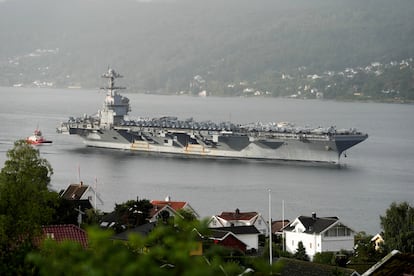
Venezuelan Defense Minister Vladimir Padrino López has issued a statement reporting that military alert levels in the country have been raised. According to the note, this is in compliance with “orders issued by citizen Nicolás Maduro Moros, constitutional president of the Bolivarian Republic and commander-in-chief.” Padrino’s announcement, according to the statement, implements “a higher phase” of the so-called “Independence Plan 200,” a military response mechanism ordered in September to strengthen defense measures against the U.S. military presence in the Caribbean.
The decision escalates political and military tensions between the United States and Venezuela. As Caracas made the announcement, the USS Gerald Ford — the largest and most advanced of America’s aircraft carriers — arrived in Latin America. The Pentagon confirmed the deployment, saying without specifying its location that the ship will help “disrupt narcotics trafficking and degrade and dismantle Transnational Criminal Organizations.” The U.S. military has so far carried out at least 19 strikes against suspected drug-smuggling vessels in the Caribbean and along Latin America’s Pacific coast, killing at least 76 people.
The measure will take effect between Tuesday, November 11, and Wednesday, November 12, and involves “placing the entire country’s military arsenal on full operational readiness,” as well as the massive deployment of “land, air, naval, riverine, and missile assets; weapons systems; military units; the Bolivarian Militia; Citizen Security Organs; and the Comprehensive Defense Commands.”
The Venezuelan government is calling for the plan to be carried out following one of the organizational maxims of the Maduro regime: “in perfect civil-military-police fusion.” During the announcement, Padrino — speaking on behalf of the country’s military leadership — said that the divisions of the Bolivarian National Armed Forces (FANB) are “stronger than ever in their unity, moral cohesion, and equipment, together with the Venezuelan people, to preserve the country’s sacred interests at all costs.”
Contrary to some predictions to the contrary, throughout 2024 — an election year — and in 2025, when Maduro resumed his functions as president, Venezuelan military forces have repeatedly demonstrated their full allegiance to the interests, narrative, and political objectives of Chavismo, the term used to describe the political strategies, leadership, and policies of former president Hugo Chávez and his successor.
Although the country’s internal situation appears calm — and disbelief persists among many — top Chavista leaders frequently warn in public statements about the possibility of a U.S. military attack on Venezuela.
The ruling United Socialist Party of Venezuela (PSUV) agreed at an extraordinary assembly to move to “an armed phase of the revolutionary process” in the event that hostilities break out. These types of warnings, interspersed with constant calls for peace, have become increasingly frequent in statements by Chavista revolutionary leaders in recent weeks.
A few days ago, Maduro declared in a political meeting with his supporters in the labor movement that “the order has been given: if an attack is made against the country, we will declare a general, insurrectional, and revolutionary strike.” On that occasion, the Venezuelan president stated that the working class “is Venezuela’s greatest shield against imperialist aggression.”
Sign up for our weekly newsletter to get more English-language news coverage from EL PAÍS USA Edition









































