
Maduro warns that he has 5,000 anti-aircraft missiles to ‘guarantee peace’
Caracas expands its military deployment while US attacks against alleged drug boats intensify
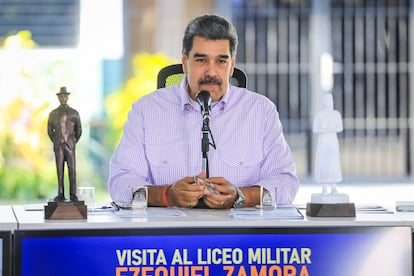

Warlike rhetoric and geopolitical tensions are taking on a new dimension in Venezuela. Nicolás Maduro warned Wednesday that the National Bolivarian Armed Forces have more than 5,000 Igla-S missiles in their anti-aircraft defense systems, as part of the equipment with which Caracas is confronting the U.S. military threat. Washington has maintained a naval deployment in the Caribbean for the past two months, which Chavismo has interpreted as a maneuver to force a change of government in Venezuela, although the White House maintains that it is part of its fight against drug trafficking.
“Any military force in the world knows the power of the Igla-S. Venezuela has no fewer than 5,000 of them in key anti-aircraft defense positions to guarantee peace, stability, and tranquility,” Maduro said in a television appearance. “Whoever understands, understands.” The Chavista leader noted that Venezuela also has “simulation equipment” that puts “thousands of Igla-S operators in a position of good aim,” and that these are deployed “even on the last mountain, in the last town, and in the last city in the national territory.” “Venezuela must be an impregnable homeland,” Maduro stated. “Let no one mess with Venezuela, because we don’t mess with anyone.”
The Igla-S is a portable anti-aircraft defense system designed to shoot down airplanes, helicopters, and drones at low altitude. The missile has already been used in military exercises ordered by Maduro in response to the U.S. deployment. On Wednesday, U.S. President Donald Trump said that if he decides to extend his anti-drug trafficking operations to land, he will notify Congress because it is a “national security” issue. On the same day, the U.S. military destroyed two more alleged drug-running boats in the Pacific, at least one of them off the Colombian coast. “Attacks on Colombia are attacks on Venezuela,” Interior Minister Diosdado Cabello declared shortly afterward on his television program.
The U.S. Department of Defense confirmed the eighth attack against suspected drug boats, and the first in the Pacific, since Washington launched its anti-drug operation in the Caribbean in late August, which had mostly been staged near Venezuelan waters. Over the past two months, Venezuela has ramped up its military exercises, while Washington has also issued threats against the Chavista government. Caracas has deployed troops along the border and ordered maneuvers across the country. It has also called for the voluntary enlistment of civilians and provided tactical and weapons training to members of the militia.
These exercises are being broadcast on state media, creating a pre-conflict atmosphere. The increase in diplomatic tensions is occurring while the two countries are attempting to maintain deportation flights. According to the Maduro government, 15,000 Venezuelans have returned since February on 78 flights. This Wednesday, another plane landed at the Maiquetía airport carrying 208 migrants expelled from the United States. Chavismo remains on alert. This week, Maduro ordered the creation of a digital application for citizens to report suspicious activity or people as part of a national defense system. The Chavista leader has asked the population to report through this channel “everything they see and hear, 24 hours a day.”
With this measure, the regime is strengthening what it calls “popular intelligence,” a system of citizen surveillance that has been the basis of the security forces’ repressive policies against government opponents for many years. Maduro has signed a decree of external unrest, which entails the activation of extraordinary national security measures that would be triggered in the event of a direct attack.
Earlier this month, Defense Minister Vladimir Padrino López told Venezuelans to prepare “for the worst,” alluding to what he called a “serious threat” posed by Trump. Padrino listed the scenarios that could occur in the event of a direct U.S. attack on Venezuela: “Aerial bombings that would cross the sky like lightning, naval blockades that would stifle commerce, stealthy commando raids in the jungle or on the beaches, swarms of drones, no-fly zones, surgical executions against leaders, and sabotage that would leave the country in darkness.” To this end, military deployment has been intensified throughout the country.
Sign up for our weekly newsletter to get more English-language news coverage from EL PAÍS USA Edition









































