
Nicolás Maduro, besieged but unshakable
The Venezuelan leader is digging in his heels. There are no signs of internal cracks despite escalating US military pressure
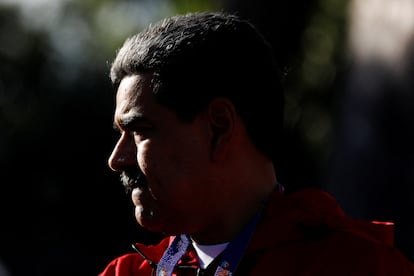
Though surrounded, it is holding firm. The Chavista regime — the political system founded by former Venezuelan president Hugo Chávez — remains immovable, pressuring anyone who challenges it, punishing its enemies, suppressing dissent without mercy. Each day, it offers new evidence that it controls Venezuela’s political and military situation, despite the escalating tensions with the United States. And its leader, Nicolás Maduro, remains at the helm.
The hold that the so-called Bolivarian Revolution has over society today has not been seen for decades. Censorship thresholds are increasingly narrow. The official narrative dominates all spheres of public life, and the intelligence apparatus is deployed everywhere. One must be careful about what is said in private conversations or on WhatsApp, while discussions in public — particularly loud complaints — are no longer as safe as they once were. And opposition leader María Corina Machado, recently recognized with the Nobel Peace Prize, has become an off-limits topic.
Maduro is unpopular, as is his government, but he is holding firm, on high alert, and constantly producing anti-imperialist propaganda. At the same time, he frequently engages civil society to display signs of grandeur. In recent weeks, the president has held multiple cultural and musical events with peace as the central theme, in an effort to project a reasonable and humanistic image.
Meanwhile, the opposition party Vente Venezuela, founded by Machado, denounced last week that the “wave of repression” unleashed by state security forces “has led to at least 30 arbitrary arrests and multiple raids,” referring to the arbitrary searches of private homes. A statement from the party added that these operations are being conducted “violently and without a court order.”
The Chavista political class lives in a state of permanent psychological terror and feels threatened by Washington, which has already attacked at least six vessels allegedly carrying drugs in the Caribbean. Maduro’s decisions reveal a genuine concern over the military crisis and a lack of foresight regarding U.S. President Donald Trump’s moves. Added to this are multiple governance problems; public frustration is evident, and critical assessments abound, even within the ruling ranks. Yet nothing indicates serious fissures at the top.
“Today, in the high political-military command of the revolution, we are more united and determined than ever to defend our homeland, idiots,” Maduro, Hugo Chávez’s successor, declared last week on television, responding to claims — reported by U.S. media — that suggested divisions among the government’s top officials.
That, of course, doesn’t mean the situation is not tense. As the days pass, the Chavista leader has focused almost exclusively on holding his ground. “Maduro isn’t going anywhere. That’s certain,” sources familiar with the internal workings of the government told EL PAÍS a few days ago.
Maduro has ordered his supporters to mobilize and deployed military units along the country’s coast and borders. Venezuela’s cities have been filled with police. At the same time, Maduro has increased his public presence. He inaugurates hospitals, meets with elderly citizens, participates in events with party militants, and at the end of each day, the regime links radio and television broadcasts to replay the day’s events: the president visits social housing, talks with collaborators, or meets with community groups, alternating between good humor and warnings.
One day after declaring a state of emergency for external disturbance in response to the threat of U.S. military action, Maduro also declared the start of Christmas, effectively bringing forward public celebrations, holidays, and a festive atmosphere. “Everyone, let’s party,” he said on television. “Party, party, and party,” he exhorted.
In this way, he prolongs, in some sense, the momentum that keeps him in power. This is a capacity even recognized by his political opponents. Since his first year in office, when he succeeded Chávez after his death in March 2013, he has managed to maintain control of the internal situation in every crisis. And he has done so despite enormous pressure: cycles of massive protests, failed insurrectional actions, international negotiations, sanctions, the collapse of a broken economy, international rejection, and the near-total loss of the political support that Chavismo once commanded when it held the majority in Venezuela.
Today the challenge is enormous. Diplomatic and military tensions with the United States worsen by the day, and the potential consequences of any escalation are unpredictable. The widespread belief among the population is that a poorly measured U.S. ground offensive could trigger violence on an unprecedented scale — and almost certainly very difficult to control.
In this context, Maduro maintains absolute control over Venezuela’s security forces, which have significantly expanded in recent years. Key personnel remain loyal to him, and, as in other critical moments for the regime, the Armed Forces — commanded by Defense Minister Vladimir Padrino López — are keeping him in power. At present, there is no hint of unrest within the military ranks.
“[Maduro’s] offered everything,” Trump said on Thursday. “Because he doesn’t want to fuck around with the United States.” But to add more layers to the tension, he added: “We attacked a submarine, and that was a drug-carrying submarine built specifically for the transportation of massive amounts of drugs. This was not an innocent group of people.”
Two survivors were among the crew members: a Colombian citizen and an Ecuadorian national, who were detained and will be repatriated.
In this context, Maduro has also shown a more cautious side in recent weeks. His insults in response to Washington’s moves have been carefully directed, always targeting Secretary of State Marco Rubio and the chorus of Republican senators amplifying the U.S. campaign of pressure on the Venezuelan regime. He has even called on the international community — which he disdains — to intervene in the situation. This includes the United Nations, with which Maduro has a tense relationship due to its human rights complaints against his government, and the Vatican.
In early October, when five U.S. fighter jets approached within 46 miles of the Venezuelan coast, Maduro issued a statement targeting Secretary of War Pete Hegseth. Interestingly, for Trump, who put a target on Maduro’s back, the Venezuelan leader has even offered some praise. He appeared to leave the door open for negotiations with Washington, consistently framing his goal as peace. Yet he has made it clear he will not relinquish power.
Sign up for our weekly newsletter to get more English-language news coverage from EL PAÍS USA Edition









































