
Maduro launches app for Venezuelans to report ‘everything they see and hear’
The measure is intended to strengthen state surveillance and ensure that citizens report any incidents to the authorities
Venezuelan President Nicolás Maduro has ordered the Bolivarian National Armed Forces (FANB) to create a new cell phone app that will allow citizens to report to authorities “everything they see and everything they hear, 24 hours a day.” The stated goal of the initiative, he said, is to “strengthen popular intelligence” and “continue guaranteeing peace.”
Maduro added that the plan to expand this network of informants — announced amid the escalating political tensions with the United States, which has the Chavista government increasingly focused on national security — should be supported by the organizational mechanisms the military already has within the government’s structure.
“The VenApp system [an application created by the Maduro administration that allows citizens to report public service problems and has a phone line for filing complaints] must proceed to facilitate this mechanism, a new application, together with the Bolivarian National Armed Forces, the Communal Militia Units, and the Popular Bases of Integral Defense, integrated into the National Territorial Defense System,” said Maduro, who has tightened his grip on power as tensions with Washington escalate
As diplomatic and military tensions with the United States overshadow the country’s daily life, the Venezuelan regime has increasingly focused on reinforcing its already tight political and social control over Venezuela’s population.
Shortly before Maduro’s announcement, the minister of interior and justice — and the government’s number two — Diosdado Cabello, unveiled plans for the mass installation of surveillance cameras “to strengthen public security.” The initiative is part of the so-called “Peace Quadrants.” Security forces are already highly visible in Caracas and other major cities, especially late at night.
These measures could lead to the controversial Decree of External Commotion, which Maduro has already hinted could be enacted, particularly if tensions with Washington escalate or if a military action materializes.
The measure — which relies on an expansive interpretation of executive powers and lacks explicit constitutional grounds — would give the government broad authority to impose security controls and punish opposition sectors allegedly involved in “the murder of people or military actions against the homeland.”
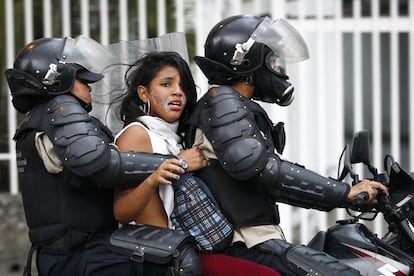
The social informant system devised by the government in its confrontations with the opposition is not new. For years, so-called “cooperating patriots” have typically been Chavista activists living in working-class neighborhoods or residential areas who report suspicious movements or denounce others’ behavior during moments of political unrest — such as the anti-government protests that erupted after the July 2024 presidential elections.
Since their creation in 2011, the “cooperating patriots” have taken on shifting levels of activity as informants. One of their main promoters has been Minister Cabello, who frequently cites anonymous tips or reports on his television programs to target political opponents.
As with many other social control mechanisms created by the ruling party that have weakened over time, there is now a clear effort to revive them and strengthen their loyalty to the Chavista cause.
Many of the more than 1,000 people imprisoned following the July 2024 presidential elections — after taking to the streets to protest the official declaration of Nicolás Maduro’s victory — were denounced by Chavista activists and “cooperating patriots.”
Sign up for our weekly newsletter to get more English-language news coverage from EL PAÍS USA Edition









































