
The United States deported migrants to Iran and Venezuela despite plans for military interventions
Since September, three deportation flights have been sent to Tehran. Meanwhile, deportations to Caracas have increased following the capture of Nicolás Maduro
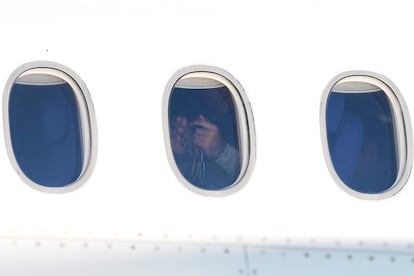

In his drive to carry out the largest deportation operation in U.S. history, U.S. President Donald Trump has not hesitated to send hundreds of thousands of migrants back to the very countries they had fled, even while knowing they could be persecuted as soon as they landed. In two cases, however, there was certainty that they were being sent into conflict zones, since the United States was planning military attacks against their governments.
On January 3, Trump ordered a military intervention in Venezuela to capture its president, Nicolás Maduro, and his wife, Cilia Flores, and on February 28, the U.S. bombed Iran alongside Israel, killing its leader Ali Khamenei and triggering a conflict that has spread across the Middle East that shows no sign of ending soon. In the months leading up to both actions, dozens of flights carrying deported migrants had landed in the two countries.
In Iran’s case, the Trump administration ended a decades‑long policy of not deporting its citizens and instead granting them asylum in the United States to prevent their return to a country with one of the world’s worst human‑rights records. On September 28, the first deportation flight in years to Tehran took place. It traveled via Qatar before landing in the Iranian capital.
It was one of the most controversial migrant transfers since Trump returned to the White House and launched his anti‑immigration crusade. On board were 120 Iranians, including three women. The danger of being in Iran had already become evident months earlier, when in June U.S. bombers and submarines attacked the Fordow uranium‑enrichment plant, the Natanz nuclear facility, and the Isfahan Nuclear Research and Technology Center. The war, which began when Israel bombed military positions in Iran, lasted 12 days.

The second flight carrying Iranians took place in December, and the third in January, both via Kuwait. The regime’s violent repression of the protests that erupted in January — which left around 30,000 dead — did not stop the White House from deciding to send its citizens back there.
“It made no sense to send them,” says Rebekah Wolf, an attorney at the American Immigration Council (AIC). “If the U.S. position is that the Iranian regime is repressive and undemocratic, the fact that we negotiated with them over our migration policy is astonishing. The idea that the United States would consider Iran a safe place to send someone clashes with the political stance toward that country over the past decades,”
Two of Wolf’s clients were on the verge of being put on those flights all three times. They arrived in the United States in January 2025 and have been detained ever since. They fled Iran because of the persecution they faced for being gay, but their asylum request in the United States was denied by an immigration judge who did not allow witnesses to be present at their hearing. They also had no legal representation.
On September 28, they boarded the plane that was to take them to Iran along with more than a hundred deportees, but the flight was commercial and the pilot, seeing their resistance, refused to transport them, according to their lawyer. Authorities attempted to deport them on the other two flights bound for Tehran as well, but due to the political and social pressure their case generated, they remain on U.S. soil while their appeals are pending. If they are deported, they face death, since belonging to the LGBTQ+ community is illegal in Iran and punishable by death.
Both obtained a temporary order preventing deportation for now. “They have an open criminal case in Iran for being gay,” says Wolf. “They will be imprisoned and executed if they are deported. This is not a guess — it is clear that this is what will happen. Every time they face imminent deportation, their mental health suffers terribly.”
The lawyer hopes that the war will halt, for now, any plans to send them back to Iran. While their cases are being decided, both are detained in Immigration and Customs Enforcement (ICE) facilities. One of them is hospitalized due to organ damage sustained when they were attacked in Mexico before crossing the border.
In the case of Venezuela, plans for military intervention did not prevent deportations to that country either before or after, except for a brief period. According to Human Rights First, as of January 20, the United States had carried out 78 flights to Venezuela, deporting nearly 15,000 Venezuelans. In January alone, after the capture of Maduro, seven flights deported 1,509 citizens to Venezuela. The country was receiving two flights per week, but they were suspended between December 10 and January 16. From that date onward, the interim government of Delcy Rodríguez has agreed to receive three flights per week.
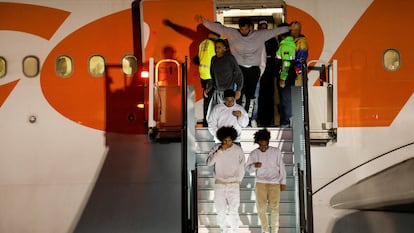
Most of the deportation flights have been direct from the United States to Simón Bolívar International Airport in Maiquetía. Beginning in February 2025, some flights were routed through the U.S. military base at Soto Cano in Honduras, but these were suspended in mid‑August 2025. If the three weekly flights become routine, the United States will deport nearly 30,000 Venezuelans this year — roughly double last year’s figure, according to migration experts. The United States and Venezuela announced last Thursday that they have restored diplomatic relations, which had been severed since 2019.
The Trump administration’s push to remove the Venezuelan community became evident when it ended Temporary Protected Status (TPS) for Venezuelans, leaving about 650,000 people without legal permission to stay in the U.S. TPS is a program that grants temporary and renewable legal status to migrants from countries experiencing armed conflict, environmental disasters, or other violent conditions.
Following the capture of Maduro and Flores, who are awaiting trial in a New York jail, politicians and migrant advocates have criticized the continued deportations. Senator Cory Booker, a Democrat from New Jersey, called it “hypocritical” that Trump ended TPS for Venezuelans who have lived in the United States for decades while simultaneously warnings Americans against traveling to the country. “This is a situation ripe for where we are being complicit in continuing human rights violations and that needs to stop.”
Sign up for our weekly newsletter to get more English-language news coverage from EL PAÍS USA Edition









































