
Maduro jailed in New York after his capture in Caracas
Trump says Washington will control Venezuela until there is ‘a safe transition,’ claiming opposition leader María Corina Machado lacks the ‘support or respect’ to assume power
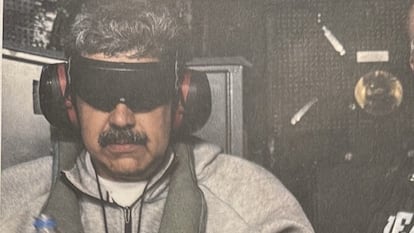
Nicolás Maduro and his wife, Cilia Flores, arrived in New York late on Saturday night, local time, and were then transferred to the Metropolitan Detention Center in Brooklyn. There they will stand trial on charges of drug trafficking and weapons possession.
A few hours earlier, U.S. President Donald Trump had threatened, in his first press conference following Maduro’s capture, a second wave of attacks if Chavismo — the government sector loyal to Maduro — offers resistance. “We will control Venezuela until there is a safe transition,” said the Republican.
Trump revealed that Venezuelan Vice President Delcy Rodríguez has made herself available to Washington and announced that U.S. companies will take over the Latin American country’s oil industry. “She’s essentially willing to do what we think is necessary to make Venezuela great again,” he said of Rodríguez. Although Rodríguez herself has come out later, demanding the liberation of Maduro and claiming the regime stands “ready to defend Venezuela, to defend our natural resources”.
Trump also claimed that opposition leader and Nobel Peace Prize winner María Corina Machado lacks the “support or respect” in Venezuela necessary to drive a political transition. Machado has promised that Maduro will answer for his “atrocious” crimes and that Washington has “fulfilled its promise to enforce the law” in the face of Maduro’s refusal to “accept a negotiated solution.” “We are prepared to take power,” the opposition leader wrote on her social media accounts.
Maduro was captured Saturday along with his wife, Cilia Flores, in a joint operation involving the U.S. military and branches of law enforcement. Speaking 10 hours after the launch of Operation Absolute Resolution, Trump said Maduro and Flores will be transferred to New York “in the near future” to stand trial for drug trafficking.
In a previous telephone interview with Fox television, Trump revealed that Maduro and his wife were captured by U.S. special forces while they were sleeping in the early hours of Saturday morning and were taken by helicopter to the U.S. warship Iwo Jima, one of the components of the flotilla deployed five months ago in international waters in the Caribbean off the coast of Venezuela.
Maduro and Flores could appear as early as next week, according to CNN, in a New York court. At the press conference in Mar-a-Lago, Secretary of State Marco Rubio reiterated that Maduro “is not the legitimate president of Venezuela” but a “fugitive from U.S. justice” for whose capture Washington was offering $50 million.
Regarding the political future of the Latin American country, Trump stated that the United States will lead Venezuela until there is a “safe, proper and judicious transition.” “We don’t want to be involved with having someone else get in, and we have the same situation that we had for the last long period of years. So we are going to run the country,” he said.
“We were prepared to do a second wave if we needed to do so — we actually assumed that a second wave would be necessary, but now it’s probably not. The first wave, if you’d like to call it that, the first attack was so successful, we probably don’t have to do a second, but we’re prepared to do a second wave, a much bigger wave, actually,” the U.S. president continued during his press conference, stressing that there were no U.S. fatalities during the operation.
Trump stated that “no nation in the world could achieve what America achieved yesterday, or frankly, in just a short period of time, all Venezuelan military capacities were rendered powerless as the men and women of our military, working with us, law enforcement, successfully captured Maduro in the dead of night.” The Chief of Staff, General Dan Caine, explained that more than 150 aircraft from 20 different military bases participated in the attack on Caracas.
The U.S. president also said Washington will assume control of the petroleum business in Venezuela, which holds the largest crude oil reserves in the world. “As everyone knows, the oil business in Venezuela has been a bust, a total bust for a long period of time,” he said. “We’re going to have our very large United States oil companies, the biggest anywhere in the world, go in, spend billions of dollars, fix the badly broken infrastructure, the oil infrastructure, and start making money for the country.”
Trump recalled the nationalization of several oil concessions in Venezuela during the Hugo Chávez era. “We built Venezuela’s oil industry with American talent, drive, skill, and the socialist regime stole it from us,” he asserted.
Maduro “captured and flown out” of country
Maduro was “captured and flown out” of Venezuela, Trump posted early Saturday on his social media platform Truth Social.
The United States carried out attacks inside Venezuela, Trump confirmed in the same message, after explosions were reported in civilian and military areas of the states of Miranda, Aragua, La Guaira, and the capital, Caracas. The Republican tycoon said he watched the operation live. “I watched it, literally, like I was watching a television show,” he said. “If you would’ve seen the speed, the violence, it was an amazing thing.”
Although the main details of the operation remain unknown, sources close to it explain that the location was tracked by the CIA. Trump had authorized the intelligence agency to carry out covert activities inside Venezuela several weeks ago.
“They just burst in, and broke into places that were not really able to be broken into, steel doors that were put there for just this reason, and they got taken out in a matter of seconds. I’ve never seen anything like it,” Trump told Fox News of the capture of the Venezuelan presidential couple.
The operation had been meticulously planned with intelligence units. Maduro suspected that an operation against him could be imminent and was obsessed with security. He had increased his protection. He moved constantly around the country, frequently changed where he slept, and regularly discarded phones to avoid being tracked.
The U.S. president gave the green light for the attacks days ago, according to government sources cited by CBS. According to this account, senior U.S. military officials considered carrying out an attack on Christmas Day but decided to prioritize military operations in Nigeria against the Islamic State.
Charges in the US
U.S. Attorney General Pam Bondi reported in a post on X that Maduro and his wife have been indicted on drugs and weapons charges in Manhattan federal court. Maduro will face the specific charges of “narco-terrorism conspiracy, cocaine importation conspiracy, possession of machineguns and destructive devices, and conspiracy to possess machineguns and destructive devices against the United States,” said Bondi. She added that they will “soon face the full wrath of American justice on American soil in American courts.”
Venezuelan Defense Minister Vladimir Padrino described the attack as “vile and cowardly” and said authorities are assessing for possible injuries or casualties. “This invasion represents the greatest outrage our country has ever suffered, driven by the insatiable greed for our strategic resources,” Padrino said in a video. “They have attacked us, but they will not break us,” he added.
Venezuelan Interior Minister Diosdado Cabello appeared on the streets of Caracas wearing a bulletproof vest and helmet, surrounded by police. “We are deployed. Trust us to get through this situation,” he said.
Shortly before 2:00 a.m., the sound of explosions woke Caracas residents as if the sky were thundering. Videos of aircraft flying overhead, along with flashes from explosions and columns of smoke, began circulating on social media. Initial reports indicate several airstrikes on the military base of Fuerte Tiuna — the main base in Caracas, located in the south of the Venezuelan capital — which has been left completely without power. A massive fire could be seen in the distance during the first minutes after the explosions, followed by an enormous cloud of gray smoke.
Attacks were also confirmed on the La Carlota air base and other military installations in Caracas, such as the Cuartel de la Montaña — where the remains of Hugo Chávez rest — as well as in Maracay and La Guaira, and at the Higuerote airport on the central coast. In videos shared by social media users, helicopters have also been seen flying over the city.
Venezuela calls for “armed struggle”
The bombings come after four months of tensions and a military escalation between Washington and Caracas. Two and a half hours after the first explosions were reported, a statement was read on state television channel VTV in which the Venezuelan government announced that it had activated a state of emergency due to external upheaval, which it had prepared for since October.
The Venezuelan government immediately called for “armed struggle” in response to the aggression by the government of the United States, the statement said.
“The entire country must mobilize to defeat this imperialist aggression,” read the statement. “The objective of this attack is none other than to seize Venezuela’s strategic resources, particularly its oil and minerals, attempting to break the nation’s political independence by force. They will not succeed.”
It continued: “The attempt to impose a colonial war to destroy the republican form of government and force a regime change, in alliance with the fascist oligarchy, will fail like all previous attempts.”
Months of tension
Trump had been threatening military action on Venezuelan territory for months, initially arguing it was to fight against drug trafficking and later seeking to take control of the Venezuelan oil sector, which he claims was illegally taken from U.S. companies and in fact belongs to Washington.
Last week, Trump said he had carried out an initial ground attack against a dock used by drug traffickers during the month of December. There is still no clear information about that operation, although U.S. media outlets have reported that the attack allegedly took place in the Alta Guajira region, on the border with Colombia. This information was also disseminated by Colombian President Gustavo Petro.
Petro, in fact, has been one of the leaders most critical of U.S. military operations in the Caribbean and the Pacific, which supposedly aim to combat drug trafficking and increase pressure on the Maduro government.
Criticism from Colombia and Cuba
The Colombian president was among the first international leaders to speak out after the attacks in Venezuela became known.
“The government of the Republic of Colombia observes with deep concern the reports of explosions and unusual aerial activity recorded in recent hours in the Bolivarian Republic of Venezuela, as well as the resulting escalation of tension in the region,” he wrote on the social network X. “The Colombian government rejects any unilateral military action that could worsen the situation or put the civilian population at risk.”
Petro also reported that his government has “put in place measures to protect the civilian population, preserve stability along the Colombian–Venezuelan border, and promptly address any potential humanitarian or migratory needs.”
In this regard, Colombia’s Minister of Defense Pedro Sánchez announced on the same social network the activation of the Unified Command Post (PMU) for humanitarian assistance in the border city of Cúcuta, as well as the implementation of the border plan “in order to assist the migrant population and provide all necessary support to those who require it.”
Meanwhile, Cuba’s president, Miguel Díaz-Canel, has “urgently” called for a reaction from the international community against what he described as a “criminal attack” by the United States on Venezuela. “Our zone of peace is being brutally assaulted. State terrorism against the brave Venezuelan people and against Our America,” he posted on his X account.
Sign up for our weekly newsletter to get more English-language news coverage from EL PAÍS USA Edition









































