
Venezuela hardens its ‘revolutionary state’ project amid pressure from Trump
The Maduro regime is tightening its legal framework, curtailing opposition activity, and imposing stricter censorship
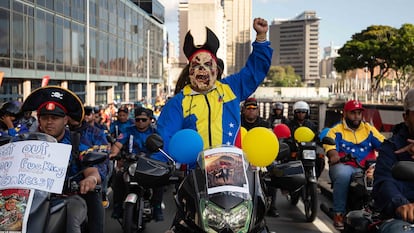
Although far from the glory of the past, Venezuelan leaders are facing the current U.S. pressure with a single goal in mind: to guarantee their continuity in power, even in the event of a military scenario. At the Miraflores Palace, President Nicolás Maduro and his collaborators not only aim to emerge unscathed from the campaign launched by U.S. President Donald Trump, but they are also working urgently to realize a long-held dream: making the Bolivarian revolution irreversible by radicalizing its foundations.
This strategic objective follows a principle that has been in place since the time of Hugo Chávez, the former president of Venezuela who gave rise to the Chavista movement. Over the past 25 years, after each confrontation with the opposition, the Venezuelan regime tightens the screws and deepens its goals to consolidate its hold on power.
To achieve this goal, the ruling elite is cracking down on dissent, shrinking the space for public debate — arresting more opposition leaders — and working to consolidate a new governing structure. The government’s latest release of political prisoners — 99 in total — allows them to buy time and show goodwill, but it does not in any way contradict their decision to radicalize the revolution.
The ultimate purpose of all this effort is to complete the establishment of the Communal State — the end point, the ultimate goal of the Bolivarian revolutionary process. This is a legal framework that, in Maduro’s words, must transcend “the old bourgeois model” to make way for “direct democracy,” “the popular model of self-management.”
The revolutionary state now invests more time and money in restructuring and strengthening the communes, cellular organizations that theoretically plant Bolivarian militancy block by block, ensuring territorial control and economic development across the country. Maduro claims that there are 5,300 communes in Venezuela currently in the process of being consolidated.
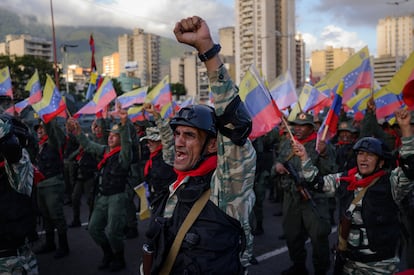
The communes are being reinforced with a military presence through the Communal Integral Defense Units, one of the organizational structures of the civilian-military coalition in power charged with responding to the White House’s pressure campaign. The Venezuelan government seeks to ensure that both spheres, civilian and military, work together. The Ministry of Defense, fully aligned with this strategy, has already deployed its deadliest anti-aircraft weaponry across the country.
The ruling United Socialist Party of Venezuela (PSUV) recently held an extraordinary plenary session, during which it agreed to move “to an armed phase of the revolution,” grounded in the Maoist principle of “protracted people’s war,” should any aggression against the country materialize. On national radio and television, Maduro personally instructed Defense Minister Vladimir Padrino López to expedite the enlistment and operational readiness of public administration workers, ordering him to “distribute weapons and prepare for national defense in every factory in the country.”
Maduro — a far-left union leader in his youth — has also decreed the start of a “union constituent assembly”: the reorganization and new legal framework for all labor circles in the country, designed to enforce adequate levels of commitment to the revolutionary state and neutralize any sign of dissent through coercion
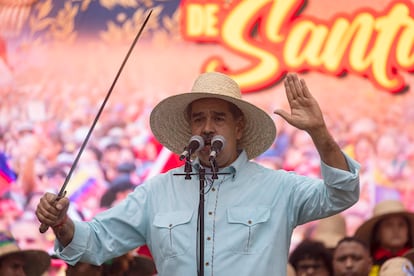
The government intends to go further: Maduro has asked all the civilian groups that support him (officially referred to as “social movements”) to meet in a plenary assembly in January to exchange proposals for a Constitutional Reform. The project was initially announced at the beginning of 2025 and is now back in the public spotlight. According to Maduro, this process “will allow us to perfect our democracy with a participatory, inclusive model, not just a representative one.”
Toward a ‘revolutionary state’
This reform could establish new regulations for the organization of elections; grant constitutional status to communal organization (which it currently lacks); undermine regional autonomy and political pluralism; and increase the role of the Armed Forces in advancing the current government’s political objectives.
The reform would put the finishing touches on the so-called “revolutionary state.” It would introduce new provisions to strengthen what is known as Popular Power, the governing framework on which the communes are based. In theory, through Popular Power, the communes would receive revenues from the national treasury to take on the direct management and execution of local development projects, thereby strengthening — at least in principle — broader access to the country’s resources. Under this model, the role of the communes — entities controlled by the executive branch, which can steer the allocation of funds at its discretion — would carry equal or even greater weight than formal government institutions.
For nearly two years now, the Maduro government has been developing a system to consolidate communal projects through what it calls the National Popular Consultation. In this process, territorially organized residents are asked to submit projects to be self-managed — for example, schools, flood-control works, paving, commercial zones, medium-scale infrastructure — and to select them through voting. Four such votes have already been held.
Both Maduro and Diosdado Cabello, the regime’s number two, have encouraged Chavista grassroots militants deployed in the streets — often referred to as “patriotic collaborators” — to report to authorities on what is happening in their surroundings, locate friends and enemies, and flag suspects through a government-created app called VenApp.
All of this coincides with mounting political and military pressure from the United States. The Chavista regime, now with little patience for criticism or challenges to its legitimacy, has intensified pressure on the media, imposed censorship, and passed legal measures that include prison sentences of up to 30 years for justifying, qualifying, or supporting any coercive action against the country.
Even indirectly echoing positions put forward by opposition leaders María Corina Machado or Edmundo González Urrutia can be punished. At the same time, the government continues to arrest political figures, including Melquíades Pulido García of the Vente Venezuela (Come Venezuela) party; political analyst Nicmer Evans; and José Elías Torres and William Lizardo, two leaders of the opposition Confederation of Venezuelan Workers (CTV).
This organizational push by the Maduro government is not new. The ruling party has spent years attempting — so far with limited success — to consolidate Popular Power and the communal state as an irreversible feature in its grip on power. The Ministry of Communes has, in fact, existed for more than a decade.
These collectivist management models, which once inspired hope in the country’s impoverished areas and absorbed vast sums of money with few tangible results, are now viewed with suspicion and indifference by the vast majority of Venezuelans, according to several qualitative analyses of opinion surveys conducted in 2024 and 2025.
By controlling the state mechanisms that convene and regulate these participatory processes, the Chavista seeks to legitimize its actions, presenting them as a “true” popular consultation rather than a “bourgeois” one. The government has not given up hope of winning back the national majority once political conditions improve. And in the event of an armed conflict, a partial attack, or a military intervention it cannot neutralize, “it wouldn’t take many people to cause enormous damage on their own,” as writer and political analyst Moisés Naím has warned.
Sign up for our weekly newsletter to get more English-language news coverage from EL PAÍS USA Edition









































