
María Corina Machado’s hidden year: From clandestinity to the Nobel Prize
The Venezuelan opposition leader has been organizing internal resistance and persuading Washington to toughen its stance against Nicolás Maduro
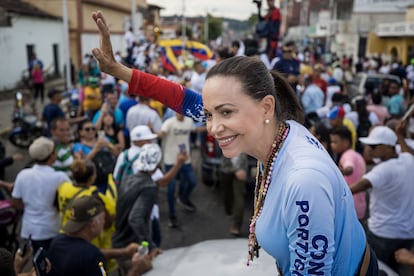
The whereabouts of María Corina Machado have been one of the great enigmas of Venezuelan politics since August 2024. Most people have always assumed she was hiding within the country, engaged in her strategy to weaken Chavista hegemony. Her enormous popular support turned the topic into a taboo, and the authorities fueled the confusion: Interior Minister Diosdado Cabello even claimed on several occasions that she had fled Venezuela. It was in this context that the first major surprise emerged. When many imagined she had been placed under close surveillance, Machado announced that she would travel to Oslo to personally receive the Nobel Peace Prize, accompanied by her family and supporters.
Machado went underground after last summer’s presidential elections. Without leaving Venezuela, she continued to work behind the scenes to force a democratic transition. She claimed victory for Edmundo González Urrutia, called on citizens to organize and protest, and urged the Armed Forces to respect the popular will in the face of orders from Chavismo.
The furious popular protests that swept across Venezuela after the results of the July 28, 2024 elections were announced surprised both Chavismo and the opposition. Amid the chaos, nine statues of Hugo Chávez were toppled in different parts of the country. On July 30, with tension at its peak, Machado and González Urrutia addressed their supporters in Caracas. There, they revealed that their teams had scanned 80% of the tally sheets that the National Electoral Council refused to release and published them on a website accessible to all citizens. According to these records, González Urrutia had won by a wide margin.
The publication of the election results and the desecration of Chavista symbols unleashed a fierce response from the regime, the likes of which had not been seen in the last 60 years. Attorney General Tarek William Saab reported that 1,062 people were arrested in just two days, and subjected to particularly harsh prison conditions. Maduro announced the refurbishment of several prisons to house “terrorists” and denounced a conspiracy, orchestrated from overseas, to ignore the election results and foment chaos. He placed Machado at the center of his accusations.
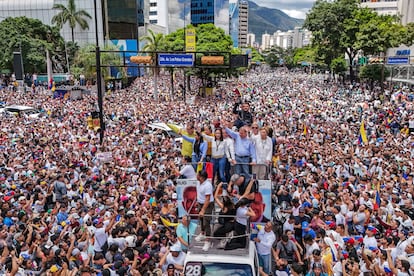
Chavismo called its supporters to the streets and gradually suppressed popular outrage through the use of force and the work of the political police. In August, González Urrutia sought political asylum in Spain, and from September onward, opposition demonstrations began to lose momentum. With each call to action, the police randomly arrested new protesters. Machado insisted on maintaining the mobilization, and the Venezuelan diaspora organized massive demonstrations overseas between October and December.
The situation became even more critical in January 2025, when Nicolás Maduro was sworn in again after a wave of repression. González Urrutia, who had promised to return to the country to assume the presidency, was unable to do so. Machado justified her absence by saying that her return would occur “when political conditions dictate.” From then on, the opposition leader began reporting on her efforts with the United States, focused on convincing the Donald Trump administration to take decisive measures to address the Venezuelan crisis.
In February 2025, Machado introduced a new strategic ally: Donald Trump Jr., 47, a business magnate and son of the U.S. president. At a time when the White House was taking hostile measures toward the Venezuelan diaspora, Machado reiterated her message of confidence: “We have in Washington the best ally of our freedom.”
Trump has declared that the United States must “take care of Venezuela” and has anticipated that ground operations against drug cartels will begin “very soon,” the central argument with which Washington is pressuring the Chavista regime. Along with Secretary of State Marco Rubio, he has become one of the key figures in sustaining Machado’s narrative and pushing Washington toward a more aggressive stance against Maduro.
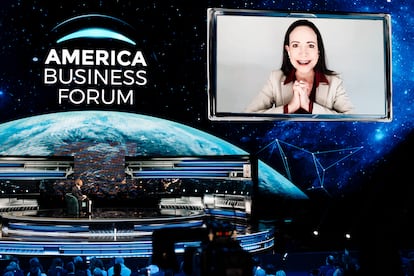
By mid-2025, while Machado insisted that the regime was weakened and close to fracturing, reality showed Chavismo firmly in control of both politics and the military, despite the economic crisis and its lack of popular support. Up to that point, Trump had shown little interest in altering the Venezuelan political landscape.
However, Machado’s efforts ultimately paid off. In the second week of August, the U.S. president began publicly referring to the Maduro regime as a structure linked to the Tren de Aragua criminal network and the Cartel of the Suns, an alleged drug trafficking organization with supposed links to the upper echelons of the Chavista regime. The rhetoric quickly escalated: U.S. forces launched operations against vessels that, according to Washington, were trafficking drugs from the Venezuelan coast. The Maduro government responded by deploying its entire political and military apparatus, including the high command of the Bolivarian National Armed Forces (FANB).
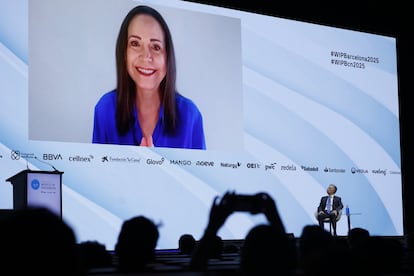
From hiding, Machado has released two new proclamations inviting Venezuelans to envision a democratic transition. In each message, the opposition leader makes it clear that she assumes political responsibility for the offensive launched from Washington against the Maduro government. Her narrative, now bolstered by the international recognition that comes with the Nobel Peace Prize, seeks to establish the idea that Venezuela faces a historic opportunity to break with Chavismo.
Sign up for our weekly newsletter to get more English-language news coverage from EL PAÍS USA Edition









































