
Venezuela’s opposition, trapped in an all-or-nothing situation
Washington’s offensive revives the specter of Nicolás Maduro’s downfall, an expectation that continues to shape the course of Chavismo’s rivals
Half the world is speculating about the outcome in Venezuela, but no one can say for sure what it will be. For some, the country is on the cusp of a historic opportunity. For others, it’s heading toward catastrophe. And for many more, it’s navigating a territory of extremes where every nuance is seen as treason. The opposition has reached this point exhausted and fractured after so many attempts at change. Some swear the regime is on the ropes. Others see a country mired in a narrative of collapse. Still others, burned out by past high expectations, distrust the epic narrative and fear that, once again, this all-or-nothing game will all end in nothing.
Managing expectations has, in fact, been the great curse of the Venezuelan opposition. Time and again, it believed it was on the verge of change. In 2002, when Hugo Chávez briefly fell. In 2004, with the recall referendum. In several regional elections. In the presidential elections of 2012 and 2013. In the parliamentary victory of 2015. In the protests of 2017. In 2019, during the tumultuous period of Juan Guaidó’s interim government. Or in the elections of July last year, when Nicolás Maduro proclaimed himself the winner without releasing the electoral records, provoking yet another international backlash.
Each episode was experienced as a threshold. And it almost always ended the same way: the opposition underestimated the Chavista power structure, its internal discipline, its networks of interests, and its capacity to repress, incite fanaticism, and mobilize its own people, even in the worst moments.
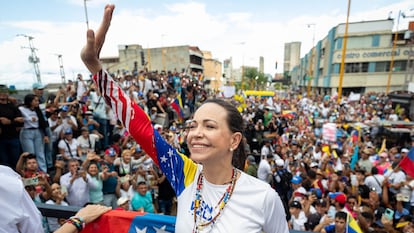
María Corina Machado, currently the most popular figure in Venezuela both within and outside the country, is playing a single card: everything. A Nobel Peace Prize laureate and a political and media magnet, she is now the benchmark upon which Donald Trump and his circle base their view of Venezuela. For weeks she has been announcing an imminent collapse that, she says, will lead to a peaceful transition.
Since receiving the Nobel Prize, Machado — who, like her inner circle, maintains close ties with U.S. Secretary of State Marco Rubio — has consistently held the same view: “Freedom must be won, and confronting a tyranny of this kind requires moral, spiritual, and physical strength,” she told this newspaper after receiving the award, and she has maintained that position in all her public statements. She has not gone further and has not openly called for an attack against Venezuela.
For months, Machado has been pushing to cut off the Chavista regime’s sources of funding, which would affect countries like Russia and China. “This is a regime that has financed itself through drug trafficking, gold smuggling, arms trafficking, human trafficking, the black market, and oil. The moment those flows begin to dry up, the structures begin to crumble,” she told EL PAÍS at the time. Furthermore, her inner circle, considered by other sectors of the opposition to be highly radical, has insisted that Venezuela cannot be seen as another Libya, Afghanistan, or Iraq, where the United States intervened militarily.
Machado is among those who argue that, even if an intervention were to overthrow Maduro, the country would experience a peaceful transition. “Venezuela will be the envy of the world,” she promised a few days ago. Carlos Blanco, one of her closest advisors, reinforces this: “Never before have we been in a position where we have cornered the regime like we have now.” For him, chaos is not yet on the horizon: “Chaos is already here.”
The Norwegian Nobel Institute has confirmed to EFE that Machado will attend the award ceremony on December 10 in Oslo. After a year in hiding, if she leaves Venezuela, it is unclear whether she will be able to return.
From Caracas, Henrique Capriles observes Machado’s epic struggle with a mixture of irritation and weariness. He is one of the last national leaders of the old anti-Chavista movement, now silenced by the regime and relegated to the sidelines in a debate dominated by sharper cries. His message isn’t as appealing for headlines: “This won’t be fixed in a day, as María Corina says.”
Capriles flatly rejects the military option: “The solution has to be political. Maduro’s failure to comply with previous agreements doesn’t make us proponents of war.” Without a passport since 2024 — the regime revoked it after the elections — Capriles denounces an environment where dissent has become suspect. “There’s a propaganda team that wants you to believe that if you’re not with María Corina, you’re with Maduro, and that’s unacceptable.” For him, what’s needed isn’t a cataclysm, but negotiation. And he takes a shot at the heart of Machado’s discourse: “If tomorrow Trump turns the page and forgets about Venezuela, they’ll be left without a theory of everything.”
But Trump, for now, isn’t turning the page. The Republican has spent weeks staring Venezuela in the eye, tightening the screws every day, while hinting at possible dialogue. Washington has considered Chavismo a geopolitical adversary since before Maduro, but the current escalation of pressure — rhetorical, military, and unpredictable — has raised all sorts of scenarios: from the imminent fall of Chavismo, after 26 years in power, to the risk of a violent clash with uncontrollable consequences.
Many international analyses view Venezuela through the lens of past and distant crises and interventions. “Between an exemplary transition and a violent explosion, there are countless shades of gray,” warns political scientist Carmen Beatriz Fernández. “These analyses tend to see Venezuela as a third-world country, armed and violent, but Venezuela had many years of democratic life. That memory, wounded but still present, remains.” Fernández leans toward a “reasonably orderly” transition, not the apocalypse that so many take for granted.
Into this landscape bursts Diego Bautista Urbaneja, writer, academic, and keen observer. He is not seduced by the epic narrative of a rupture, nor by the signs that seem to herald it. “It’s difficult to decipher what’s coming, but this is going to continue,” he warns. For him, the United States is not pushing for a resolution, but rather a prolonged siege, a sequence of pressures that will keep expectations inflated and frustrate anyone expecting an immediate collapse. Once again, the labyrinth in which the opposition lives. “Expectations will remain high the whole time, and people will have to get used to it.”
At the less combative end of the spectrum is Timoteo Zambrano, the opposition figure who chose to remain within the institutional framework when almost everyone else was abandoning it. The other opposition calls him a “scorpion.” Zambrano insists that what Venezuela is experiencing is not the prelude to a transition, but rather “a process of aggression.” And, like Chavismo, he points to Trump’s intentions: “He wants to be the administrator of our oil and gas and be the one to sell it to the world.” Zambrano speaks of “psychological warfare” and of a country that, despite its divisions, “is united against the invasion.” And he is confident that, in the end, “dialogue and diplomacy” will prevail.
The Venezuelan opposition is thus caught between impatience, fear of collapse, and faith in an uncertain transition. Each faction holds its own script and is suspicious of the others. They all speak of a possible end, but not the same end. And the question is no longer just whether Maduro will fall, but whether the opposition will be able to recognize itself when that moment arrives. If it ever does.
Sign up for our weekly newsletter to get more English-language news coverage from EL PAÍS USA Edition









































