
Venezuela’s Maduro breaks silence about call with Trump: ‘It was respectful and cordial’
Chavismo had been withholding any information about this call for days, giving rise to endless speculation. Experts say it could be a first step toward continuing dialogue within a context of heightened tension
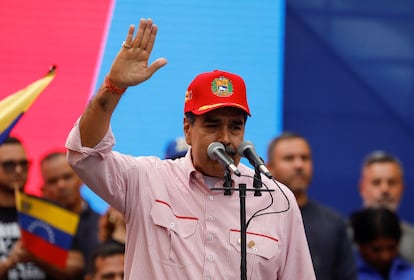

The president of Venezuela has spoken for the first time about his telephone conversation with Donald Trump on November 21. “About 10 days ago, the White House called Miraflores Palace, and I had a conversation with President Donald Trump,” Maduro began. “It was respectful and cordial. If that call means that steps are being taken toward a respectful dialogue between our countries, then dialogue and diplomacy are welcome,” he said live on television. Maduro, who thus broke his silence on the matter this Wednesday, emphasized that his years as foreign minister taught him to exercise prudence on important issues.
Chavismo had been withholding any information about this call for days, giving rise to endless speculation. “The world press has been talking about that [the call]...,” Maduro said, then warned: “I like prudence. I don’t like microphone diplomacy; when there are important matters, they must be handled quietly until they are resolved.”
The existence of this conversation was revealed by The New York Times, which viewed it as a step toward dialogue between the two leaders. Sources familiar with the conversation underscored to EL PAÍS that the tone of the conversation between the two leaders was “correct” and that, as Maduro now suggests, it could be a first step toward continuing dialogue in a context of “heightened tension.”
The U.S. president had already acknowledged the call last Sunday, while refusing to comment on it. Responding to questions from reporters on Wednesday, Trump spoke again about his conversation with Maduro. “I spoke to him briefly, just told him a couple of things, and we’ll see what happens with that,” he said at the White House.
In his news conference, Trump denied that there had been a second conversation with Maduro, a scenario that has been speculated about in recent days. Sources familiar with the inner workings of the crisis believe that if there had been a second conversation, it would have been kept quiet.
Since it emerged that the two leaders had spoken, all kinds of theories have been circulating about the terms of that call. According to Reuters, Maduro made his departure conditional on a full legal amnesty for himself and his family, the lifting of sanctions against a hundred senior officials, and the installation of an interim government led by his vice president, Delcy Rodríguez. This proposal was rejected by Trump, according to various U.S. media outlets. This is not what Maduro’s words suggest.
The leader of Chavismo spoke from a neighborhood in Petare, a working-class area of Caracas, where he met with Defense Minister Vladimir Padrino López and other military leaders. During the meeting, he also confirmed the resumption of deportation flights from the U.S. and announced that one would be landing Wednesday afternoon in Maiquetía, while airspace restrictions remain in place due to Washington’s warning of increased military operations.
In his brief reference to the call, the Venezuelan president seems to be leaving the door open to negotiations. Maduro underscored, as he has done recently, his personal familiarity with the United States and all the times he traveled to the country on diplomatic missions during the late Hugo Chávez’s administration.
The conversation took place amid the escalating U.S. military action against Venezuela, with an unprecedented deployment of aircraft and warships in the Caribbean that has the entire region on alert, and threats of potential land attacks. On Wednesday morning, two U.S. military bombers flew over Venezuela again, along the western coastline, according to flight monitoring platforms. Similar operations have been recorded in recent weeks.
Sign up for our weekly newsletter to get more English-language news coverage from EL PAÍS USA Edition









































