
Israel upends the map of the West Bank with its annexation frenzy
With an eye on the October elections, Netanyahu’s government is approving measures that deepen Israel’s de facto annexation of the occupied Palestinian territory, transferring prerogatives from military to civilian hands

Israel holds parliamentary elections in October. With Benjamin Netanyahu’s coalition polling worse than the opposition, the ultranationalist partners who dream of Greater Israel fear the end of the settlement “miracle,” as one of their ministers, Orit Strock, described it in a closed-door meeting with settlers last year. “I feel,” she said, “like someone who stops at a traffic light and suddenly the light turns green.”
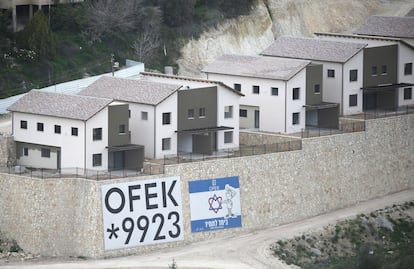
The Netanyahu government (the most ultranationalist the country has had since its founding in 1948) has been rapidly transforming the West Bank since 2022. The result: an unprecedented expansion of settlements, overshadowed by the invasion of Gaza; record land expropriations; and more than 3,000 people expelled by settler violence. This month, it has further accelerated the process with a series of measures that deepen the de facto annexation of the West Bank, the Palestinian territory it has militarily occupied since 1967 but has never formally annexed, unlike East Jerusalem and the Syrian Golan Heights. Everything is becoming increasingly rapid and explicit, with a new buzzword in the national political lexicon: sovereignty.
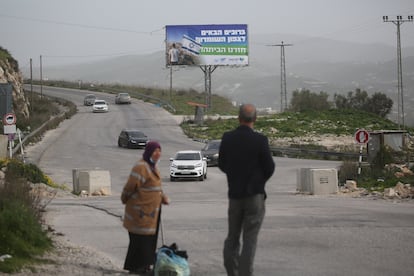
The consequences are visible. Every journey through the West Bank reveals something new. From more Israeli flags and Jewish symbols along the roadsides to the near-total absence of Palestinians in open spaces: they have been replaced by Israeli settlers taking their livestock out to pasture. There are also the occasional proto-settlement on a hilltop and new barriers at the entrances to Palestinian towns. Even real estate listings appear in settlements once considered remote.
The situation in the West Bank
The key to the transformation is the transfer of powers from Israeli military authorities (who, in theory, are occupying the territory temporarily) to civilian authorities. This creates a situation that is effectively equivalent to annexation, just without a formal declaration. As Israel’s ultranationalist Minister of Heritage Amihai Eliyahu said on February 4: “Sovereignty is not a declaration. It is an action.”
Finance Minister Bezalel Smotrich, a hardliner, is spearheading the process thanks to the parallel Defense portfolio that Netanyahu tailor-made for him in order to regain power (Netanyahu needed the support of Smotrich’s Religious Zionist Party to form government). He created a Settlements Division that manages day-to-day civil affairs in most of the West Bank and hoped that 2025 would be “God willing, the year of sovereignty over Judea and Samaria,” the official and biblical term for the West Bank.
It didn’t happen. In 2026, the annexation remains de facto, not de jure, because last October—when the announcement seemed imminent—U.S. President Donald Trump met with his Arab and Muslim allies and adopted a very different tone from his usual staunch support for Netanyahu. “I will not allow Israel to annex the West Bank. It will not happen [...] Israel would lose all of its support from the United States if that happened,” said Trump.
“The annexation has already happened, but it’s also happening. It’s a process,” says Lior Amijai, executive director of Shalom Achshav (Peace Now, in Hebrew), Israel’s leading peace organization, which closely monitors decisions regarding the West Bank. “Israel could have made a decision: ‘We have annexed the territories, and from now on, Israeli [civil] law applies here.’ But not even this administration, not even under Trump, can it do that, so it’s proceeding in a process that makes us understand that, in a sense, it’s already largely annexed, but it can still be annexed even further.”

“Urgent sovereignty”
It’s not enough for everyone. Last July, 71 of the 120 members of the Knesset (three more than the combined total of the ruling coalition) called for formal annexation. Representatives of the settlers are pushing for it. They believe it would send a clear message to the Palestinians: stop dreaming of their own state because it won’t happen. “It is urgent. Clear [Israeli] sovereignty establishes law and borders and eliminates the illusion of a ‘future Palestinian state,’” wrote Yehudit Katsover and Nadia Matar, two co-chairs of the Sovereignty Movement, last week. Smotrich has proposed annexing 85% of the West Bank (everything except the cities where the vast majority of Palestinians live) following the slogan of “maximum territory, minimum Arabs.”
The shift from military to civilian control is exactly what the latest decision—approved on Sunday—does: it resumes the registration of West Bank land, suspended in 1968, a year after the occupation began. Beneath an administrative veneer, lies a much deeper significance. It is a process begun by the British authorities during their Mandate (1917–1948) and continued by the Jordanians (1949–1967) with the aim of determining—using more modern criteria—who owned each plot of land. When, in 1967, Israel conquered the West Bank in just six days of war, it became an occupying power, without the authority to allocate land and, in theory, only for a limited time. So, although two‑thirds of the land still remained unregistered, it issued a military directive a year later to halt the process.

On Sunday, Netanyahu’s government ordered the Armed Forces to amend the directive and allocated 244 million shekels (approximately $78 million) for the first five years of the 30-year process it intends to complete. Responsibility for the land will shift from the Civil Administration—a defense agency—to the Land Title Registry under the Ministry of Justice.
A century after it began, the registry is anything but innocent or merely technical. It is, rather, a victory for the settler organizations, whose voice has never carried as much weight in Jerusalem as it does now. “We know who is leading it, who has pushed for it, and what their intentions are, which makes the process a way of taking more and more land from Palestinians,” Amijai says.
Palestinians losing their land
Palestinians will have to prove ownership of the land, even though it sometimes dates back several generations, has been fragmented among numerous descendants (including refugees in neighboring countries), or is not documented. Those who cannot prove ownership will lose it forever. Proving ownership is cumbersome, bureaucratic, and expensive. And the decision will be made by the military authorities of a country interested in registering the land not as private property, but as state land, which has been the basis of decades of colonization.
The registration will take place in Area C, which makes up 60% of the West Bank and is under full Israeli control (administrative and security), Half a million Jewish settlers and some 300,000 Palestinians live in Area C. According to Shalom Ajshav, 58% of the land in Area C remains unregistered. The Netanyahu government now aims to regularize at least 15% of this land as state property, as stated in the order itself.
The struggle for territory underlies other important decisions approved by the Israeli Security Cabinet on February 8, including two long-standing settler demands: the publication of the land registry in the West Bank and the repeal of a Jordanian-era law (1953) that prevented non-Arabs from directly acquiring land. This will facilitate land sales, which have been rife with trickery and document forgery. Until now, land transactions could only be carried out through companies, and without a registry, so pressure on and contact with landowners will predictably increase. In the midst of the territorial conflict, Palestinians who sell land to settlers face social ostracism (they often flee beforehand) and, in theory, even the death penalty, although Palestinian Authority (PA) President Mahmoud Abbas has not signed any decrees for two decades.
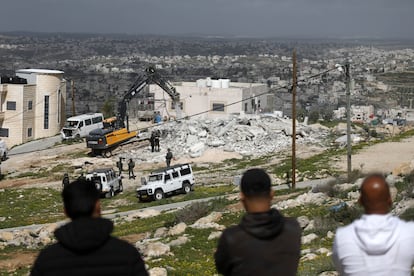
What’s more, Smotrich will be able to more easily extend to the remaining 40% of the West Bank the demolitions of Palestinian structures (built illegally because Israel’s military authorities do not grant permits) that have surged in Area C. Authorities have now been granted the power to demolish buildings in Areas A (the major cities, where the PA holds both administrative and security control) and B (their surroundings, under PA administrative authority) by claiming it is to protect archaeological sites or the environment.
“It’s very vague, it has nothing to do with security, and it violates agreements signed by Israel, such as the Oslo Accords,” laments the executive director of Shalom Ajshav.
Heritage Authority
On February 3, an Israeli parliamentary committee gave the green light to a draft law that goes even further on heritage matters. It entails another transfer of powers from the military to civilians, through the creation of a Heritage Authority responsible for “all matters of heritage, antiquities and archaeology, including the preservation, restoration, development and rescue of antiquities, as well as the excavation, development and management of sites.” Its sponsor, Zvi Sukkot, from Smotrich’s party Religious Zionism, made his vision clear: “There is no Palestinian heritage. What exists is a Jewish heritage that goes back thousands of years, and it is our responsibility to protect it.”
If approved (it still needs to pass three readings in the full chamber), it would mark the first time the Parliament applies Israeli civil legislation directly to West Bank territory, rather than—as until now—to people (the settlers), as peace and human rights organizations have warned.
The government has also taken another step toward erasing the Green Line, the boundary internationally recognized between Israel and the Palestinian territories (Gaza and the West Bank, including East Jerusalem), which does not appear on Israel’s official maps. This is the first project to expand Jerusalem into West Bank territory since it enlarged its municipal boundaries—from 2.3 to 29.3 square miles—after capturing the eastern part of the city in 1967.
Once again, it’s being done through the back door. On paper, it’s listed as a plan to build thousands of homes in Adam, a settlement in the West Bank. In practice, they will lie farther from Adam than from Neve Yaakov, another settlement—but one already inside Jerusalem’s municipal limits—as shown on the official map released Monday by Shalom Ajshav. The homes are, in fact, intended for ultra‑Orthodox Jews, like those who live in Neve Yaakov, and a road will connect them.
Sign up for our weekly newsletter to get more English-language news coverage from EL PAÍS USA Edition









































