
Reunions and uncertainty after 20 years separated by the Golan Heights fence between Israel and Syria
Druze on both sides are pressing the Jewish state to protect them from the Arab country’s new regime

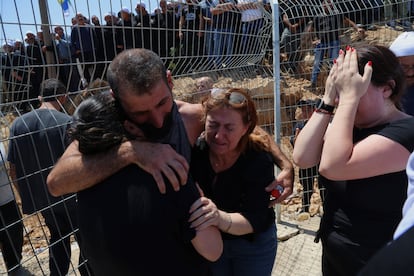
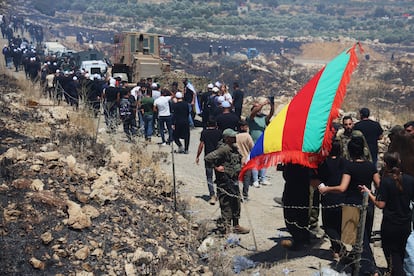
Munder Safadi, a man in his thirties, passes through the fence recently opened by the Israeli military and embraces a group of women and men of various ages. Amid the crowd, scenes of joy and tears unfold at noon Wednesday. They caress Munder’s sweaty face to try to overcome their disbelief as they take a family selfie with one of their cell phones. “Twenty years, twenty years!” one of the women shouts in response to the question of how long it has been since they last saw each other. Munder has just set foot in Majdal Shams, a Druze-populated town in the Syrian Golan Heights, occupied since 1967 by Israel and separated from Syrian territory under Damascus’ authority by a metal fortress.
A short distance from where several thousand people from both sides are gathered, the conflict is escalating with increased Israeli bombing of Damascus and other areas of Syria. Authorities in the Jewish state say they are trying to defend the Druze minority under the new Syrian government led on an interim basis by Ahmed al-Sharaa, the former jihadist who led the offensive that resulted in the fall of Bashar al-Assad’s regime last December.
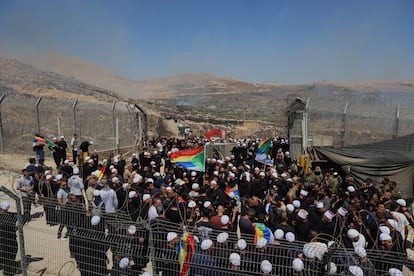
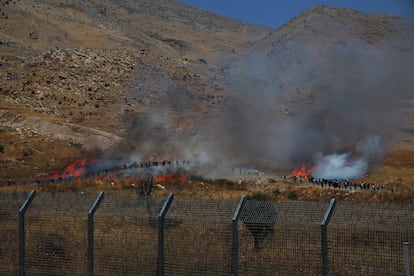
Like the Safadis, many other Druze on both sides were able to be reunited after military commanders, leading a deployment of about 100 uniformed personnel, decided to open the fence to prevent further damage. Tensions had been growing since mid-morning after several hundred people arrived at the fence from the Syrian side. The smoke bombs launched by the soldiers not only failed to stop the marchers — who continued to advance while waving Druze flags — but ended up causing several fires in the area. Some residents of Majdal Shams fired gunshots in the air in anger.
Finally, a fire truck arrived, and to extinguish the flames the large gate had to be opened. Hundreds of people took advantage of this to mingle festively, unopposed by Israeli security forces. The Druze population under Israeli administration numbers around 150,000, and they are exempt from military service, so very few enlist.
After the waters calmed, dozens of young people from Majdal Shams managed to overcome the fences in waves throughout the afternoon and began running toward the other side, ignoring the calls made by Israeli Prime Minister Benjamin Netanyahu. As night fell, a trickle of people could be seen returning in both directions.
“My brothers, the Druze citizens of Israel: the situation in Suwayda, the situation in south-western Syria, is very serious. The IDF is operating, the Air Force is operating, other forces are operating,” the prime minister said in a statement. “We are acting to save our Druze brothers and to eliminate the gangs of the regime. And now I have a single request of you: you are Israeli citizens. Do not cross the border. You are risking your lives.”
“Israel has to choose between helping the Druze or standing with the murderer Ahmed al-Sharaa and the Islamic State,” says Daniel, a 28-year-old resident of Majdal Shams, firmly and angrily. Like the vast majority of residents of the Golan Heights, except for Jewish settlers, he doesn’t feel Israeli. The young man, standing on a promontory amid a crowd of people just a few meters from the fence, laments that the international community is whitewashing the new Syrian leader and that even U.S. President Donald Trump considers him “a good guy.” In addition to having held a cordial meeting with Al-Sharaa, Trump has lifted sanctions against the Damascus regime. But at the same time, the Republican magnate is Netanyahu’s staunchest ally.
Daniel emphasizes that the Druze in Majdal Shams and other towns in the Golan Heights have always protested peacefully, but that this could end. At that moment, he takes out his phone and shows a video supposedly from recent days in Suwayda in which a car is seen repeatedly driving over the bodies of two Druze in the street. He indignantly plays it on repeat, oblivious to the cruelty of the scene. It is because of these kinds of acts that Daniel defends the Israeli army’s bombing of Suwayda and Damascus. “We are a minority in danger. Our relatives are there too,” he argues, pointing to the other side of the fence.
“I was born here and have never been to the other side, but I don’t feel Syrian or Israeli,” says Arish, a 40-year-old woman who watches the busy day from the privileged vantage point of her home, a dozen meters from the fence. She admits she has never witnessed anything like it. She says that at this point on the dividing line, neighbors from both sides sometimes come to see each other, even though they are separated by the fence. Beside her, her 15-year-old daughter, Julie, keeps an eye on the fires, the people running, the shouts, the chants, the demands...
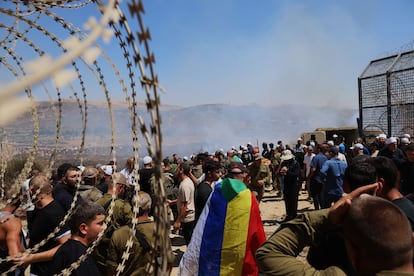
The Israeli-controlled Golan Heights even called for a general strike Wednesday to pressure for the rights of their brothers on the other side. A meeting with local authorities attempted to unite opinions and discuss how to act amid the conflict. It was unsuccessful. Some advocated going to the fence to pressure the Israelis, while others preferred not to further stir up the situation. On Tuesday afternoon, around 50 people had crossed to the other side without being challenged by the military, but all were forced to return. Fayez Shoquer, 49, wants the population to move. “We have to cross and help our families in Suwayda. They are being massacred. We don’t really know what’s happening there.”
Tensions have been rising after Syrian army troops entered the town of Suwayda, about 100 kilometers (62 miles) from Majdal Shams, prompting Israel to decide to attack from the air. Suwayda province has been the scene of sectarian clashes in recent days — leaving nearly 300 dead, according to the Syrian Observatory for Human Rights — between Druze and members of Bedouin tribes that favor the Damascus government.
Minutes after crossing into Israeli-controlled territory, Munder Safadi returns to the side of the fence from which he arrived. He climbs onto his motorcycle as his family members wave goodbye, raising their arms to the sky with tears glistening on their faces. They don’t know how the war will end, or if it will take another 20 years before they can hug each other again.
Sign up for our weekly newsletter to get more English-language news coverage from EL PAÍS USA Edition









































