
María Corina Machado: ‘Venezuela’s freedom is near. It has been a long and painful journey’
The Venezuelan opposition leader, recently awarded the Nobel Peace Prize, asserts that the Maduro regime ‘is weaker than ever’
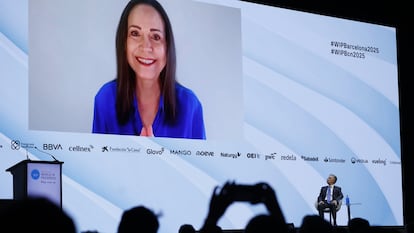

Venezuelan opposition leader María Corina Machado, recently awarded the Nobel Peace Prize, has predicted that “Venezuela’s freedom is near.” In a recorded speech broadcast Monday at the World in Progress (WIP) Barcelona 2025 forum, organized by the PRISA Group, the former member of Venezuela’s National Assembly, who has been in hiding for over a year due to repression by Nicolás Maduro’s regime, asserted that her country is “at a decisive moment”: “After 26 years of darkness, Venezuela’s freedom is finally near. It has been a very long and painful journey,” she noted. The Venezuelan politician asserted that the Maduro regime is “weaker than ever”: “Venezuela has demonstrated its resilience. We are ready to advance to a final stage of transition to democracy in peace.”
Machado is a veteran of the Venezuelan opposition. She had already engaged in fierce confrontations with former president Hugo Chávez and, after some time away from the front lines, she is once again, along with Edmundo González Urrutia, the main rival of Maduro and Chavismo. The Norwegian Nobel Committee, which awarded her the prize 10 days ago, highlighted Machado’s “tireless work promoting democratic rights for the people of Venezuela” and “her struggle to achieve a just and peaceful transition from dictatorship to democracy.” The opposition leader has been in hiding in a secret location since late August of last year due to the repression of Chavismo, a persecution that intensified after the July 2024 presidential elections, in which Machado, who was unable to participate due to her disqualification by the courts, actively supported the candidacy of diplomat Edmundo González.
During her speech, broadcast during the final session of the first day of WIP Barcelona 2025, Machado denounced the close ties between Chavismo and organized crime and asserted that Chávez “established alliances with these actors to build a sanctuary for crime in Venezuela that would expand by using Venezuelan resources and subjugating the population.”
According to Machado, despite the public backlash expressed over the past two decades — there have been hundreds of protest marches, 30 electoral processes, and 17 episodes of dialogue, she noted — the regime “managed to prevail by appealing to force and deception.” Specifically, she noted, Chavismo systematically employed three practices: “The division and fracture of society, pitting some sectors against others; through lies, imposing false narratives, taking control of the communications apparatus, and investing billions of dollars in buying alliances that would corroborate these narratives. And the third practice was fear, terror, subjecting society to a sense of constant surveillance and persecution.”
The tables turned, however, in 2023, when the Venezuelan opposition began to unite a “divided, sad, hopeless” population, Machado said, and managed to bring that discontent to the polls in the summer of 2024: “We managed to do what was impossible: defeat the regime by its own rules. It was the victory of popular sovereignty,” she claimed, referring to the controversial elections in which Maduro declared himself the winner, although much of the international community has always questioned the validity of those results.
“Every day the regime is showing more desperation, fracture, betrayals, and divisions,” Machado asserted. “It knows that not only is 90% of society united and determined to live in freedom, but that more than 80% of the Armed Forces and police also want to live with respect, justice, and the rule of law. The world has understood that this is not just another dictatorship, but a criminal structure that must be confronted by applying the law.”
The Venezuelan opposition leader admitted that “these are tremendously dangerous and delicate times,” but maintained that Venezuelans are “ready to rebuild a country that is in ruins.” “Venezuela will be free, and its freedom will bring waves of democracy to our region and, I hope, to the world,” she stated.
“For there to be peace, there must be freedom. And freedom requires moral, spiritual, and physical strength. And we have it,” she concluded.
Following Machado’s intervention, another Nobel Peace Prize laureate, former Colombian president Juan Manuel Santos, commented on her remarks and, in addition to celebrating her award, emphasized that the Venezuelan opposition leader has always “been in favor of a peaceful solution” to the Venezuelan crisis. “I hope there will be a regime change without violence,” insisted Santos, who received the Nobel Peace Prize in 2016 for his efforts in the peace process with the FARC in Colombia.
The former Colombian president emphasized the importance of cultivating “reconciliation” to heal wounds and stabilize democracy in Venezuela. “A country needs reconciliation to be able to work together toward a common goal. This reconciliation is absolutely necessary, and I have seen in María Corina that spirit, that attitude: if necessary, to sit down and negotiate and make sacrifices for a peaceful transition. This reconciliation requires generosity, a long-term vision, and peacemaking. We must persuade people to change their attitude,” he said.
Santos recalled that polarization and radicalism “render democracies ineffective” and warned of the risks facing current democracies: “Democracies are on the defensive. Today, there are more countries with autocracies than with democracies. The extremes are advancing. That is why it is important to recover the message of democratic values.”
Sign up for our weekly newsletter to get more English-language news coverage from EL PAÍS USA Edition









































