
In Colombia primaries, Paloma Valencia’s strong performance complicates presidential race
The conservative senator is threatening the leadership of the far-right candidate De la Espriella, and triggering new scenarios ahead of the battle against the left for the presidency in May
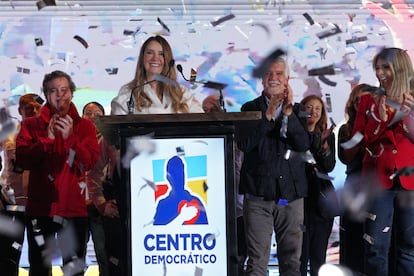

The party primaries held this Sunday in Colombia have propelled Senator Paloma Valencia, the candidate supported by former president Álvaro Uribe, into the presidential race. Her victory within the center-right bloc, with more than three million votes, threatens the leadership of far-right candidate Abelardo de la Espriella in his bid to oust the left from power. While Valencia counted ballots by the thousands, the left-wing and center party primaries — in which Roy Barreras and Claudia López emerged victorious — were lackluster, with a meager turnout that barely exceeded one million votes.
The results have changed the script of a campaign that will be reactivated this Monday with new strategies. The center-right is gaining momentum and opening up the field on a flank previously dominated by the far-right candidate from Barranquilla. And the surprising success of the economist Juan Daniel Oviedo, who has condemned the genocide in Gaza and avoided fierce criticism of President Gustavo Petro, opens a door for the traditional right to seek the center ground, which ultimately decides the election.

On the left, Roy crashed with just over 200,000 votes and blames Petro for the debacle, accusing him of discouraging Colombians from voting in his primary. But the progressive movement is heading into the first round on May 31, leading the largest bloc in the Senate and less divided than expected. Its voters have made it clear that Iván Cepeda, the frontrunner in the polls, should represent them, though he has a clear ceiling. Roy’s dream of challenging the leftist senator for the spotlight is now a thing of the past. “Petro’s boycott has won,” his team says. “Roy is going into the first round in the name of change.”
The center, meanwhile, has come out diminished, with a turnout that barely exceeded half a million votes. Its survival will depend on whether former Medellín mayor Sergio Fajardo can reverse the decline he has suffered in recent polls. The weakness of the political center raises a question that arises in every election: whether a viable political space truly exists between the left and the right. Fajardo has tried for years to build such a space without much success, and the primary results suggest that this electorate ultimately leans toward one of the two poles that dominate politics in Colombia and the rest of the world.
The strong results enjoyed by Valencia change the game. The outcome—with more than three million votes out of a total of almost six million—shatters the scenario that favored the far-right candidate Abelardo de la Espriella as the sole strong opposition figure to the leftist government led by Petro. For Uribe’s movement, which suffered several defeats and evident decline following Iván Duque’s presidency, the vote represents a show of strength that was not guaranteed at the start of the campaign.

The second surprise of the day, the unexpected success of Oviedo, who came in second behind Valencia with over a million votes, has further opened up the race. His last-minute surge, ironically, was thanks to a political enemy: De la Espriella. The far-right politician had mocked him by imitating his high-pitched voice and mannerisms, which sparked a wave of supportive messages condemning the homophobic nature of the comment and a surprising spike in the economist’s popularity.
His results — which have exceeded expectations at the start of his campaign — reveal a shift in the right-wing electorate. His statements, focused on a more technical and less ideological approach, have attracted urban voters who distrust both Petro’s supporters and the rhetoric of the more aggressive opposition. This space — diffuse but decisive — often tips the scales in Colombian presidential elections. It remains to be seen how Valencia will choose to capitalize on it. A move toward the center could help her defeat De la Espriella, even if it risks alienating the hardline right wing.
A blow to De la Espriella
The rise of these new candidates ultimately complicates the scenario that best suited the three favorites in the polls: the direct duel between Cepeda and De la Espriella not only gave both of them an advantage, but also served as a campaign slogan for Fajardo, who is betting everything on avoiding the extremes.
But it’s no longer so clear that the two candidates on the extremes will even make it to the second round, which will force a reformulation of strategies. Perhaps the most affected candidate is De la Espriella. It’s no longer so easy for him to claim that he’s the only one capable of concentrating the anti-Petro vote. Now the right wing is forced to resolve its own internal competition first before facing the government at the polls.
The campaign that restarts this Monday bears little resemblance to the one that existed just a few days ago. Cepeda remains the favorite, but the opposition no longer has a single candidate and is coming in strong to challenge him. Valencia has demonstrated that Uribismo — despite its current weakness — retains the structure and votes necessary to compete. With almost three months until May 31, and in an election decided in two rounds, the race for the Colombian presidency is once again wide open.
Sign up for our weekly newsletter to get more English-language news coverage from EL PAÍS USA Edition









































