
Economic debate takes center stage in Colombian election campaign
The increase in the minimum wage, the fiscal deficit, or taxes imposed by decree are overshadowing issues like security or corruption
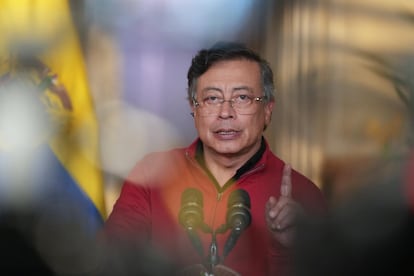

Less than a month before the legislative elections in Colombia, a senator seeking reelection is kidnapped, another candidate’s campaign convoy is attacked, and others report threats. Despite this, security is not the main topic of debate. Nor is corruption, even though scandals, both large and small, are multiplying, to the point that they even affect ministers, the president of the nation’s largest company, and members of Congress also seeking reelection. The environment is even less of a focus, despite the fact that the country has experienced a succession of dry periods followed by torrential rains in recent years, leaving more than 150,000 people affected. Instead, the discussion centers on the economy, with a debated minimum wage increase, a growing fiscal deficit, the government’s proposal to define taxes by decree, and unemployment at one of its lowest levels in history.
The minimum wage is the issue that has brought the economy to the forefront of public debate. This began last Friday when a State Council member temporarily suspended the decree by which President Gustavo Petro, at the end of December, decided to increase it by 23%, 18 percentage points above the 5.1% inflation rate. All the presidential candidates weighed in, as it was an unavoidable topic, and Petro dedicated a presidential address to it on Sunday. What is striking is that the opposition candidates, from Abelardo de La Espriella to Paloma Valencia, including former finance minister Mauricio Cárdenas, recommended maintaining the increase, acknowledging that the left had won this battle: calling for a wage cut for approximately 1.5 million people, just days before Colombians went to the polls, was politically suicidal.
That, precisely, led them to continue talking about the economy. “The minimum wage cannot be lowered. What needs to be done is to lower taxes for businesses, to level the current economic situation and protect jobs,” said De La Espriella. Valencia, an Uribista senator, said something similar in a lengthy statement titled Petro’s Bureaucratic Waste and the Fiscal Hypocrisy of the “Government of Change.”
The two politicians were not only referring to their shared proposal to reduce the tax burden — a key element of their economic vision — but also to Petro’s failed attempts to push through a reform to increase state revenue and thus plug a fiscal gap that the government has estimated at around 16 trillion pesos (around $4.36 billion) in 2025. The president has declared an economic emergency twice in recent weeks to create taxes by decree. He first did so citing this deficit, but the Constitutional Court ruled that the congressional rejection does not allow the government to enact new taxes. Last week, he issued a second decree, this time justified by the environmental crisis in the Caribbean, which includes a new wealth tax on the largest corporations. Again, each measure has sparked debates that focus attention on the economy.
That doesn’t mean all economic news has had that impact. On Monday, the economic growth figure was released; 2.6%, which is below expectations and the 3.4% the government had estimated at the end of the year, but is precisely what the previous finance minister projected at the beginning of 2025. That figure — the most general and basic indicator of a country’s economic performance — went largely unnoticed during the campaign. This shows that what motivates the government is not the economic debate, but rather the potential social impact of its policies, especially in the short term — the period leading up to the legislative elections on March 8 and the presidential elections on May 31.
It is precisely from this perspective that Valencia points out that the minimum wage increase in an election year, the last of the Petro administration’s four-year term, was intended to “cover up the government’s rampant corruption and buy elections.” Following this same logic, the government has come out to defend the increase with the broad and catchy concept of a “living wage.” “They are seriously mistaken: the country has changed. This arbitrary suspension will be met with the strongest rejection, which will be expressed in the streets and through social mobilization,” said Iván Cepeda, the leftist candidate, as soon as the State Council’s decision was announced last Friday. This is precisely the social mobilization that the opposition fears and the ruling party seeks to ensure its base is highly active on March 8. And it serves as yet another reminder that, for many, it is true that what defines elections is “the economy, stupid.”
Sign up for our weekly newsletter to get more English-language news coverage from EL PAÍS USA Edition









































