
Colombian left picks Iván Cepeda as presidential candidate for 2026
The veteran senator doubled Carolina Corcho’s lead at a vote organized by the Historic Pact, a center-left to far-left coalition
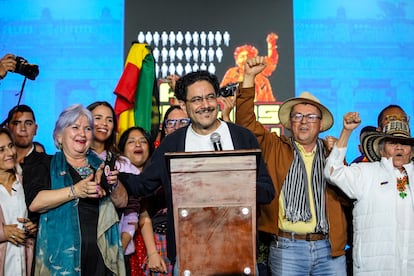
Colombia’s political left now has its presidential candidate for the 2026 elections. Senator Iván Cepeda, 63, one of its most loyal members, surpassed former minister Carolina Corcho in the Historic Pact primary vote held this Sunday, rallying the bulk of the progressive forces around him. The philosopher and peace negotiator thus inherits the banners of the diverse coalition supporting President Gustavo Petro’s government, with 730,616 votes, equivalent to 64%, compared to Corcho’s 341,054 votes, as of 5:40 p.m. That makes Cepeda the Petrista presidential candidate for the May 2026 elections.
The Historic Pact — a collective of center-left to far-left parties that replaces an earlier coalition named Historic Pact for Colombia launched ahead of the 2022 election — has a plan to unify the aspirations of the left and various sectors of the center through another primary vote to be held on the same day as the legislative elections, on March 8. Cepeda would then compete with former ministers Roy Barres and Juan Fernando Cristo, Senator Clara López, or even former Medellín mayor Daniel Quintero, if the proposal is approved.
“I am a human rights defender, a survivor of political genocide, the son of a Patriotic Union senator assassinated for his commitment to the rights of the people,” Cepeda introduced himself just two months ago, when he launched his candidacy from the city of Pasto. He is one of the many orphans of Colombia’s political violence in recent decades. His father, the communist politician Manuel Cepeda Vargas, was murdered by state agents in complicity with paramilitaries on August 9, 1994. Since 2010, when he first appeared in Congress, he has established himself as one of the most visible faces of the left, very close to victims’ organizations — such as the mothers of the so-called “false positives” — and various social organizations.
He was also one of the Petro administration’s main negotiators at the stalled negotiations with the ELN, the last armed guerrilla group in Colombia, and participated in the talks that led to the peace agreement signed by Juan Manuel Santos’ administration with the former FARC (Revolutionary Armed Forces of Colombia) in late 2016. Cepeda is also widely recognized as the left-wing senator who brought former right-wing president Álvaro Uribe Vélez to justice for a protracted witness tampering case, in the so-called “trial of the century.” The former president has just been acquitted of all charges by an appeals court, after having been initially sentenced to 12 years in prison.
In the troubled process of the Historic Pact primary, which has faced countless legal obstacles, Cepeda consolidated his favorite status a month ago, when the majority of the pre-candidates withdrew and decided to endorse him. Corcho was his last rival. Now, the left’s roadmap involves holding another primary in March, called an inter-party referendum, to form a broader coalition they call the Broad Front.
In addition to the votes for Cepeda and Corcho, the Registry has counted the results for former Medellín mayor Daniel Quintero, who withdrew from the primary just 10 days ago, so late that there are doubts about the legal implications of his decision. The politician, only recently affiliated with the left, is facing trial in a corruption case, and only secured 69,900 votes, or 6.12% of the total. There is an ongoing legal debate over the possibility that he may be disqualified from running for the March vote.
In addition to the presidential candidate, this Sunday’s vote defined two other key elements. First, the candidates on the left’s lists for the Senate and the key constituencies in the House of Representatives, such as Bogotá and Valle del Cauca. Results for these contests are slower to arrive, and the winners have not yet been confirmed.

Second, the total vote count has been seen as a barometer of the left’s strength ahead of the 2026 electoral cycle. Although it is difficult to compare with the votes obtained in the 2022 legislative or presidential elections, there was a general view that fewer than one million votes would represent a defeat and more than two million a victory. So far, with most of the votes counted, records show that 1,000,663 citizens participated, which indicates a positive result for the left.
Sign up for our weekly newsletter to get more English-language news coverage from EL PAÍS USA Edition









































