
A year after ‘No Other Land’ won Oscar, ‘everything has gotten worse’
Palestinian Hamdan Ballal, co-director of the Oscar-winning documentary, denounces a recent settler attack on his family and laments the bleak outlook for the West Bank
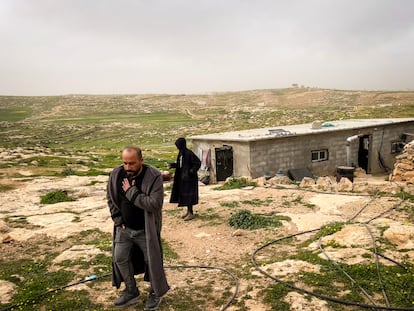

Hamdan Ballal anticipates the inevitable question and answers it with a mixture of annoyance and weariness. “I know you’re going to ask me: ‘If this isn’t a life, why do you stay?’ Well, because I have no reason to leave my land […] It’s a question that puts the responsibility on the victim. The real issue is why, if international law prohibits what’s happening to me, nothing is being done.” In his situation, he adds, leaving wouldn’t be “a choice” like those made daily by so many other people around the world, but rather compliance with the “order” he receives daily from the Israeli settlers around him and the military authorities who support them, whether by action or omission.
It has been almost a year since he won the Oscar for No Other Land, but the Hollywood statuette has neither improved his daily life nor protected him from the settler attacks already documented in the acclaimed Palestinian‑Israeli film that earned him the award. “Sometimes the settlers make comments to me about the Oscar, but I don’t know if it has made things worse. What I do know is that, when they come to my house, the message they send is: ‘We don’t care that you have an Oscar.’ Two weeks ago, one of them came to my home and told me: ‘If you want to live in peace, leave. If not, I’ll come at night and destroy you and your family.’”
The documentary — co‑directed with Yuval Abraham, Basel Adra and Rachel Szor — takes place where Ballal lives and speaks: Masafer Yatta, an inhospitable area in the south of the West Bank where more than a thousand residents can legally be expelled at any moment. In Masafer Yatta, nothing has improved since the documentary. Ballal, 37, conveys this reality both in his expression and in his words: “I see a very bleak future. Anyone who lives here will tell you the same thing.” He recalls that the Israeli army has such control over the West Bank — where it has accelerated its de facto annexation this month — and that it can “isolate all the villages in a minute by closing all the gates.”
An activist and journalist, Ballal is less well‑known than the Israeli Abraham and the Palestinian Adra, the two protagonists of the film (and now friends) who went onstage to accept the award with a speech about their different realities in Israel and the West Bank. But he is fully aware that his only “weapons” — he uses that word — are a security camera mounted on a precarious pole and powered by a small solar panel (to record possible attacks and refute accusations), a handful of dogs (“to alert us at night with their barking if they come to beat us,” he explains), and, of course, the visibility that No Other Land has given him. He sees it as a new “responsibility” toward his community, a way to amplify a message that others cannot. “I wasn’t going to take the Oscar and leave,” he says.
That is why he has called the press together (through a message circulated by Abraham) at his modest family home — with unpainted cement walls and an aluminum roof — in Susya, one of the hamlets that make up Masafer Yatta. The bucolic setting, with the first hints of spring green and birdsong, contrasts sharply with the nearness of danger. Just a few dozen meters away, three settlers from the nearby radical settlement (which is also called Susya and known for its history of violence) watch closely. Moments earlier, they had honked aggressively at a car climbing the rocky, uneven path too slowly, making it clear that they are the ones in charge here. Israeli fighter jets pass overhead every so often, filling the air with an unsettling hum.
“The situation has gotten worse because this is an area of farmers and herders, and people can’t plow or plant their land. If anyone takes their livestock out to graze, the army and the settlers come to stop them.” Between one and the other, he continues, “they corner you.”
Last month, a group of settlers burned parts of several homes, stole livestock, and threw stones at Palestinians in Jirbet al‑Fajit, Jirbet al‑Halawa and Jalet al‑Daba — three other villages in Masafer Yatta — according to activists, paramedics and videos shared on social media, which also reported that the army blocked ambulances from reaching the area.
The reason for the press gathering is the latest attack against Ballal’s family last Sunday. Specifically, his brother Mohamed, who ended up in the hospital after a settler‑soldier — a phenomenon that has skyrocketed over the past two years with the mobilization of reservists following the invasion of Gaza — reached his home, despite an Israeli court ruling two weeks earlier ordering the area closed to non‑residents.
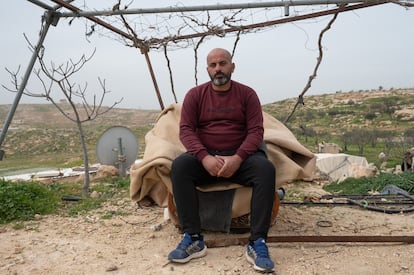
Mohamed, 34, says he was eating with his family on some chairs among the vegetation next to their house when two soldiers arrived. He saw a settler appear to be giving them instructions. When they got to the house, they asked for his identification.
“He told me to lie down on the floor. I did. He demanded my documents. I told him I had them inside the house, but that I could show them on my phone. They wanted everyone’s. He started getting very violent and told me I was on settlers’ land and that I had to leave. He ended up grabbing me by the neck,” Mohamed tells EL PAÍS.
Hamdan recalls how his nephew panicked when he saw him “turning blue” and struggling to breathe on the way to the hospital, where he was given oxygen and kept for several hours.
The settler, he specifies, was Shem Tov Luski — the same one who assaulted Hamdan upon his return from the Oscars ceremony in Los Angeles. “They came to kill me,” he said at the time, still wearing blood‑stained clothes after he was released from custody.
The soldiers arrested two of his brothers and a nephew. “They left them handcuffed for three hours in front of a base and then released them in the middle of a road where the settlers are. It was very dangerous. I wasn’t at ease until I learned that someone helped them and taken them home,” Hamdan recalls.
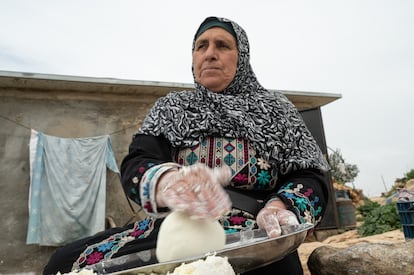
Beside him, dressed in the traditional clothing of the area, Hamdan’s mother, Hamdi, prepares labneh, a typical cheese from the Middle East. At 65, she is less inclined to speeches and more to resignation. “The settlers drive us crazy every day, but this is our land and everything comes from it. We simply have patience. What else can we do?”
Sign up for our weekly newsletter to get more English-language news coverage from EL PAÍS USA Edition









































