
China’s robot warriors: A show of technological prowess that goes far beyond the Lunar New Year spectacle
The Spring Festival Gala showcased Beijing’s strategic commitment to robotics and artificial intelligence amid its heated rivalry with the United States

On the eve of Lunar New Year, last Monday night, China used the Spring Festival Gala — the most‑watched television program in the world — to showcase a technological prowess that goes far beyond entertainment. The broadcast, watched by nearly 600 million Chinese as they devour jiaozi (traditional Chinese dumplings) with their families, became a display of cutting‑edge innovation at a time of growing technological rivalry with the United States.
There was a bit of everything: from a comic sketch featuring hyper‑realistic humanoid robots chatting with an elderly woman, meant to highlight the potential of artificial intelligence, to a kung‑fu performance that raises questions about what future warfare might look like.
The highlight of the evening was likely the performance by a squad of humanoid robots executing martial‑arts movements. It was a striking demonstration of the Asian giant’s technological ambitions. The videos are almost unbelievable. Twelve “masters” made of cables and metal strike with precision, coordination, and speed. There are punches and flying kicks. They do somersaults, three-meter leaps. They spring up from the ground, limbs spinning like a whirlwind. They wield swords, spears, and nunchaku while interacting with human children — students from a martial‑arts school. They may even do it better than humans. They never miss. And the finale is breathtaking: a robot warrior even larger than the rest appears, wielding a saber as epic music swells.
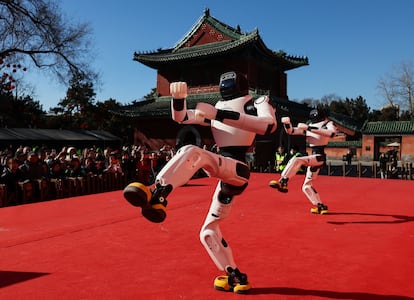
The images were carefully crafted to underscore China’s technological drive — a central pillar of government policy and a source of national pride. In the race to develop humanoid robots, the Asian giant currently holds an edge over the United States.
“The technologies showcased in the Gala consistently align with ongoing government strategies, from Made in China 2025 to the robotics goals of the 14th Five‑Year Plan,” explains Georg Stieler, managing director for Asia and head of robotics and automation at the technology consultancy Stieler, in a message exchange. “And the companies that make it onto that stage receive tangible rewards in the form of government contracts, investor attention, and market access.”
China accounted for nearly 90% of the roughly 13,000 humanoid robots sold worldwide last year. It is far ahead of its U.S. rivals, including Tesla’s Optimus, according to research firm Omdia. Morgan Stanley forecasts that humanoid robot sales in China will double to reach 28,000 units this year, according to figures cited by Reuters.
In a world already shaped by trade decoupling, tariffs, and sanctions, China’s demographic crisis adds another layer of pressure. The U.N. estimates that the country’s working‑age population will fall by more than 20% — around 200 million people — by 2050. Faced with this outlook, the government has doubled down on the industries it considers essential to securing its future and maintaining competitiveness with the United States. The upcoming Five‑Year Plan, already sketched out and expected to be approved in March, aims to accelerate “self‑sufficiency” in cutting‑edge technologies and warns that the nation must be prepared to weather possible “violent storms.”
“The government is confident that the productivity gains from robotics will help offset the economic pressures of an aging society,” says Stieler.
The concern about China’s aging population and replacing human labor also made its way onto the Gala stage on Monday night in a scene rooted in everyday family life. It became one of the most talked‑about moments: the sketch Grandma’s Favorite. The tragicomedy opens with a young man rushing in with open arms to hug his grandmother, but she stops him cold. She snaps a photo of him with her phone and asks her virtual assistant: “What is this thing?” The answer booms through the house: “It’s a grandson. A real grandson.” He’s stunned by her coldness, and she scolds him for the 262 days and seven hours that have passed since his last visit.
In the middle of their argument, the grandmother calls for her “other grandchildren,” and four robots of different sizes burst into the room — capable of doing laundry, telling jokes, and performing acrobatics. They challenge the flesh‑and‑blood grandson to keep up, but his pride is wounded as he realizes the machines have filled the space he left empty.
Amid the chaos, the grandmother announces she is “running out of battery” and locks herself in her room. When the defeated young man is about to leave, the front door opens and the matriarch walks in again, this time far warmer and smiling. The mystery is finally revealed: the grandmother who greeted him earlier was a hyper‑realistic bionic humanoid robot, standing in for the real grandmother while she was out. Last year, China formalized a policy promoting the use of robotics and artificial intelligence to improve elder‑care services.
Humanoid androids — metallic bodies promising productivity gains never seen before — have been making brief appearances at the Spring Festival Gala since at least 2005. Last year, they already took center stage with a perfectly synchronized dance performance. This year, the demonstration made a significant leap forward.
Four leading startups in the sector — Unitree Robotics, Galbot, Noetix, and MagicLab — took part in the show, each covering different areas of the field. Yu Lei, the Gala’s director, said they opted for a high “concentration” of robots to show audiences “the multidimensional development of China’s robotics industry,” according to the Global Times, a newspaper owned by the Chinese Communist Party.
The show also served as a massive propaganda showcase for the potential of China’s robotics industry in the consumer market. The performances sent demand for humanoids soaring. While the Gala was still underway, the online retailer JD.com announced that the MagicLab, Unitree, and Noetix models it had listed were already sold out.
“They still operate at only 30%–50% of a human worker’s efficiency. Profitability hasn’t yet reached the thresholds needed for factory deployment,” says Poe Zhao, a tech analyst and founder of Hello China Tech, based in Beijing. “What the Gala really provided was state backing at the exact moment companies need to turn publicity into valuations in the capital markets,” he adds.
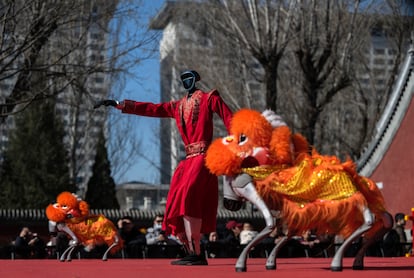
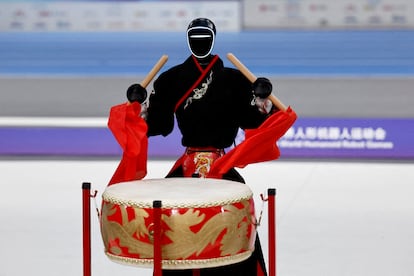
Over the past year, China has accelerated the appearance of its robots in all kinds of events, with results that haven’t always lived up to expectations. In April 2025, it put its robots to the test in the world’s first half‑marathon featuring both humans and humanoids; in the summer, it staged something akin to the first “robot Olympics.”
“A robot doing a somersault is still more spectacular than one carefully holding a plastic cup of water — even though the latter is far more technically demanding. The real challenge lies in the brain and in dexterity,” says Stieler. The leap the industry is now seeking is cognitive: machines capable of understanding complex commands, adapting to changing environments, and carrying out entire tasks from start to finish without constant supervision.
That’s where, according to Stieler, China could consolidate its structural advantage. “Chinese companies have an advantage in feeding their models with real-world data thanks to their proximity to the hardware supply chain. This allows for faster iterations, more integrated offerings, and larger-scale fleet deployments,” he notes.
Sign up for our weekly newsletter to get more English-language news coverage from EL PAÍS USA Edition









































