
Colombian court acquits former president Álvaro Uribe of all charges
The right-wing leader has been acquitted on appeal nearly three months after the initial 12-year sentence; victims plan to appeal to the Supreme Court for a final ruling
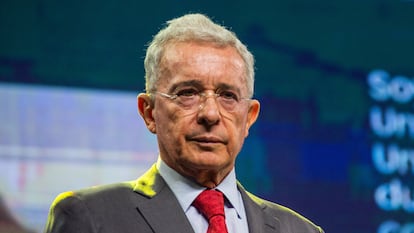

The criminal case against Álvaro Uribe Vélez, the first former president of Colombia to be criminally convicted in more than half a century, has been resolved on appeal in record time. The Bogotá Superior Tribunal has acquitted the right-wing leader in a case that has shaken Colombian politics with its twists and turns over 13 years.
On August 1, a judge sentenced the former president to 12 years of house arrest for witness tampering and procedural fraud, to be served immediately at his home. Uribe was released 20 days later when the same Superior Court annulled that order. Now, a three-judge panel has acquitted him of bribery and procedural fraud charges.
On Tuesday morning, Uribe attended the hearing for the reading of a summary of the appellate ruling, in which the judges reviewed, one by one, the five incidents for which he was convicted in the first instance. The review began with the three bribery cases: that of former paramilitary Carlos Enrique Vélez, known as Víctor; the testimony of Eurídice Cortés, alias Diana; and the statement of Juan Guillermo Monsalve. In all three cases, the court found the testimonies contained inconsistencies and contradictions. “The mere existence of a gift is not enough; illicit intent must be proven,” read Judge Manuel Merchán in the Monsalve case.
In Vélez’s case, the court found that he never claimed the former president intended to bribe him to change his testimony. The magistrate emphasized the “dishonesty” of the witness and even ordered copies of his testimony to be sent for further investigation for perjury. Merchán was especially critical of the evaluation of evidence by Judge Sandra Heredia, who issued the initial conviction, stating that her ruling “introduced facts unrelated to the accusation, violating the principle of congruence and the right to defense.”
Among the court’s arguments is that “Uribe’s knowledge of [his lawyer Diego] Cadena’s actions alone does not constitute bribery.” Regarding the former president’s relationship with the lawyer, the court noted that Mario Uribe — a second cousin who was convicted for his ties to paramilitaries — introduced him to Cadena in a meeting where no criminal activity was proven. “There is no evidence of functional subordination or that the legal mandate implied criminally relevant obedience. Interceptions show Cadena reporting on actions already taken, with no signs of pressure or criminal inducement by the accused.”
At the end of the hearing, the magistrate stressed that “some witnesses testified about events they were unaware of, guided by expectations of benefits.” Merchán noted that these motivations were significant given that Monsalve and Vélez were in prison and had an interest in obtaining benefits under transitional justice. “The conviction gave full credibility to adverse testimonies without evaluating underlying interests, suggesting a market for information,” the magistrate read, adding that the interest of senator and presidential hopeful Iván Cepeda in the outcome should have been considered along with other evidence.
After dismissing the three bribery cases, the magistrate addressed the two procedural fraud incidents for which the first-instance court concluded the former president had tried to alter the process. The first involved Cadena’s efforts to have ex-paramilitary Juan Guillermo Monsalve retract his statements against Uribe and claim he had been pressured by Senator Cepeda.
The second concerned the testimony of drug trafficker Juan Carlos “El Tuso” Sierra, who was also contacted by Cadena while in a U.S. prison to write a letter favorable to Uribe. In that letter, the former paramilitary denied any links between Uribe and paramilitarism and accused Cepeda of attempting to manipulate witnesses. The court found no evidence that Uribe had committed a crime, as the first ruling “should have proven whether Sierra lied willfully,” concluding Uribe’s responsibility “based merely on the benefit obtained, without robust proof that the idea [to manipulate testimony] originated with Álvaro Uribe Vélez.”
The magistrates of the Bogotá Superior Tribunal, led by Manuel Antonio Merchán, explained that the appellate ruling spans more than 700 pages, analyzing the evidence in the case file and Judge Sandra Heredia’s reasoning in the first-instance decision. In their review, they invalidated the telephone interceptions of Uribe’s communications in 2018. That year, the Supreme Court had ordered the interception of then-congressman Nilton Córdoba Manyoma for the “Cartel de la Toga” case (a judicial corruption scandal involving top magistrates), but an alleged typing error led to the surveillance of Uribe Vélez’s conversations.
Although Judge Heredia had validated this evidence, Magistrate Merchán noted that the court excluded it. “The interception renders the information obtained illicit, null and void by law,” he read, while the initial ruling argued that the evidence should not be excluded even though it originated from an error, because once its content was identified, the Attorney General’s Office could use it as it revealed potential criminal acts.
A long process with one final stage
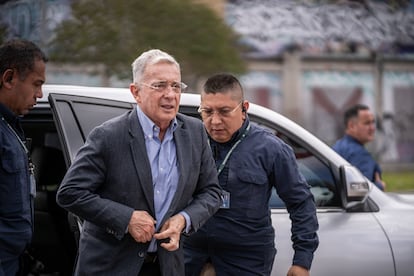
The second-instance ruling comes two months after the unprecedented conviction of Uribe, a former president who still leads Colombia’s main right-wing political force. If the initial sentence felt like a political earthquake ,Tuesday ’s decision — delivered amid a pre-electoral climate— marks another dramatic turn in a saga that has already seen several twists.
On August 1, Judge Heredia sentenced Uribe to 12 years of house arrest and, in an unusual move, ordered the sentence to be enforced immediately, without waiting for the outcome of the defense’s appeal. The conservative leader filed a constitutional injunction to regain his freedom, and on August 19, the courts ruled in his favor, finding that the house arrest was “disproportionate and violated his right to the presumption of innocence.” That ruling gave Uribe new political momentum. Just hours later, he reappeared in Antioquia — his home department and electoral stronghold — and threw himself back into the presidential campaign.
With that renewed drive, the leader of the right-wing Democratic Center party later waived the statute of limitations in the case, which would have expired on October 15 and allowed him to avoid a final ruling. Uribe’s decision contrasted with Judge Heredia’s claim that he had deliberately sought to delay the process to reach prescription — an accusation that both the politician and his lawyers consistently denied. His waiver extended the deadline for the court’s decision until October 2027, though the judges needed far less time to resolve one of Colombia’s most closely watched criminal cases in decades.
With this second-instance ruling in his favor, only one legal path remains: a possible appeal by the victims to the Supreme Court through an appeal cassation. If admitted, the case would return to the same court where it all began 13 years ago. It was there, in 2012, that Uribe accused Senator Iván Cepeda of witness tampering — an investigation that, six years later, the high court closed against Cepeda and instead opened against Uribe. In 2020, the former president resigned from his Senate seat to avoid being tried by the Supreme Court, but over the years, his criminal case has found its way back to where it started.
Sign up for our weekly newsletter to get more English-language news coverage from EL PAÍS USA Edition









































