
US joins Colombia’s right in denouncing ‘lawfare’ over ex-president Álvaro Uribe’s bribery conviction
American officials and senators back the accusations about the ‘weaponization of the judiciary.’ Gustavo Petro replies that these remarks are ‘an intrusion into national sovereignty’
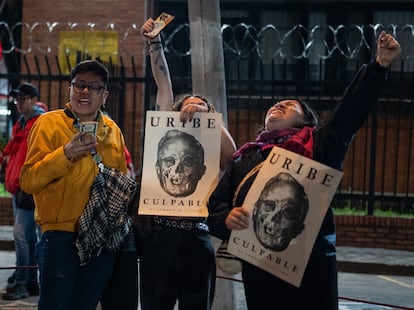

The political standoff did not take long. The conviction of former Colombian President Álvaro Uribe on Monday for bribery in criminal proceedings and procedural fraud quickly gave rise to conflicting interpretations. The right has made serious accusations that question the legitimacy of the justice system: it claims that the former conservative president is the victim of persecution, that the ruling is a form of revenge, that democracy is under attack. This view has received support from the United States government. The left, led by President Gustavo Petro, is asking for respect for the justice system and insisting on its independence.
On Monday, Judge Sandra Heredia handed down the sentence and said that Uribe, now 73, had asked his lawyer to offer benefits to various individuals, including a former paramilitary, in exchange for providing testimony that would be favorable to Uribe and damaging to the leftist congressmember Iván Cepeda. Although the lower-court decision may be appealed, it was historic in that it is the first time in modern Colombian history that a former president is convicted in a court of law.
“Former Colombian President Uribe’s only crime has been to tirelessly fight and defend his homeland,”wrote State Secretary Marco Rubio on X.“The weaponization of Colombia’s judicial branch by radical judges has now set a worrisome precedent.” The left has responded that the judge’s decision must be respected and that this is the first of many expected judicial setbacks for Uribe. “The world must respect Colombia’s judges,” declared President Gustavo Petro, the first left-wing president in the country’s recent history.
Some of the senators closest to former President Uribe have been denouncing lawfare (the weaponization of justice for political ends), a strategy that lawyer Jaime Granados had already foreseen in a conversation with this newspaper. “This is not a ruling, it’s revenge. It’s not a sentence, it’s an attack. It’s not justice, it’s fear,” declared senator and presidential candidate Paloma Valencia on X. Her colleague María Fernanda Cabal expressed similar thoughts, stating that the ruling “sends a political message.” “It puts the credibility of institutions at risk. It will be a driving force in the fight for a justice system that is never weaponized to judicialize politics,” she said. Vicky Dávila, an independent right-wing candidate, asserted that it is “the materialization of criminal revenge against those who confronted terrorism,” alluding to Uribe’s aggressive campaign against leftist armed groups during his tenure (2002-2010).
These claims are not just an isolated strategy of Uribe’s supporters. The U.S. government, which has already imposed tariffs on Brazil for its trial against former President Jair Bolsonaro, has echoed the lawfare argument. Besides Secretary Rubio, several Republican congressmembers have lashed out at the South American country. Senator Bernie Moreno asserted that “Colombia gets one step closer to illegitimacy. We’ve seen this movie before in Venezuela.” His colleague Ashley Moody has described the trial as “a political persecution.”
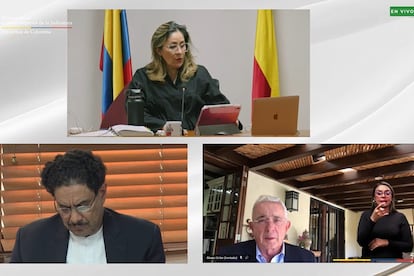
The left has been forced to wade into the debate. President Petro stated that both Uribe’s supporters and opponents must respect the justice system. “Anything else is brutal, and Colombia must be wise. This government does not persecute anyone for political, sexual, gender, or religious reasons,” he declared on X. He also added that the comments from foreign authorities are “an outrage” that his country will not allow. “It is an intrusion into national sovereignty,” he responded to the U.S. Secretary of State.
Senator Iván Cepeda, a Petro supporter and a victim of Uribe’s witness tampering, has made a similar call: “We call on our counterparts to respect and abide by justice. Today is a day to recognize justice as the guarantor of democracy and as an effective check on politicians and their crimes.”
Juanita Goebertus, Americas director at Human Rights Watch, emphasized that Colombia has “an independent judiciary” and that Monday’s ruling is not a weaponization of justice. “Bribing witnesses and committing procedural fraud in a case involving human rights violations is very serious. No one is above the law,” she said in messages in English and Spanish published on X.
There is particular concern for the safety of the judge who handed down the sentence, Sandra Heredia. The National Protection Unit, in charge of security for officials, issued a statement reporting that it is conducting studies on the judge’s risk level and said that her security detail might be reinforced.
Just the start
The left celebrated the Monday ruling but also emphasized that witness tampering is just one of the many crimes they are accusing Uribe of. Senator and presidential candidate María José Pizarro has called for further investigations into the allegations that gave rise to the entire process that led to Monday’s conviction: the ex-paramilitary Juan Guillermo Monsalve’s statements about the former president’s alleged ties to the paramilitaries. “[We must investigate] the role of the Uribe Vélez family in the formation of the Bloque Metro paramilitary group,” she said, referring to Monsalve’s testimony. She also mentioned “the massacres of El Aro and La Granja and the murder of [lawyer and human rights defender] Jesús María Valle, among hundreds of other serious human rights violations,” crimes that occurred when Uribe was governor of the department of Antioquia.
“We not only feel that our dignity is honored [today], but also that of many victims in Colombia,” said Senator Cepeda. “We also honor this fair decision for the mothers of the missing boys presented as false positives [extrajudicial executions of civilians who were later passed off as paramilitaries], for those who died in the massacres of El Aro, San Roque, and for the judges who were victims of espionage by the DAS [Administrative Department of Security]. To all of them, we say that we will continue until the full extent of the truth is revealed,” he declared to the media after leaving the Paloquemao court complex, 13 years after Uribe falsely accused him of bribing witnesses.
The Mothers of Soacha, who are demanding justice for their children who were killed during the Uribe administration, thanked the senator for his gesture. “Thank you, Iván. Thank you for honoring our children. For honoring our struggle.”









































