
Brazil responds with reciprocal tariffs to Trump’s tariff hike over Bolsonaro trial
The US has slapped the country with a 50% levy — more than any other nation — as the Republican president calls the former leader’s trial a ‘witch hunt’

U.S. President Donald Trump, as part of the latest offensive in his trade war, launched his most severe attack yet on Brazil, threatening the country with a sweeping 50% tariff, set to take effect on August 1. In a letter released Wednesday, he described the measure as a response to how Brazil’s judiciary is treating former president Jair Bolsonaro and to alleged attacks on freedom of expression affecting U.S. social media platforms operating in Brazil.
The far-right leader is facing trial for leading a coup plot after losing the 2022 elections. The U.S. president claims that the so-called “Tropical Trump” is the victim of a “witch hunt.” Following the tariff blow, announced on the social network Truth Social, the Brazilian real fell by 2%, to 5.56 per dollar, and the São Paulo Stock Exchange dropped by 1.3%.
Trump also ordered the Office of the United States Trade Representative to open an investigation into Brazil for unfair trade practices, a move that could further escalate the tariff hike.
Brazilian President Luiz Inácio Lula da Silva responded in a statement after an emergency meeting with his core Cabinet. He announced that “any unilateral measure to increase tariffs will be addressed in accordance with the Brazilian Economic Reciprocity Law,” passed in April.
He also laid out several points to counter Trump’s justifications for imposing the 50% tariff: “Brazil is a sovereign country with independent institutions that will not accept control by anyone”; the trial of “those who planned a coup d’état” falls under the jurisdiction of the courts; freedom of expression does not protect violent practices; and the information that the United States has a trade deficit with Brazil “is false” — in fact, the U.S. has run a trade surplus of around $410 billion over the past 15 years. Brazil has also recalled its ambassador to Washington for consultations.
The United States is Brazil’s second-largest trading partner, after being overtaken by China. The bad news for Americans is that the tariff hike could impact their breakfasts and snacks, as one-third of the coffee and half of the orange juice the U.S. imports come from Brazil.
Tendo em vista a manifestação pública do presidente norte-americano Donald Trump apresentada em uma rede social, na tarde desta-quarta (9), é importante ressaltar:
— Lula (@LulaOficial) July 9, 2025
O Brasil é um país soberano com instituições independentes que não aceitará ser tutelado por ninguém.
O processo…
“The way Brazil has treated former president Bolsonaro, a highly respected leader throughout the world during his term, including by the United States, is an international disgrace,” Trump wrote in his Wednesday letter. “This trial should not be taking place. It is a witch hunt that should end IMMEDIATELY!” His attempt to interfere in an ongoing judicial process in a foreign country through trade threats is unprecedented.
The letter stands out from the others announcing new tariffs, which were nearly identical and sent out earlier this week. The 50% figure — the highest imposed so far on any country targeted in this latest round — is five times the tariff Trump placed on Brasília on April 2.
Bolsonaro responded to the tariff hike with a Bible quote about just and wicked governments. The retired military officer is on trial for five criminal charges carrying a combined sentence of up to 43 years in prison. The plot allegedly included plans to assassinate President Lula, his vice president, Geraldo Alckmin, and the figure most reviled by Bolsonaro’s supporters, Supreme Court Justice Alexandre de Moraes. The Supreme Court is expected to deliver a verdict around September. Bolsonaro is also currently barred from holding public office.
Trump also openly criticizes the rulings issued by Justice Alexandre de Moraes against Bolsonaro supporters as part of his crackdown on disinformation, as well as Supreme Court decisions holding major tech companies accountable for content published by users.
The U.S. president’s letter continues as follows: “Due in part to Brazil’s insidious attacks on free elections and fundamental free speech rights of Americans (as lately illustrated by the Brazilian Supreme Court, which has issued hundreds of SECRET and ILLEGAL censorship orders to U.S. social media platforms, threatening them with millions of dollars in fines and eviction from the Brazilian social media market) starting on August 1, 2025, we will charge Brazil a tariff of 50% on any and all Brazilian products sent into the United States, separate from all sectoral tariffs.”
Hours before the 50% tariff hike, Brazil’s Foreign Ministry summoned Gabriel Escobar, the chargé d’affaires at the U.S. Embassy, to request explanations regarding Trump’s tirades against the trial of Bolsonaro. After Trump announced the tariffs in a letter published on Truth Social, the Foreign Ministry contacted him again to verify the authenticity of the document, which he confirmed, according to sources from the Brazilian presidency. The ministry returned the letter, stating that it was “offensive” and contained “false information.”
Before Brazil, 21 countries had received the dreaded letter announcing tariffs, including South Korea, Japan, and Malaysia. Fourteen letters went out on Monday, followed by seven more to countries such as Algeria, the Philippines, and Libya on Wednesday — the date marking the end of a 90-day deadline Trump had given to allow dozens of trade partners time to reach new agreements with the United States. Those letters announced tariffs ranging from 20% to 40%.
In recent days, Trump has also taken aim at Brazil for its membership in BRICS — the bloc of 11 Global South countries that includes China, India, and Russia. Just as BRICS leaders were meeting in Rio de Janeiro for a summit, the former U.S. president threatened via Truth Social that “any country aligning themselves with the Anti-American policies of BRICS, will be charged an ADDITIONAL 10% tariff.”
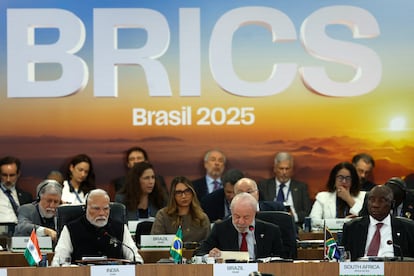
Hours earlier, the bloc criticized Trump’s tariff war but did so cautiously, using stiff diplomatic language without mentioning him by name. The final statement said that “the proliferation of trade-restrictive actions, whether in the form of indiscriminate rising of tariffs […], threatens to further reduce global trade […] and introduce uncertainty into international economic and trade activities.”
Since Trump launched his tariff war against the rest of the world, Brazil had remained off his radar. The relationship between Presidents Lula and Trump is nonexistent. While Lula supported Democrat Kamala Harris in the election, Trump flaunted his close ties with the Bolsonaro clan before supporting the former president’s claim that is being unfairly targeted. The leaders of the two most populous countries in the Americas have never met or even held a bilateral conversation.
In response to the threat against BRICS, Lula replied to his counterpart: “The world has changed. We do not want an emperor; we are sovereign nations.” Lula added that if the U.S. punished them with tariffs, they would respond based on the principle of reciprocity. Trump himself mentioned in his letter that if that happened, “whatever the number you choose to raise them by, will be added onto the 50%.”
Brazil, Mercosur’s main partner, is putting enormous effort into the South American bloc’s negotiations with the European Union to quickly conclude the agreement that would create the world’s largest trade zone. This will help diversify its foreign trade.
The U.S. surplus led Brazilian Finance Minister Fernando Haddad to appear relatively confident last Friday in an interview with this newspaper: “Brazil is at a deficit [in its trade relationship with the U.S.]. They have imposed a minimum, a 10% minimum, which is unfair. They are now negotiating on other fronts, but our turn will come, and we will present our arguments.”
When Trump won the election, the Bolsonaro family decided to bet heavily on gaining his support to ease the judicial pressure on the former president. One of his sons, Eduardo Bolsonaro, who speaks English and is the family’s link to the international national-populist movement, gave up his seat in Congress and moved to the U.S. There, he lobbies on behalf of his father before the White House and Republican congressmen.
Trump himself and his administration had already taken steps to pressure Judge Alexandre de Moraes, who is overseeing the case concerning the coup attempt in Brasília in January 2023 — the same judge who shut down platform X for a month in 2024 and clashed strongly with magnate Elon Musk.
The day after Brazil’s attorney general charged Bolsonaro, Trump Media and the Rumble network filed a lawsuit in the U.S. against the Brazilian judge, accusing him of censorship. Weeks later, U.S. Secretary of State Marco Rubio said in a parliamentary session that imposing sanctions on the judge was “very possible.” This week, Steve Bannon told Brazilian media outlet UOL that Trump would punish Judge Moraes — “I think that will happen in a matter of weeks.” Maybe it will, but in the meantime, Trump has launched a tariff attack to save an ally in a foreign country.
Sign up for our weekly newsletter to get more English-language news coverage from EL PAÍS USA Edition









































