
The thousand political lives of Álvaro Uribe
The former Colombian president returns to the center of public debate after once again coming close to losing his power
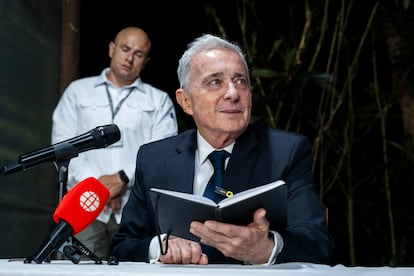

Between 2002 and 2010, a common comment around Colombian dinner tables was that then-president Álvaro Uribe Vélez enjoyed the so-called “Teflon effect”: regardless of the scandals affecting the government, whether due to corruption or abuse of power, Uribe managed to maintain his popularity. Despite ceasing to be president 15 years ago, he chose not to retreat from the public sphere and has remained a decisive politician in election after election. Therefore, on August 1, when he was sentenced in the first instance to 12 years of house arrest for the crimes of witness tampering and procedural fraud, many Colombians thought his retirement had finally arrived. But Tuesday’s second-instance ruling, which acquitted Uribe, has revived his political project. For some, the acquittal is proof that justice never reaches the powerful. For others, it’s a well-deserved victory for a politician whom many have tried, unsuccessfully, to remove from public life. Uribe, everyone agrees, has a thousand lives. Vicky Dávila, one of the dozens of right-wing candidates for the 2026 presidential elections, celebrated on social media with a ranchera song made famous by Vicente Fernández and evoking invincibility: El Rey, with its chorus of “pero sigo siendo el Rey (but I am still the King).”
The first time a judicial decision curbed the former president’s enormous power occurred in 2009, when the Constitutional Court denied him the right to seek a second reelection. Uribe had already managed to change the rules of the game for the 2006 elections, becoming the first president to serve two terms in over a century. His power was such that that year he also promoted a massive legislative bloc with a new party, named after the first letter of his last name: the U party. Officially, the U party stood for Unity, but the real nod was to Uribe. The final blow, however, was not his political defeat. In 2010, Uribe had Juan Manuel Santos, one of the founders of U and his former defense minister, elected. Santos’ victory was, in fact, Uribe’s victory.
But that achievement was also the second major setback for Uribe’s power: Santos appointed Uribe’s critics to his cabinet, charted his own course, and, above all, opened negotiations with the FARC guerrillas, which Uribe had weakened through military operations. Santos even retained almost the entire U party, which supported the peace process, but Uribe accepted the challenge. He nearly defeated Santos — who was seeking reelection with the support of a majority of parties in 2014 — after giving his blessing to former minister and candidate Óscar Iván Zuluaga. Uribe also achieved almost the same number of votes from his former party with a newly formed one, created in his image and likeness, in which he headed the Senate ticket: the Democratic Center, which became a powerful right-wing opposition party with the second most powerful bloc in the legislature.
His great electoral victory came in 2016, when he pushed for a “no” vote in a referendum called by Santos to endorse the achievements of the negotiations with the FARC: the Havana peace accords. To the astonishment of many, the “no” vote outweighed the “yes” votes pushed by the executive branch. Uribe’s resurrection was so obvious that Santos summoned him to a meeting at the Casa de Nariño, the seat of government, to try to define some reforms to the agreement that would make it more acceptable to Uribe’s supporters. That door never opened. Santos ended up endorsing the agreement through the legislature, with the Democratic Center against it, but he never managed to secure Uribe’s approval. And although the former president ultimately failed to stop the peace pact, he did return to power, again as a backseat candidate, in 2018. That year his protégé Iván Duque was elected. Unlike Santos, he did not have a political trajectory of his own, nor had he betrayed his political godfather.
During all those years, the invincible Uribe seemed untouched by the judicial investigations of his former subordinates. Three of his top officials were convicted in the so-called Yidispolitics case, a scheme to buy congressional votes to approve the presidential reelection. Two of his former directors of the DAS, the former intelligence agency, were convicted of illegally wiretapping opposition judges and politicians. Several of his military leaders during his term face cases in transitional justice over the so-called “false positives;” the murders of young civilians who were presented as guerrillas killed in combat. In some cases, the president has defended those who worked for him; in others, he has denied knowledge of their crimes. None of the allegations against him as president have advanced in the much-criticized Accusations Commission of the House of Representatives, where no investigations against heads of state ever make progress, to the point that it is known as the “commission of acquittals.”
The case against Uribe for witness tampering, opened by the Supreme Court in 2018, seemed to be the exception. The judges were able investigate him because the events occurred when he was a senator, not president, and they gathered enough evidence for two judges to deny the request of Francisco Barbosa’s Prosecutor’s Office — an ally of Uribe’s party — to dismiss the case. Later, Sandra Heredia seemed set to go down in history as the judge who sent Colombia’s most powerful president of this century to prison. But Uribe has many political lives. Acquitted, his name will now garner votes on the Democratic Center’s Senate ticket in the March elections. And right-wing presidential pre-candidates, inside or outside of his party, know that if Uribe Vélez’s blessing was important before, it is now imperative.
Sign up for our weekly newsletter to get more English-language news coverage from EL PAÍS USA Edition









































