
Juan Manuel Santos: ‘In the fight between the world’s largest drug producer and its largest consumer, only organized crime wins’
The Nobel Peace Prize laureate and former Colombian president urges restraint from Donald Trump and Gustavo Petro after their clash on Sunday
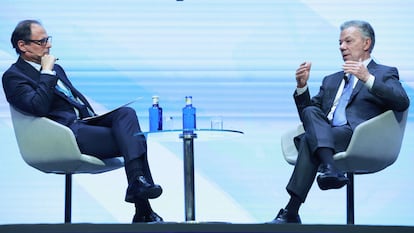
Nobel Peace Prize winner and former Colombian president Juan Manuel Santos called on Donald Trump and Gustavo Petro to show “restraint” Monday after their verbal clash over the weekend. The U.S. president accused his South American counterpart of being an “illegal drug leader” after the latter complained about a military attack on an alleged trafficking boat in Colombian waters. “In the fight between the world’s largest drug producer and the world’s largest drug consumer, only organized crime wins,” said Santos, who spoke with Jan Martínez Ahrens, editor-in-chief of EL PAÍS, at the World in Progress (WIP) forum being organized in Barcelona by the PRISA Group, publisher of EL PAÍS.
“Both peoples lose,” emphasized Santos, who currently leads The Elders, a group of world leaders dedicated to promoting sustainability and good governance. In Bogotá’s case, he noted, trade dependence on the U.S. is extremely high, and Trump has threatened to cut off collaboration programs with Colombia; a country that, he added, has historically been one of Washington’s allies in the region. “I hope that institutionality is rescued and the instruments of international relations prevail,” he said.
Santos focused on the personalities of Trump and Petro: “As long as we have two presidents who insult each other on Twitter [now X] every day, it will be more difficult.” Both leaders, the Nobel Prize winner argued, have their own agendas in this clash. “Petro has been seeking a confrontation with Trump for some time. His very aggressive speeches against the U.S. aim to portray him as a martyr or as the leader of anti-imperialism; that’s an advantage for him,” he stated. Regarding the U.S. president, Santos pointed out that this gesture “demonstrates strength to his citizens in the fight against drugs.”
The 2016 Nobel Peace Prize winner, who sealed the peace agreement between the Colombian government and the FARC guerrillas, has been cautious regarding U.S. incursions into Venezuelan and Colombian waters. “I think they’re trying to pressure the [Venezuelan] regime to see if it breaks down internally or if we achieve what we’ve all wanted for a long time: a peaceful solution,” he noted. These military operations, in his opinion, raise serious questions about respect for international law.
The awarding of this year’s Nobel Peace Prize to Venezuelan opposition leader María Corina Machado was greeted as good news by the former president of Colombia. “She is a woman who has taken many risks, shown immense courage, and stood up to a repressive regime like few others,” he said. “In recent days, since the award decision was announced, the repression has intensified.”
Santos, who governed from 2010 to 2018, has defended his peace agreement in Colombia and blamed his successors, Iván Duque and Petro, for the lack of greater progress in implementing it. He asserted that the former was more influenced by the ideological opposition to the demobilization of the FARC, while the current president has opted for his commitment to “total peace,” which he sees as a failure, as evidenced by the loss of state control in areas formerly occupied by the guerrillas.
“Accords usually fail after five years, and we’re nine years in. And even today, more than 85% of the agreement remains in place,” he stressed, referring to the fact that 85% of the guerrillas who laid down their weapons have reintegrated into civil society. “There are still six years left, and I hope the next government assumes responsibility,” he concluded.
Santos also advocated for multilateralism and cooperation between countries to address what he has called “existential risks” to humanity, one of the concerns of The Elders. Among these, for example, he has mentioned the possibility of nuclear war. The former president was invited to unveil the latest calculation of the Doomsday Clock, an initiative launched by Albert Einstein and J. Robert Oppenheimer to symbolize the proximity of humanity’s self-destruction, which is at its worst indicator in 77 years: 89 seconds to midnight (the moment that, on the metaphorical clock, symbolizes the end of the world).
“The risk of nuclear war has increased significantly, not only because of the increase in the number of atomic bombs, but also because of the technology to launch missiles and the vulnerabilities of artificial intelligence,” he said. This theoretical apocalypse is also closer, he added, due to deforestation, climate change, and the risk of a new pandemic, among other factors.
“No country is capable of solving the problem on its own,” insisted Santos, who advocated for “responsible, long-term leadership” that is detached from electoral calculations and willing to accept making the right decisions even if it comes at a political cost. He also called for a revival of multilateralism. “The United Nations is not doing what it should be doing: preventing wars, preventing conflicts, enforcing international law, enforcing human rights,” he concluded.
Sign up for our weekly newsletter to get more English-language news coverage from EL PAÍS USA Edition









































