
Local police agreements with ICE are skyrocketing in the United States, reigniting debate over public trust
Over 1,000 agencies now collaborate on immigration matters as fears grow of a rift with immigrant communities
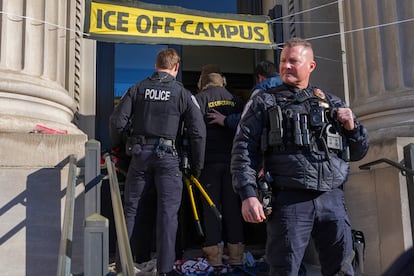

Agreements allowing local police forces to collaborate with Immigration and Customs Enforcement (ICE) have multiplied at an unprecedented rate. An analysis of official data by FWD.us, a nonpartisan organization that advocates for comprehensive immigration and criminal justice reform, shows that 1,168 police departments had officers enrolled to assist ICE at the end of January, up from 135 during the Biden administration and 150 at the end of Donald Trump’s first term.
While the Republican administration constantly attacks so-called sanctuary jurisdictions — those cities or municipalities that by decree or law do not cooperate with the federal government on immigration matters — the number of those that do has continued to grow. According to data published by ICE itself, as of February 13, 2026, the agency had signed 1,415 memoranda of understanding under section 287(g) of the Immigration and Nationality Act, covering 40 states. In the first few weeks of 2026 alone, nearly 150 new local agencies joined the program.
Section 287(g), created in 1996, authorizes the federal government to delegate certain functions of federal immigration agents to state and local police. Under this scheme, local officers can identify, question, and detain individuals suspected of being in the country without authorization and transfer them to federal custody. ICE maintains that the program “enhances the safety and security of our nation’s communities” and allows agents to “protect the homeland through the arrest and removal of aliens who undermine the safety of our nation’s communities and the integrity of U.S. immigration laws.”
In its most controversial form — the so-called “Task Force Model” — local officers can exercise immigration powers during their regular patrols. This model had been dismantled in 2012 following allegations of racial profiling, but was reintroduced in 2025, accompanied by new financial incentives. ICE has offered to cover training costs and provide resources, including up to $7,500 per trained agent for equipment and up to $100,000 for vehicles and overtime pay.
According to FWD.us, the growth is considerable. The organization estimates that, thanks to the injection of federal funds included in the so-called “One Big Beautiful Bill,” state and local agencies could receive between $1.4 billion and $2 billion this year if they participate in the program. “This amount would dwarf all other federal funding for local law enforcement,” the report concludes.
But the rapid rollout has also set off alarms. Former officials from the Department of Homeland Security’s Office of Civil Rights and Civil Liberties warned that the expansion of 287(g), combined with the reduction of internal oversight mechanisms, could become “a threat to civil rights across the country.”
Before the change in administration, that office was preparing a report ordered by Congress that identified possible civil rights violations in some participating jurisdictions. Former officials told The Guardian that the document has not been released and its status is uncertain. Similarly, it was reported that an advisory board that reviewed new applications was dissolved at the beginning of Trump’s second term.
Critics say the risk is not only legal but also social. Under the task force model, local agents can question and detain people on suspicion of immigration status in the course of their daily work, even when the immigration violation is minor.
The fear, according to experts, is that as the line between local police and federal immigration authorities blurs, immigrant communities will lose trust in those who patrol their neighborhoods. When a traffic stop, a report of domestic violence, or testimony as a witness can lead to immigration detention, the willingness to report crimes may decline. This is exactly the argument given by local authorities when defending their policies of non-cooperation with the federal government on immigration, more commonly known as sanctuary policies, which have been one of the main targets of the Trump administration.
Previous experiences with the program showed collateral effects on the daily lives of these communities: a decline in school attendance, reduced access to health services, and families avoiding leaving their homes out of fear.
While some counties have refused to join, other states have actively encouraged the signing of agreements. The result is a fragmented national map, with an ever-growing network of local agencies linked to immigration authorities.
Sign up for our weekly newsletter to get more English-language news coverage from EL PAÍS USA Edition









































