
Tensions between Trump and Petro escalate as boat attacks reach the Pacific
The US president calls the Colombian leader a ‘thug’ and a ‘bad guy,’ and Petro announces legal action for slander
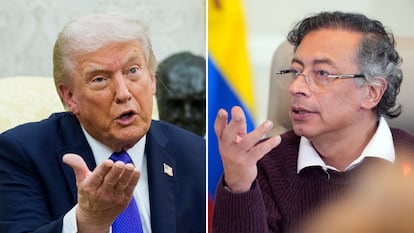
The crisis in bilateral relations between the United States and Colombia shows no signs of abating. Although Gustavo Petro, the loquacious Colombian president, maintained an eloquent silence, his American counterpart, Donald Trump, raised the already high tone of his attacks against a man he has most recently described as a “thug” and a “bad guy,” after accusing him of being a “drug trafficking leader” over the weekend. He did so on Wednesday in the Oval Office, during a press conference following his meeting with NATO Secretary General Mark Rutte. “They’re doing very poorly, Colombia. They make cocaine,” he added, without providing evidence of the Colombian president’s alleged criminal involvement. “Today we suspended all payments to Colombia. He better watch it or we’ll take very serious action against him and his country.”
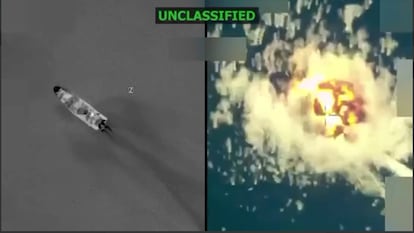
Trump’s words, however, this time came after the events. Late this morning, Secretary of Defense (now relabeled Secretary of War) Pete Hegseth had announced a new extrajudicial attack, the eighth, against a suspected drug boat. It brought two novelties: it was the first time the Trump administration acknowledged that one of these operations had taken place off the Colombian coast, and, unlike the previous ones, the military killed the two crew members while they were sailing in the Pacific Ocean, the route for most of the drugs that reach the United States by sea, and not in the Caribbean, where an ongoing military deployment has been interpreted as pressure on Venezuela.
A few hours later, the same official revealed a second attack in the Pacific, in which he did not mention Colombia this time, but he did resort to the same narrative: calling the victims “narco-terrorists” and comparing them to members of Al Qaeda. “We will find them and kill them until the threat to the American people is extinguished,” he said.
The U.S. president always justifies these attacks by virtue of a war on drugs that he himself declared in early September, based on a 1970s law that gives the president authority to do so, although it had never been used before against drug trafficking organizations. On Wednesday, he also repeated something he has said in recent weeks: that the campaign is ready to continue “by land.” It was unclear whether he was referring only to Venezuela, where, according to his administration, all the drug vessels so far have originated, or whether the threat also includes Colombia.
Regarding the new offensive in the Pacific, Petro has said that these are murders and are part of a strategy that “breaks the norms of international law.” In response to Trump’s attack on Wednesday, he simply said he will pursue legal action in the United States for what he called “slander.” If he has exchanged attacks with anyone, it hasn’t been with the U.S. president but rather other Republican politicians, such as Florida Representative Carlos Giménez. “Insults always indicate the size of the brain; the more insults, the less brains,” the Colombian president responded to a message in which the congressman of Cuban descent called Petro a “clown.”
Petro has instead chosen to argue that his government has acted effectively against drug trafficking. He insists that cocaine seizures have been the highest in history and, in response to the claim that this figure simply reflects an increase in production, criticized the source of that data. It is the annual report of the United Nations Office on Drugs and Crime (UNODC), which, according to the president, has erred in its projections. The agency has officially responded that it “recognizes that data related to potential cocaine production is limited” and that it will work to include a new indicator in its future studies, the amount of cocaine available on the market, to better reflect factors such as seizures.
The Colombian Interior Minister has argued that the American president is misinformed about Petro’s government, echoing Petro’s own criticism of the UN report. The restraint of these responses contrasts with the president’s resounding criticism of previous U.S. attacks, the war on drugs, and Trump’s position on Israel and Palestine. A month ago, he combined all these accusations in his speech before the United Nations General Assembly. “They say the missiles in the Caribbean were to stop drugs. That’s a lie; they were simply poor young people from Latin America,” he said at the time. Three days later, in New York, he called on U.S. soldiers to disobey orders when it came to supporting Israel’s military offensive in Gaza. Washington responded by revoking his visa and calling the Colombian’s statements “reckless and inflammatory.”
In February, Washington added several Mexican cartels and the Venezuelan Tren de Aragua criminal group to the State Department’s list of terrorist organizations. Four years earlier, with Biden in the White House, the two main branches of the many dissident groups of the defunct FARC guerrilla group, the so-called Central General Staff and the Second Marquetalia, were added to the list. Furthermore, since the list was created in 1997, the National Liberation Army (ELN), a guerrilla group created in the mid-20th century and which today has such a significant presence in Venezuela—and good relations with its regime—that many analysts consider it a binational guerrilla group. Indeed, the U.S. Secretary of War had already indicated over the weekend that one of the vessels attacked in the Caribbean belonged to this group.
Since last Sunday, Trump has threatened Bogotá with new tariffs as punishment for Petro’s accusations of having carried out extrajudicial killings of Colombian citizens in these offshore attacks. So far, Colombia, whose main trading partner is the United States, is among the countries with the most favorable tariffs, with only 10%, which has given it a competitive advantage in sectors such as coffee and flowers.
The South American country has been holding its breath since the beginning of this week, and several political and private sector figures have initiated talks with their contacts in Washington, although those new tariffs have yet to materialize. Over the past few decades, a strong spirit of collaboration has united the two countries, spurred by, precisely, the joint fight against drug trafficking. The idea of curtailing free trade through tariffs contradicts the most widely held economic theories about the best way to combat drug trafficking. Making legal exports less lucrative doesn’t seem like the best way to combat crime.
Sign up for our weekly newsletter to get more English-language news coverage from EL PAÍS USA Edition









































