
Meeting between Colombia’s Petro and US ambassador marks uneasy respite in bilateral crisis
The South American nation is anxiously waiting to see if Donald Trump will impose new tariffs, as he has threatened to do over his clashes with the Colombian president
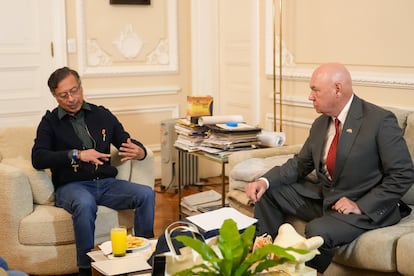

Anxiety is running high in Colombia. U.S. President Donald Trump did not carry out his threat to impose new tariffs on the Andean country’s exports this Monday, but he hasn’t withdrawn it either. Quite simply, his priorities are elsewhere, such as addressing the fragile ceasefire he secured for Gaza. Meanwhile, in Bogotá, President Gustavo Petro recalled his ambassador in Washington, gave an extensive interview on Monday in which he announced he would ask the Republican administration for explanations, and closed the day with a private meeting with John McNamara, the superpower’s acting ambassador, or chargé d’affaires, in Colombia. Upon finishing, neither of them made any statements. Although the meeting shows that communication channels are not broken, the risk of a severe economic blow has not been left behind.
This is a particularly serious risk for Colombia: the United States is the destination for 26% of its exports and its main source of foreign investment and security assistance. A century of political alignment has not passed in vain, nor have 25 years of deep military assistance, since the creation of the so-called Plan Colombia, which was fundamental to the recovery of what some once described as a failed state. The link is so strong that Petro himself defended the existence of a free trade agreement between the two nations this Monday on X, despite the fact that this agreement has been criticized for years by the Colombian left, which he represents. “There shouldn’t have been any tariffs because there was an international free trade agreement between the two countries,” he said in a recent interview, referring to the tariffs that the U.S. imposed on April 2 on all countries, although Colombia came out less affected than many of its neighbors and competitors.
Some export sectors, such as coffee, have explored strategies to take advantage of this unexpected competitive advantage, but uncertainty has limited their ability to capitalize on it. This is even more the case given the difficult relations between two governments with opposing ideologies, led by loquacious presidents prone to rhetorical excesses and hot-headed reactions. The early clash over the deportation of chained Colombians, which led the two presidents to announce a trade war, has underscored both mutual distrust and Trump’s weapon of choice. Then came an escalation in September. On the 15th, the U.S. government decertified Colombia in its fight against drug trafficking; on the 23rd, the Colombian leader issued a fierce condemnation of Trump at the United Nations General Assembly; on the morning of the 27th, he spoke at a street rally in New York and called on soldiers to disobey Trump regarding Israel; that same night, the U.S. State Department announced it was revoking Petro’s visa due to his “reckless and incendiary actions.”
The new clash involves a third actor, one of particular importance to Colombia. This third party is Venezuela, the neighbor with which Petro has the closest historical ties and with whom he has maintained an uneasy relationship since Nicolás Maduro declared himself the winner of the July 2024 presidential election without showing proof of it, while opposition leader Edmundo González’s campaign produced copies of 83.5% of the voting records, indicating his victory by more than 30 points. Petro initially demanded that Maduro reveal the records, avoided attending his inauguration, and kept Colombia’s doors open to the wave of Venezuelan refugees and asylum seekers fleeing the political repression of the following months, but he has maintained diplomatic relations throughout. In his Monday interview, the journalist Daniel Coronell asked him about his position on Maduro, and the president avoided a direct answer, opting for a long detour through the history of Colombian-Venezuelan relations, the problems of oil-dependent economies, and his “contempt” for “traitors” who call for an invasion of their own country (a reference to Nobel Peace Prize winner and Venezuelan opposition leader María Corina Machado).
Over the past two months, Trump has increased pressure on the Maduro regime with an unprecedented display of force in the Caribbean and at least seven missile attacks on vessels he accuses of transporting drugs to the U.S. The clash with Petro is related to this: in a message delivered last Saturday, Petro accused the Americans of having hit a Colombian fishing vessel, “presumably” in Colombian waters. It was in response to these accusations that Trump reacted furiously: he called Petro “an illegal drug leader” who incentivizes the mass production of drugs, announced the immediate suspension of all aid to the Andean country, and, hours later, stated that his decision on the tariffs would be announced on Monday.
That hasn’t happened, and so Colombia remains on tenterhooks. Without any known details of the conversation between McNamara and Petro, who told Coronell that the meeting was not to concede anything, but to make demands, the uncertainty remains. Five days before Petro’s movement chooses its presidential candidate for the May 2026 elections, Colombia continues to await an announcement from Trump, while it grapples with the political shock of the upcoming appeal verdict in the witness-tampering trial for which former right-wing president Álvaro Uribe was convicted in July.
Sign up for our weekly newsletter to get more English-language news coverage from EL PAÍS USA Edition









































