
US adds Colombia to list of nations failing to cooperate in the drug war
The Trump administration issued a waiver of sanctions that would have triggered major aid cuts, but President Gustavo Petro must deal with the consequences of this new stigma in the final stretch of his term
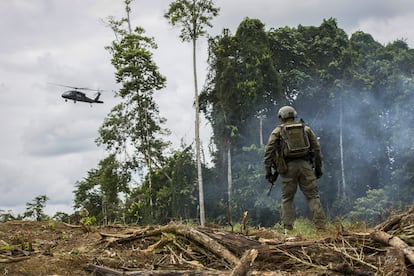

Colombia has suffered a new blow to its difficult relationship with Donald Trump’s America. The Republican president has disapproved of the Andean country’s performance in the fight against drugs, resulting in the dreaded “decertification”: on Monday the U.S. added Colombia to a list of nations failing to cooperate in the drug war. “The United States is decertifying us after dozens of deaths,” the Colombian president, Gustavo Petro, lamented during a Cabinet meeting, while still awaiting the official announcement by U.S. officials.
However, the Trump administration issued a waiver of sanctions that would have triggered major aid cuts. Still, Petro, who is already under enormous pressure to show results on that front, must now deal with the consequences of this new stigma in the final stretch of his term.
Colombia is by far the world’s leading producer of cocaine, but it has also been a close ally of the United States, which only put it on the list of uncooperative nations during the days of former president Ernesto Samper (1994-1998). Illicit crops in the Andean country remain at unprecedented levels and show no signs of reaching a ceiling. By the end of 2023, crops reached 253,000 hectares, according to the United Nations Integrated Illicit Crop Monitoring System (SIMCI). While this is considered the official figure, other measurements predict an even greater increase when the data is updated.
“Although the certification process is based on clear criteria, the decision is made by the U.S. president and is deeply influenced by political and diplomatic considerations,” Elizabeth Dickinson, an analyst with the International Crisis Group (ICG), recently explained. “Previous administrations have repeatedly certified Colombia despite concerns about insufficient compliance because, in their view, maintaining close cooperation with Bogotá was more favorable to Washington.”
Since 2013—when there were only 48,000 hectares—the area under coca leaf cultivation has increased fivefold. During his first term, Trump had already hinted that he intended to decertify Bogotá, but he never followed through on that threat. Although Petro has clashed with the Republican administration on more than one occasion, Colombia needs U.S. assistance to confront the security threats posed by dissidents from the defunct FARC guerrilla group, drug trafficking gangs, and the ELN guerrilla group, among others. This is even more so after Petro’s “total peace” policy, which was intended to negotiate simultaneously with all armed groups, faded without any major achievements to show for it.
Adding to the growth of drug crops is the decline in forced eradication, with less than 10,000 hectares last year. This is the figure that raised the most questions in the United States regarding Bogotá’s commitment to the war on drugs. The Petro administration attempted to emphasize the increase in cocaine seizures, a variable that directly affects drug traffickers and not the farmers who grow the coca plants. In 2024, authorities in the South American country seized nearly 900 tons, a significant increase compared to the 746 tons in 2023. In the first half of this year, the figure was more than 500 tons.
In this context, three possible scenarios have been eagerly awaited in Colombia for months: a full certification, which seemed unlikely; a partial decertification—a sort of general exemption based on national security considerations, without punitive measures—or a total decertification. Both the Minister of Defense, retired General Pedro Sánchez, and the ambassador to Washington, Daniel García-Peña, have conveyed the message that the only ones who benefit from decertification are the criminals. Withdrawing cooperation funds would weaken Colombia by affecting its legal economy, García-Peña argued last week in The Washington Post. And it would also weaken the United States by reducing maritime and air interdiction capacity and by hindering the flow of intelligence, he wrote.
At a time when traditional bipartisan support in the U.S. Congress for Colombia has eroded and relations between Bogotá and Washington have become strained, Bogotá has also sent out contradictory signals, such as its intention to negotiate with the Gulf Clan as part of a comprehensive peace process, or messages of alignment with Nicolás Maduro’s regime in neighboring Venezuela, just as Trump is boasting about his military deployment in the Caribbean.
Trump and Petro clashed head-on earlier this year over repatriation flights, which the Colombian leader initially rejected due to what he considered undignified treatment of deportees who flew in chains. At the time, the Republican’s tariff threat brought the Colombian economy to the brink, but the crisis was resolved in less than 24 hours, and Colombia now has the minimum tariff of 10%. The episode, however, was a harbinger of the turmoil to come between two leaders who are ideologically at odds and prone to taking sides via social media.









































