
Colombia on alert as dissident groups ramp up drone attacks
The fatal attack on 13 police in an anti-narcotics helicopter illustrates the threat these devices pose in the hands of former FARC guerillas
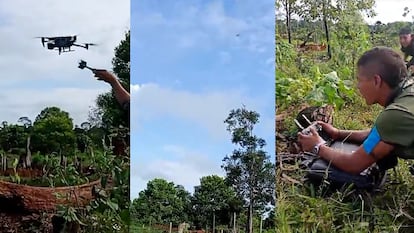

The sounds of war are unmistakable. In several parts of Colombia most affected by violence — such as the department of Cauca or the Catatumbo region along the border with Venezuela — residents have learned to recognize the hum of drones. Illegal armed groups are increasingly using them to drop explosives. That buzz, which heightens the communities’ anxiety, has become a warning that sends people running for cover.
Reports of these devices rigged with explosives are skyrocketing. Observers fear the phenomenon could escalate further following the crash of an anti-narcotics helicopter — a confusing incident that killed 13 police officers last week in Amalfi, a mountainous area of Antioquia in the northwest of the country. It was the deadliest attack against the Public Forces (the constitutional term encompassing army, navy, air force and National Police) since Gustavo Petro took power in August 2022.
Initial reports suggested that dissident factions of the now-defunct FARC guerrilla, led by Calarcá Córdoba, attacked the officers using drones and explosive devices. When the helicopter touched down, it landed on a mine. “The spot where the helicopter successfully landed, atop a hill, had been prepared days — or perhaps months — earlier with explosive cylinders buried a meter underground,” President Petro said on social media.
As authorities awaited more details, alarmed voices quickly spoke up. “Phenomena we thought had been overcome are reappearing, but we also shouldn’t exaggerate,” said Humberto de la Calle, the government’s chief negotiator in the peace process that led to the FARC’s disarmament. “The former guerrillas tried a thousand times to buy surface-to-air missiles, but they never succeeded. With drones, I think strategically we are at a point where we must stop the ways we are being attacked from the air. That has never happened before in Colombia,” he warned.
Drones can be used to attack helicopters, “but in a very limited way,” explained researcher Daniela Gómez, who served as deputy defense minister until the end of last year. The type of commercial drones adapted for use in Colombia so far cannot reach the altitudes at which helicopters normally fly, so they can only attack during takeoff or landing, she explains.
In addition, military aircraft are only vulnerable on the ground, since Colombian airports are equipped with signal jammers that prevent drones from flying. That, Gómez emphasizes, should be the priority: urgently acquiring signal jammers and anti-drone systems.
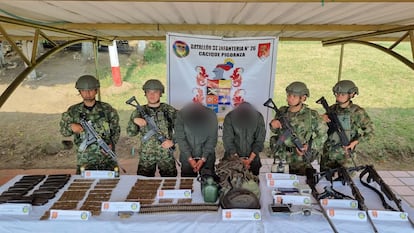
Beyond the debate over helicopters, the Army commander, General Luis Emilio Cardozo, acknowledged last week that they were not prepared to prevent new drone attacks. “You can understand that this is arduous, difficult, and costly work. The National Army alone has 3,000 platoons deployed nationwide, and being able to equip all our personnel[with anti-drone systems] is complicated,” he lamented in statements to the press.
Although various types of unmanned aircraft have been used for decades in many parts of the world, Russia’s invasion of Ukraine has popularized them on the battlefield. Drone warfare is now here. Colombia, which is experiencing the chaotic fragmentation of armed groups fighting over illegal revenues, is no exception.
The first report of drones being used in the Colombian conflict dates back to 2018. Since then, different armed groups have deployed drones for both strategic surveillance and offensive purposes — attacks with explosives. The number of incidents has risen dramatically, increasing by more than 50% so far in 2025. Although figures vary, according to the army, there were 119 drone attacks in 2024, leaving 32 military personnel, seven police officers, and 28 civilians injured. In the first eight months of 2025, at least 180 attacks have been recorded.
Dissident groups led by Iván Mordisco are the main perpetrators, particularly in Cauca, though they are not the only ones. Attacks have also been reported by the ELN in Catatumbo and “drone units” of the last remaining armed guerrilla group in Nariño. In one of the most recent incidents, this past weekend, a Navy ship was attacked with explosives carried by a drone in Putumayo.
The Public Force still does not have enough systems to counter these attacks, warn several analysts. So far, armed groups have only used commercially available drones adapted to carry explosives — a practice that is indiscriminate and imprecise. Last year, a 10-year-old boy was killed in one such attack while playing soccer in El Plateado, Cauca.
In a country long scarred by the proliferation of landmines, a cursed legacy of its armed conflict, explosive devices of all kinds remain a persistent concern. Drone use, however, falls into a different category: aerial-launched devices, which also includes cylinder bombs. One of the most worrying trends highlighted in the latest humanitarian report by the International Committee of the Red Cross (ICRC) was precisely the intensive use of improvised aerial-launched explosives and armed drones. Between January and May, the ICRC recorded 137 people injured or killed by aerial-launched devices in Colombia.
“The Colombian state’s response has been slow and fragmented,” noted a recent analysis by Laura Bonilla, deputy director of the Pares Foundation. “Anti-drone systems have been acquired, technology donations have been received, and military personnel have been trained, but vast regions remain unprotected. Armed groups are adapting, changing frequencies, and planing autonomous flights. Shooting down one drone isn’t enough when there are 10 more ready to take off.”
The Defense Ministry, headed by Pedro Sánchez, a retired Aerospace Force general, presented a bill to Congress last month to regulate both drones — which are now an everyday object in various fields — and anti-drone systems. The military consider them “emerging technological threats.” The initiative aims to define competencies between civilian and military authorities for regulation, create national registries, and amend the Penal Code to impose harsher penalties for using these aircraft in terrorist acts.
“It is evident that we need to develop this legislative initiative in order to establish a comprehensive regulatory framework for the importation, manufacture, marketing, use, possession, carrying, transportation, surveillance, and control of drones and anti-drone systems,” said Sánchez at the time.
Sign up for our weekly newsletter to get more English-language news coverage from EL PAÍS USA Edition









































