
Iván Mordisco, the ‘drug trafficker dressed as a revolutionary’ who is challenging the Colombian government
The Gustavo Petro administration attributes the attack that left six dead in Cali to the leader of the FARC dissidents of the Central General Staff, which it now considers a terrorist organization
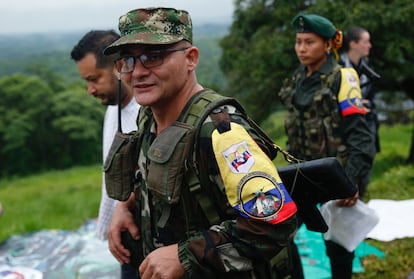

Colombia’s third-largest city is under siege by Iván Mordisco, a veteran warlord, presumed dead on more than one occasion, who refuses to lay down his arms. Néstor Gregorio Vera Fernández, his real name, heads the structures grouped within the self-styled Central General Staff (EMC), the largest dissident group of the defunct FARC guerrilla organization, which this week launched a cylinder bomb attack on an air base in Cali, leaving six people dead and more than 70 wounded.
Mordisco is a “traqueto (drug trafficker) dressed as a revolutionary,” as President Gustavo Petro has defined him. “What happened in Cali shows us the shift of Iván Mordisco’s dissidents toward purely terrorist actions,” the president said after last Thursday’s attacks, which he considered crimes against humanity. The EMC, the Second Marquetalia, and the Gulf Clan, all FARC offshoots and heirs to paramilitarism, “will be considered terrorist organizations, prosecuted anywhere in the world,” Petro emphasized.
These are three of the armed groups with which Petro’s government opened talks as part of its “total peace” policy. The Central General Staff, specifically, sat down to negotiate on October 8, 2023, after months of rapprochement. It even agreed to a bilateral ceasefire, but the group, which had been a fragile federation of fronts, eventually fragmented in April 2024 when more than half of its men walked out, urged by Mordisco himself — the minority faction of Calarcá Córdoba is still involved in talks. By then, the process had entered its umpteenth crisis, following a series of actions by dissidents that included attacks against military targets and Indigenous communities, such as the murder of leader Carmelina Yule in the department of Cauca, neighboring Cali. “The offensive against the EMC in Cauca is total,” Petro proclaimed at the time.
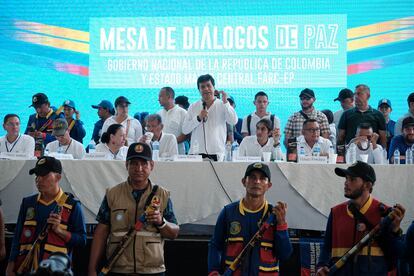
The integration of dissident groups into the total peace fold was, from the outset, one of the greatest challenges of the Petro administration’s flagship policy, which is now blurred. In the plural, since several organizations at different times withdrew from the Havana talks that led to the peace agreement at the end of 2016. The label “dissident groups” deserves its plural, as it is an amalgamation of organizations that are difficult to classify. The Mordisco factions and Iván Márquez’s decimated Second Marquetalia consolidated their position as the most notorious, acting as a kind of umbrella organization.
Both were designated as terrorist organizations by the United States when it removed the FARC from that blacklist, disarmed and transformed into a political party. Both also engaged in a war to the death in some regions, in which several of their leaders fell in confusing clashes — most often across the border with Venezuela. Gentil Duarte seemed to emerge as the winner, and the most visible face of the dissidents, to the point that people were talking about Los Gentilianos. But he was assassinated in May 2022.
Mordisco has since garnered power and managed to survive for nearly a decade as one of the most-wanted dissidents, despite having been presumed dead at the end of the presidential term of Iván Duque (2018-2022), Petro’s predecessor. He reappeared two months later in a video to express his willingness to engage in dialogue with the new government. And later, wearing glasses and a military uniform, in the plains of Yarí, now as head of the then-newly named Central General Staff. A few weeks ago, rumors, never confirmed, circulated again that he had been killed. And this very Saturday, he addressed a public letter to Petro, after authorities captured his brother, accused of serving the dissidents. “I don’t believe in Colombian justice, but I trust in revolutionary justice,” wrote Mordisco.
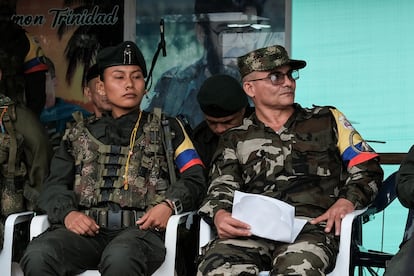
He is recognized as dogmatic and radical, “always in disagreement with a political solution or negotiation,” said a report on the origins of the dissidents by the Ideas for Peace Foundation (FIP), which attributed to him a process of “criminal degradation.” He was distinguished by an openly hostile attitude toward agreements and those who promoted them. He was also characterized by his opposition to illicit crop substitution programs, in addition to marked violence and distrust toward the civilian population, particularly Indigenous communities.
Recognizing the EMC as an armed group with political status was a risky step, one that the Petro administration was willing to take when it proposed negotiating simultaneously with all armed groups. It is “the worst strategic error committed in Colombia in the last 25 years and the greatest damage done to the peace process,” Sergio Jaramillo, the Peace Commissioner who sealed the agreement with the FARC, warned in a statement before the Constitutional Court. These groups are, among others, most responsible for the murders of signatories and the forced recruitment of minors.
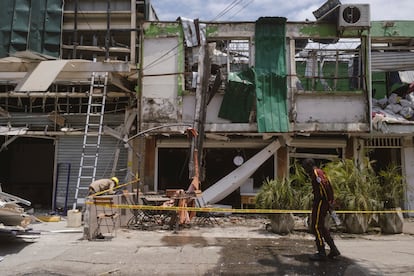
Even after losing half of its members in the split, the Mordisco dissidents operate throughout much of the south of the country. They do so both in the so-called Amazon deforestation arc and in three troubled southwestern departments: Cauca, Nariño, and Valle del Cauca. There, Cali holds great symbolic weight as the de facto capital of the entire Pacific region and the third most-populous city in Colombia. For the EMC, launching actions against the state there is a show of force. There are other locations in the Valle del Cauca, such as Buenaventura, the main port on the Pacific, two and a half hours away by road, with strategic value due to its access to the sea. Ultimately, the municipalities of southern Valle del Cauca and northern Cauca respond to the same dynamic of the armed conflict. They are strategic corridors fought over by armed groups because they are crucial for illegal economies.
“Cauca has been one of the historical centers of the armed conflict. Since the FARC-EP laid down their arms, the EMC dissidents have reconfigured and consolidated their territory without the state being able to prevent it,” noted an analysis by Kyle Johnson, a researcher at the Conflict Responses Foundation (CORE), in response to another wave of attacks prior to last week’s. “No security policy — neither the Santos administration’s Victoria Plan nor the Orus plan, nor the Duque administration’s strategy, nor the Petro administration’s proposals — has contained their expansion. Although there are differences on paper, in practice they have not translated into results.” In addition to the muscle provided by their illicit economies, they have achieved a certain internal cohesion that allows them to coordinate attacks, move members between fronts, and operate in different scenarios.
Last week’s bombing, part of a pattern of attacks on military and police facilities in Cali, also serves as a warning about the level of EMC’s penetration in Colombia’s major cities, not just in rural areas, warns Elizabeth Dickinson of the International Crisis Group. It’s part of “a strategy of terror” to respond to the security forces’ offensive in other regions, such as the Micay Canyon, she adds, and thus increase the cost to the government of combating them.
Sign up for our weekly newsletter to get more English-language news coverage from EL PAÍS USA Edition









































