
The new kings of Hollywood: How the Ellison family built a media empire
David Ellison has just won the battle against Netflix to acquire Warner Bros. He already controls CNN and CBS, two of the largest news networks in the United States
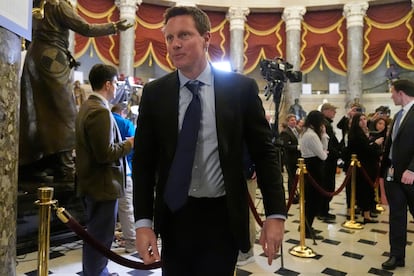

David Ellison once dreamed of becoming a Hollywood actor, but after an unsuccessful start, he instead rose to become one of the most powerful figures in the entertainment industry. He is now on the verge of acquiring Warner Bros. Discovery, having outmaneuvered Netflix, and last summer he bought Paramount as part of a rapid series of acquisitions that allowed him to build a media empire in just six months.
The Ellison family now controls one of the world’s largest audiovisual and news conglomerates. Through Paramount and Warner they shape Hollywood’s rules, through CBS and CNN they influence news, and they own numerous entertainment channels that allow them to project their worldview. They also control TikTok’s U.S. subsidiary, giving them significant influence — an influence strengthened by their close relationship with President Donald Trump.
The success of David Ellison, 43, is tied not only to his ambition but also to his father, Larry Ellison, one of the richest men in the world and the founder of Oracle. Oracle has recently expanded into artificial intelligence through partnerships with OpenAI, and is now valued at $420 billion. Larry Ellison is also a personal friend of U.S. President Donald Trump: he has donated to Trump’s campaigns since the Republican’s first run in 2016.
Larry Ellison’s close relationship with Donald Trump has helped him become one of the major shareholders of TikTok’s U.S. operations, giving him management authority and even the ability to moderate comments — which gives him significant influence. The Ellison family, however, has not always been tied to the media or film industries; their rapid rise in this sector has coincided with Trump’s return to the White House.
David Ellison first tried his hand at acting in 2006, producing and appearing in Flyboys alongside James Franco. The film was a commercial failure, but he refused to give up on Hollywood. With financial support from his father, he founded the production company Skydance. Over the past two decades, Skydance has produced several successful films, including entries in the Mission: Impossible and Top Gun franchises, yet within Hollywood’s ecosystem it remained a relatively small player.
David Ellison’s sister, Megan Ellison, also pursued a career in the film industry. With financial support from their father, she founded the production company Annapurna, where she demonstrated a stronger artistic sensibility than her brother, producing several critically acclaimed and Oscar‑winning films such as Her and Zero Dark Thirty.
The siblings grew up with their mother — Larry Ellison’s third wife — on a horse farm in Woodside, near the San Francisco Bay Area. She played a central role in nurturing their love of cinema, taking them to the movies every Sunday and keeping a home collection of more than 2,000 VHS tapes.
While their mother shaped their artistic interests, their father had an even greater influence on their understanding of business. For most of the year, they lived a quiet life with their mother, but summers were spent traveling the world with Larry Ellison aboard his superyacht, Ronin. Those summers exposed them to his aggressive, combative worldview. Biographies recount that when David was still a child, his father bought a World War II fighter plane so they could simulate aerial dogfights over the Pacific together.
Larry Ellison is one of Silicon Valley’s most controversial figures. Although he built a successful tech company, he is known less as a visionary and more as a ruthless businessman — very different from his friend Steve Jobs. Even at 81, he remains fiercely competitive, an archrival of Microsoft founder Bill Gates, and someone who cultivates an image of himself as a samurai. People close to him say he likes to quote Genghis Khan, especially the line: “Winning is not enough. All others must lose.” Former colleagues recall his fondness for violent metaphors when discussing business. At one point, he was even accused of rummaging through competitors’ trash bins to find information he could use against them.
Ellison was born in Manhattan to a single mother of Russian‑Jewish descent, who left him in the care of his aunt near Lake Michigan. In the 1970s he moved to California to start a computing company. One of his earliest contracts was with the CIA, helping manage databases at a time when the technology was still in its infancy. From that work, he founded Oracle, which eventually became a tech giant and allowed him to amass a fortune estimated at nearly $200 billion, according to Bloomberg’s Billionaires Index.
Larry Ellison’s immense fortune has allowed him to finance his children’s ventures. By 2024, Paramount was in serious financial trouble: it had fallen behind in the streaming race, its films were underperforming, and its TV channels were losing both audience and advertising revenue. In a bold move, David Ellison — frustrated that his own production company wasn’t growing — decided to go after Paramount. Despite being much smaller, Skydance managed to acquire the historic Hollywood studio and its networks (CBS, MTV, Nickelodeon, Comedy Central) for around $8 billion after a year of negotiations with regulators. Trump’s return to the White House helped unblock the deal.
Less than a month later, David Ellison made an offer to David Zaslav, CEO of Warner Bros. Discovery, to buy the century‑old studio, its streaming service HBO Max, and its cable television business, including CNN. The talks did not go well. The initial offer — $19 per share — was seen as insulting at Warner’s headquarters in Burbank. As a result, the studio behind films like Casablanca and the Harry Potter franchise opened the sale process to the highest bidder.
After weeks of negotiations, Netflix announced in early December that it had reached a preliminary agreement to buy Warner Bros. Discovery’s film studios for $83 billion. David Ellison was stunned. He felt betrayed, as he had been the first to show interest and had submitted nine different offers in an attempt to convince Warner’s board. Furious, he began looking for ways to derail the Netflix deal and secure the acquisition that would allow him to complete his media empire.
For weeks, he threatened a hostile takeover and improved the financing terms of his proposal. His father, Larry Ellison, pledged $40 billion of his personal fortune to guarantee the operation. David also met with President Trump to seek political support and hired a dozen consulting firms to lobby on his behalf. Last week, he finally decided to raise his offer to $31 per share, for a total of $111 billion. It is the price of an empire — one ultimately funded by his father.
Sign up for our weekly newsletter to get more English-language news coverage from EL PAÍS USA Edition









































