
The paradox of Ecuador: An oil-producing country where people wait in line for up to 72 hours to buy gasoline
Fuel shortages in major cities expose the deterioration of the national industry. While the government blames hoarding, distributors denounce serious import problems
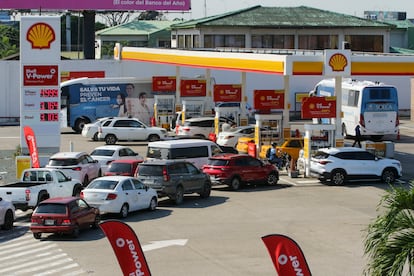
The scene has been repeating itself for 72 hours in Ecuador’s main cities: lines of vehicles snaking around corners, drivers waiting for hours in the sun, and gas pumps only allowing customers to fill up with $15 or $20 worth of gasoline. In Quito and Guayaquil, two cities accustomed to endless traffic, now there’s also a fight over fuel. “I’m frantically looking for fuel because my tank is practically empty,” says Darwin Medina, a taxi driver in Guayaquil. He visited three stations before finding one with gasoline available. On his fourth attempt, he managed to fill up with just five gallons of Ecopaís, a blend of gasoline and ethanol used by a large portion of Ecuador’s vehicles because it’s the cheapest.
Margarita Zambrano waited almost an hour to reach the gas station and heard the same answer repeated throughout the city: only $15 worth of Ecopaís per vehicle. At the new price of $3.16 per gallon, she estimates it will last her two days. “I turned around and got back in line because you never know what might happen here,” she says from the seat of a white car in which she takes her children to school.
The crisis for the government began on May 11, the day before the monthly fuel price update under the price band system. Authorities blamed gas stations for hoarding gasoline to profit from the price increase. Faced with this critical situation, control operations and potential sanctions were announced. However, of the 87 gas stations inspected that day, only two were sanctioned, and one of those was for failing to report damage to its equipment.
Hours passed. May 12th arrived, and the new price adjustment took effect: $3.16 per gallon for Extra and Ecopaís gasoline, $4.97 for 97-octane Super gasoline, and $3.10 for diesel. Never before had the country paid so much to fill a tank. The lines, however, continued.
“The current situation must be analyzed from a holistic perspective,” stated Christian Puente García, executive director of the Hydrocarbons Regulation and Control Agency (ARCH). This official insists that hoarding exists, but also points to international factors. “The closure of the Strait of Hormuz generates a reduction in supply and an increase in price worldwide,” he explains. “Furthermore, we depend on the arrival of ships, unloading, and all the import logistics. It is a complex situation.”
For those who wait for hours in line, those explanations sound distant. “The price increase might be an international problem. But the lack of gasoline is an internal problem,” reflects a driver in Guayaquil. “That’s not happening in other Latin American countries,” she asserts.
The distributors’ version contradicts the official narrative. Ivo Rosero, representative of the Chamber of Petroleum Derivatives Distributors (Camddepe), asserts that the problem is a lack of imports. “There is rationing because not enough was imported,” he maintains. According to Rosero, since May 9, distribution centers have notified retailers that they would only deliver 50% of the usual volume due to limitations imposed by Petroecuador. “Retailers receive reduced quotas and end up distributing in dribs and drabs,” he explains. “It’s a serious failure in import logistics that worsened after the fire at the Esmeraldas Refinery.”
Deterioration of the oil industry
The crisis has exposed a deeper, longer-standing problem: the deterioration of the oil industry in a country that relies on crude oil but cannot supply its own fuel needs. The Esmeraldas Refinery, the country’s largest and a key component of the national hydrocarbon system, has been operating below capacity for months following several fires and accumulated failures. Petroecuador expects to fully reactivate some of its units only by mid-May. “Currently, work is underway to restore operations, and in the meantime, demand must be met through imports,” admits Puente.
Rosero asserts that the shortage has been building for weeks. “There was already a diesel shortage in Manabí on April 23. And on May 9, we received formal notification of the 50% cut,” he points out. “Meanwhile, the authorities say they have plenty of fuel. We’re not going to allow this to be used as a smokescreen to cover up the reality of inefficiencies in imports,” he adds.
The government also attributes part of the problem to the nighttime curfew, which restricts movement between 11:00 p.m. and 5:00 a.m., which, according to authorities, affects distribution. Distributors reject this explanation. “Quito and Guayaquil—where the problem is concentrated—have their own supply centers. A tanker takes about 40 minutes to reach the furthest station,” Rosero responds. “If deliveries begin at 5:00 a.m., there isn’t a logistical problem due to the curfew.”
The paradox strikes a country that builds a large part of its national budget around crude oil. Ecuador is currently facing its lowest oil production in decades, while its dependence on imported fuels increases and allegations of corruption and lack of maintenance plague a strategic sector.
Distant wars and international volatility are driving up oil prices, but Ecuador’s problem is primarily domestic: repeated fires and a state unable to sustain the industry that has financed the country for over half a century. Seventy-two hours after the crisis began, fuel supplies have still not fully returned to normal. Lines have shortened in some areas, but uncertainty lingers at gas stations.
Sign up for our weekly newsletter to get more English-language news coverage from EL PAÍS USA Edition









































