
The war against Iran reinforces US hegemony in oil and gas
Crude oil sales, at record highs, are making the country a net exporter for the first time since World War II
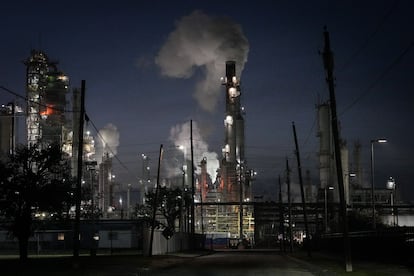
The double blockade of the Strait of Hormuz is a landmark event with countless repercussions. For oil and gas importing countries, especially the poorest ones, it means suffering. It also means hardship for Persian Gulf exporters, accustomed to abundance, who are now seeing their sales channels cut off. And it means a windfall for fossil fuel powers outside the region, who are able to sell—and at much higher prices—everything they extract from the ground. One name stands out: the United States, which in little more than a decade has gone from significant energy dependence to a hegemony now reinforced by the war—its own war—against Iran.
Spurred on by the closure of the Strait of Gibraltar, the U.S. is now the world’s largest supplier of fossil fuels and, for the first time since World War II, a net exporter of crude oil. With Saudi Arabia, the United Arab Emirates and Iraq severely hampered—only able to transport a portion of their production via pipeline—and Kuwait and Bahrain unable to sell a single barrel on the global oil market, U.S. crude is finding buyers much more easily.
By destination, U.S. crude oil exports to Asia and Europe have skyrocketed, given the urgent need of both continents to replace all the oil they previously received from the Persian Gulf. Crude oil, yes, but also diesel and kerosene, both so scarce these days. And at soaring prices. It’s a lucrative business for their energy companies, but one that American consumers are bearing the brunt of: like the rest of the world, they are having to pay significantly more every time they fill up at the gas station—where prices are now averaging $4.50 per gallon, just over one euro per liter—or buy a plane ticket.
The latest figures from the U.S. Energy Information Administration (EIA) reveal that the country’s oil exports reached a new record last week: six million barrels per day, practically double the amount before the first U.S.—and Israeli—bombs began falling on Tehran. This was followed by the closure of the Strait of Hormuz, through which a fifth of the world’s crude oil and liquefied natural gas (LNG, the kind transported by ship) typically passes, and which today is little more than a wasteland.
If crude oil sales are combined with those of refined fuels, U.S. exports soar to 14 million barrels per day, also a new record. This is primarily due to the surge in diesel shipments to Europe. To put these figures into context, the U.S. exported virtually nothing until 2014. It was from then on that fracking, a new technique that at the time was barely known—and only vaguely so—in specialized circles, began to bear fruit.
“The short-term benefits for the United States are clear: its main competitors are being severely restricted, which in turn is driving up prices. It’s a huge windfall for U.S. oil and gas producers,” notes Ira Joseph, a researcher at Columbia University’s Center for Global Energy Policy, in an interview with EL PAÍS. “In the long term, however, oil consumption for transportation will fall [due to the electrification of the vehicle fleet]. And renewables and battery demand will undermine LNG demand.”
Qatar, offside
In April, U.S. natural gas exports, a key fuel for industry and heating, soared to a new record. This was largely due to the forced retreat of its main competitor, Qatar: with the Strait of Hormuz blocked, the emirate went from supplying more LNG than anyone else to being able to sell virtually none. U.S. energy companies are taking full advantage of this situation.
Doha, a major gas exporter, has not only seen its export channels severed: in retaliation for US and Israeli attacks, Iran has targeted some of its key energy facilities, casting doubt on its future capacity. Iranian military bombings and drone strikes have damaged the Ras Laffan complex, the world’s largest gas field. This offensive, according to calculations by the powerful state-owned Qatar Energy, threatens almost a fifth of its export capacity over the next five years.
“The United States not only sells more LNG today than any other country; its export capacity will roughly double by 2030,” emphasize analysts at the Institute for Energy Economics and Financial Analysis (IEEFA, an environmental think tank). This is a true revolution, with enormous repercussions on two levels: the economic—its industry has access to natural gas that is much cheaper than in other parts of the world—and the geostrategic—it has given it more strategic autonomy than it ever imagined.
This total change in the U.S. energy landscape has only been possible thanks to fracking, a technique that involves injecting a mixture of water, sand, and chemicals into rock formations to obtain shale, rich in oil and natural gas.
American LNG sales will continue to grow in the coming years as the five major extraction projects come online and increase production. This growth will extend beyond shipments by sea, with pipelines being a key component, particularly to Mexico, which now also seeks to capitalize on this trend. This growth is driven by a desire to reduce its reliance on its northern neighbor.
The U.S. administration projects an 18% increase in its net natural gas exports this year. This figure could fall short if the Strait of Hormuz remains closed and Qatar is sidelined longer than anticipated. Net exports are expected to increase by an additional 10% in 2027.
For months, Trump has been boasting about how the United States has become a fossil fuel superpower. His fanatical animosity toward renewables was popularized by his “drill, baby, drill” slogan during his election campaign.
Although this strong surge in U.S. exports is crucial in filling the void left by the Gulf states, it’s also a double-edged sword for countries desperately relying on it. In the Trump era, the United States is anything but a reliable partner. Not for Europe, not for Asia, not for anyone.
Sign up for our weekly newsletter to get more English-language news coverage from EL PAÍS USA Edition









































