
Mexico’s slow and steady return to fracking
Over the course of a few months, President Sheinbaum has distanced herself from her opposition to this gas extraction technique
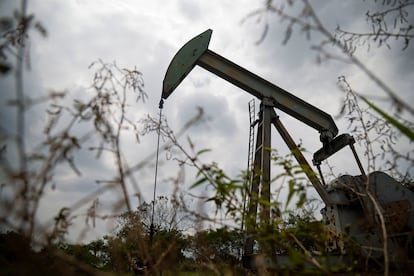
Mexican President Claudia Sheinbaum has unequivocally announced her government’s openness to “fracking” — or hydraulic fracturing — to extract natural gas from the subsoil, with the aim of reducing imports of this resource from the United States. The announcement comes after months of subtle moves and carefully worded statements meant to prepare the ground without sparking major controversy.
Around the world, environmental organizations and progressive movements have been at the forefront of the battle against fracking. They consider it highly damaging due to the amount of water it requires and its health impacts on communities. Within the government coaltion, there are also dissenting voices, in line with Andrés Manuel López Obrador, the country’s former president and the leader of Morena, the ruling party. He imposed a ban on fracking during his administration (2018-2024). Sheinbaum now faces the challenge of convincing both her supporters and detractors that there is such a thing as environmentally-friendly hydraulic fracturing, as she hinted during the press conference where she made the announcement.
The president’s stance is paradoxical. Sheinbaum studied physics and energy engineering. Before entering politics, in the 1990s, she published several articles in specialized journals that established her as a pioneer in climate change studies in Mexico. Years later, she served on the Intergovernmental Panel on Climate Change (IPCC), where she co-authored a study on greenhouse gas emissions from the industrial sector. In 2007, the IPCC was awarded the Nobel Peace Prize for its contributions to understanding climate change, which was already considered to be one of humanity’s greatest challenges.
Even during her 2024 presidential campaign, Sheinbaum pledged to maintain the fracking ban implemented by her predecessor. In December 2023, she stated that the activity “requires large quantities of water.” She added that “the water used [for fracking] is difficult to reuse.”
As president, however, Sheinbaum has had to put those environmental concerns on the back burner and give way to pragmatism, prioritizing Mexico’s energy sovereignty vis-à-vis the United States. This transition has been quiet. One of the first signs of change — though it was difficult to understand at the time — was when, in Congress, Morena rejected a constitutional amendment through which López Obrador wanted to prohibit hydraulic fracturing. A legislator from Morena — with access to the National Palace — confirmed to EL PAÍS that this refusal was intentional, meant to keep open the window that now allows the government to fully embrace fracking.
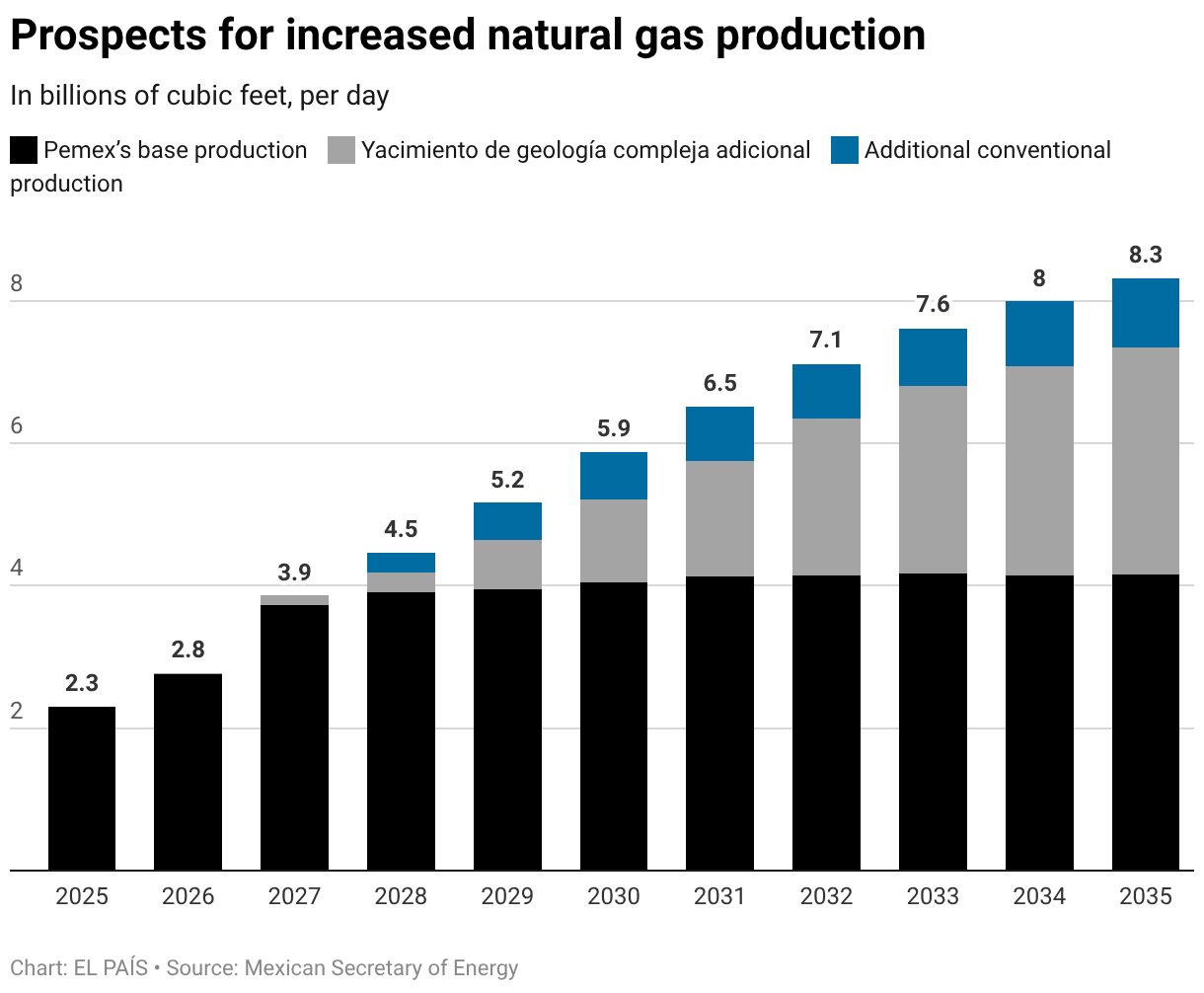
Another sign came with Pemex’s 2025-2035 Strategic Plan, designed to revive the state-owned oil and gas giant’s severely compromised finances. This plan stipulated the reactivation of “the evaluation of complex geological deposits” — one of the most common euphemisms used to avoid the thorny term “fracking” — through “contractual schemes that allow for private investment.” Simultaneously, a multi-million dollar budget was allocated to Pemex for areas related to this type of resource extraction. The machinery had been set in motion.
In recent months, working meetings have been held between specialists and government representatives to design the technical, economic and political strategy for making the leap to fracking, as EL PAÍS exclusively reported back in February.
Sheinbaum has sought advice from a group of experts, who have convinced her that hydraulic fracturing has become so sophisticated that its environmental impacts are less harmful than before. For example, as Sheinbaum listed during her press conference on Wednesday, April 8, saltwater (which isn’t potable) can be used to stimulate gas deposits. And the chemicals that are added to the water — which is injected into the subsoil — are no longer “so potent” and can even be “organic substances,” meaning that this modified water can be reused. “If we’re going to exploit unconventional gas, it has to be done in a sustainable way, minimizing environmental impacts as much as possible,” the president said.
Environmental organizations refute the term “sustainable fracking” that’s used by the technique’s proponents. “That technology still doesn’t exist,” the Mexican Alliance Against Fracking — a collective of more than 40 organizations from various states across the country — has previously stated. “To date, science has demonstrated, in numerous ways, that this technology always carries serious risks. The exploration of deposits alone […] requires the use of water that, when heavily contaminated, becomes impossible to recycle and return to its natural cycle,” the Alliance stated, adding: “Treating this water is technologically possible, but economically unfeasible; the industry uses fresh water simply because it’s cheaper.”
Another point of contention is the belief in natural gas as a “transition” resource toward clean energy, because it supposedly “generates energy with fewer polluting emissions.” This was a statement made by Energy Secretary Luz Elena González at the same press conference. However, various NGOs maintain that there’s evidence that the long-term use of gas can be highly polluting, due to methane emissions during its extraction and transportation. For fracking critics, Mexico’s decision to embrace natural gas only confirms the country’s dependence on fossil fuels, while renewable sources of energy remain a low priority.
The largest deposits of “unconventional” or “geologically complex” gas (the industry’s other favorite euphemisms) are located in northern Mexico and around the Gulf of Mexico, in the states of Coahuila, Tamaulipas, Puebla and Veracruz, which are states characterized by water scarcity. These fields hold approximately 141 trillion cubic feet of gas, according to estimates by Pemex, which expects to begin exploiting these resources in 2027.
According to the state-owned firm’s projections, by 2035, production could reach an additional 3.196 billion cubic feet per day (Bcf/d) of unconventional gas and 960 million cubic feet per day of conventional gas, complementing Pemex’s base production of 4.154 Bcf/d. Currently, Mexico consumes nine billion cubic feet of natural gas per day, 75% of which is purchased from the United States. The remainder is produced by Pemex.
Extracting natural gas through fracking is a slow and very expensive process. Hence, the Mexican government is also working on developing public-private investment schemes, in order to ease the burden on public finances. Business leaders are hoping for reforms that will grant them tax breaks to make their investments profitable, according to sources familiar with the matter. The political cost — the other side of the coin — will fall on Sheinbaum, who has decided to go against the grain of progressive movements worldwide, and even against her own past campaign promises.
Sign up for our weekly newsletter to get more English-language news coverage from EL PAÍS USA Edition









































