
Winette Van der Graaf, oncologist: ‘I never would have imagined seeing patients with colorectal cancer at age 19′
The physician says she is worried about the rise in early-onset tumors and laments inequalities between countries in access to cancer treatments
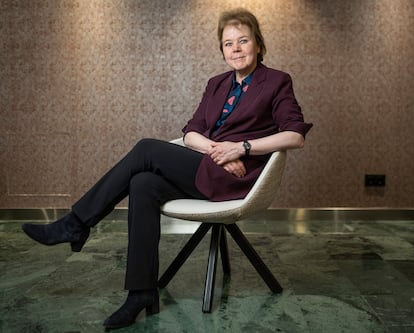

A glance at Winette Van der Graaf’s extensive résumé is enough to certify that this Dutch oncologist has been an exceptional witness, if not a fundamental part, of the great scientific revolution that cancer research has undergone in recent decades. An expert in sarcomas and cancers in teens and young adults, Van der Graaf was one of the pioneers in providing care — and personalized assistance — to people between the ages of 15 and 39 who develop cancer. Sometimes in no man’s land, halfway between pediatric and adult oncology, cancer at this age puts life “on hold,” says Van der Graaf.
The doctor, who is currently professor of medical oncology at the Netherlands Cancer Institute in Amsterdam and the Erasmus Medical Center in Rotterdam, has been dealing with cancer for more than three decades. From all perspectives. As an oncologist, she created specific structures to address the disease in adolescents and young adults, experienced firsthand the arrival of the promising drug imatinib for gastrointestinal stromal tumors (GIST) and led other key clinical trials, such as the one that endorsed pazopanib for a subgroup of sarcomas. But in these years, Van der Graaf has also experienced cancer from the other side: in the early 2000s, she had to deal with the medulloblastoma that her six-year-old daughter was diagnosed with.
The child’s brain tumor had “a huge impact”, she says. “It was a pretty difficult time. My daughter survived, but I’ve seen the short-term, and also the long-term effects of treatment [she received chemotherapy, radiation therapy, and surgery] and the impact on families. I was always very interested in the patient behind the disease, but since this experience, even more,” admits the oncologist, who is also president of the European Organisation for Research and Treatment of Cancer.
You learn from everything. And these experiences helped her to analyse in detail how paediatric cancer care was organized, and to realize that there was no specific care for young people with cancer: “As soon as you turned 18, you became part of the great world of adult oncology and there was nothing organized there.” Her experiences on both sides of the divide were the seed for devising and deploying a network of research and approach to cancer in adolescents and young adults in the Netherlands that has already involved hospitals in several European countries.
“There is a long way to go,” warns Van der Graaf, who was passing through Barcelona to give a lecture at the 30th anniversary event of the Catalan Institute of Oncology, and spoke with EL PAÍS in a hotel in the city center a few hours before the scientific conference.
Question. What does a cancer diagnosis at such a young age mean?
Answer. One of the most important things patients often say is that their life is on hold. While their peers are living their lives, having fun, getting a job or studying, they are only busy with their illness, with the side effects of treatment, and with a potentially life-threatening diagnosis. That makes their life totally different: you’ve never been to a hospital and you don’t know what to expect; in the day hospital you will see many things, also other sick people, and that affects your mind; There can also be a difficult relationship with parents because you are at an age where you want to be independent, maybe you were studying somewhere or living by yourself, and now you have to move back in with them; you want to stay young, but sometimes you’re very tired from the treatment... Treatment and diagnosis go far beyond the disease, social life is also affected.
Q. Where is the knowledge gap in adolescent and young adult cancer?
A. I think the important question is: why do I have cancer at this age? There are hereditary factors, such as the BRCA1 and BRCA2 genes, those of breast cancer, and other very rare syndromes, that could be an explanation. But there is a growing perception that it could be due to external factors: we know how to prevent melanoma or that vaccination against the human papillomavirus, which causes cervical cancer, is very important; but it is also striking that there is an increase in early-onset gastrointestinal cancers, such as colorectal and esophagogastric cancer, and this remains unexplained. There could be lifestyle factors, such as a sedentary lifestyle or obesity, but we also wonder if environmental factors such as pesticides or pollution play a role. It is necessary to have a great knowledge of epidemiology, at the country or regional level, to understand what is happening.
Q. Early-onset cancer is growing in the world. Are you concerned about this trend?
A. I’m very concerned about early-onset cancer. I think if you look at the epidemiology, you see a similar incidence of patients with diagnoses that occur in the pediatric age, but the incidence is increasing in the case of cancers that normally occurred at age 60. And that’s worrying if you don’t know exactly why that’s the case, because it’s something you need to prevent. I never would have imagined seeing patients with colorectal cancer at age 19.
This is very worrying, and early-onset tumors often have a poor prognosis because they are detected late, and the biology of the tumor probably doesn’t help either. There are indications that the biology of breast cancer, for example, is different at an early age: in old age they are usually hormonal positive tumors, while at an early age the percentage of triple negative cancer [the subgroup with the worst prognosis] is relatively high.
Q. Will today’s young adults be the generation most at risk for cancer?
A. If it turns out that pollution plays a role and climate change and pesticides influence cancer risk, it might. But I think we first need to understand why this happens.
Q. It seems that science plays cat and mouse with cancer. And the tumor always finds a way to resist the therapies that come out.
A. Yes, unfortunately, cancer is always smarter than we are. What happens is that cancer is not a homogeneous disease: there are many cells and mutations and the cells are not only really smart at escaping treatments, but they can also be inherently very resistant.
Q. Are we condemned to coexist with cancer and perhaps aspire to turn it into a chronic disease?
A. With some types of cancer, such as chronic myeloid leukemia, it has been possible to live much longer: the life expectancy of patients, when they take treatment, is as long as that of the normal population and that was unimaginable years ago. With immunotherapy we even cure patients with metastatic disease and I think that we do have something really substantial there. The only problem is that not all tumors are sensitive to immunotherapy.
I’ve always had a bit of a problem with the concept of cancer as a chronic disease. Because a chronic disease is not, in itself, a disease that causes death. And cancer, as a chronic disease, usually ends in death. Now we have the concept of metasurvival, that is, people with metastatic disease who survive, and that is something different from a chronic disease. Diabetes is a chronic disease and you can die from complications, but not necessarily. I mean, you can go blind, but it doesn’t mean you die from it. On the other hand, from chronic cancer, the vast majority ultimately die.
Q. How would you define the current era in the fight against cancer?
A. Maybe I’m being a bit cynical, but I think there’s a lot of hype around new drugs, while there’s a lot less attention being paid to other parts of the world where you can’t even provide basic cancer care. There is a huge disparity in the world. And I’d love to see that more often on billboards: let’s cure the whole world of cancer and not just a lucky few in high-income countries.
That’s my big frustration. There’s a lot of talk about new drugs that only offer a progression-free survival benefit [before the disease progresses again] of three months, or even less, even though statistically they’re a positive outcome. But what does that mean for patients? Are they living longer? Do they live better? Or is it just a small, very costly benefit for health systems? I would like this hype to be transformed into hope for many people who do not even receive the drugs that are put on the WHO essential medicines list for cancer.
Sign up for our weekly newsletter to get more English-language news coverage from EL PAÍS USA Edition









































